Question
Biology
How do allopatric and sympatric speciation follow different isolation paths?
Answer
Biology
Expert Answer
Allopatric speciation starts with separation in space; sympatric speciation develops without that initial geographic separation. In both cases, the groups exchange fewer genes through reproduction, allowing them to evolve as distinct species.
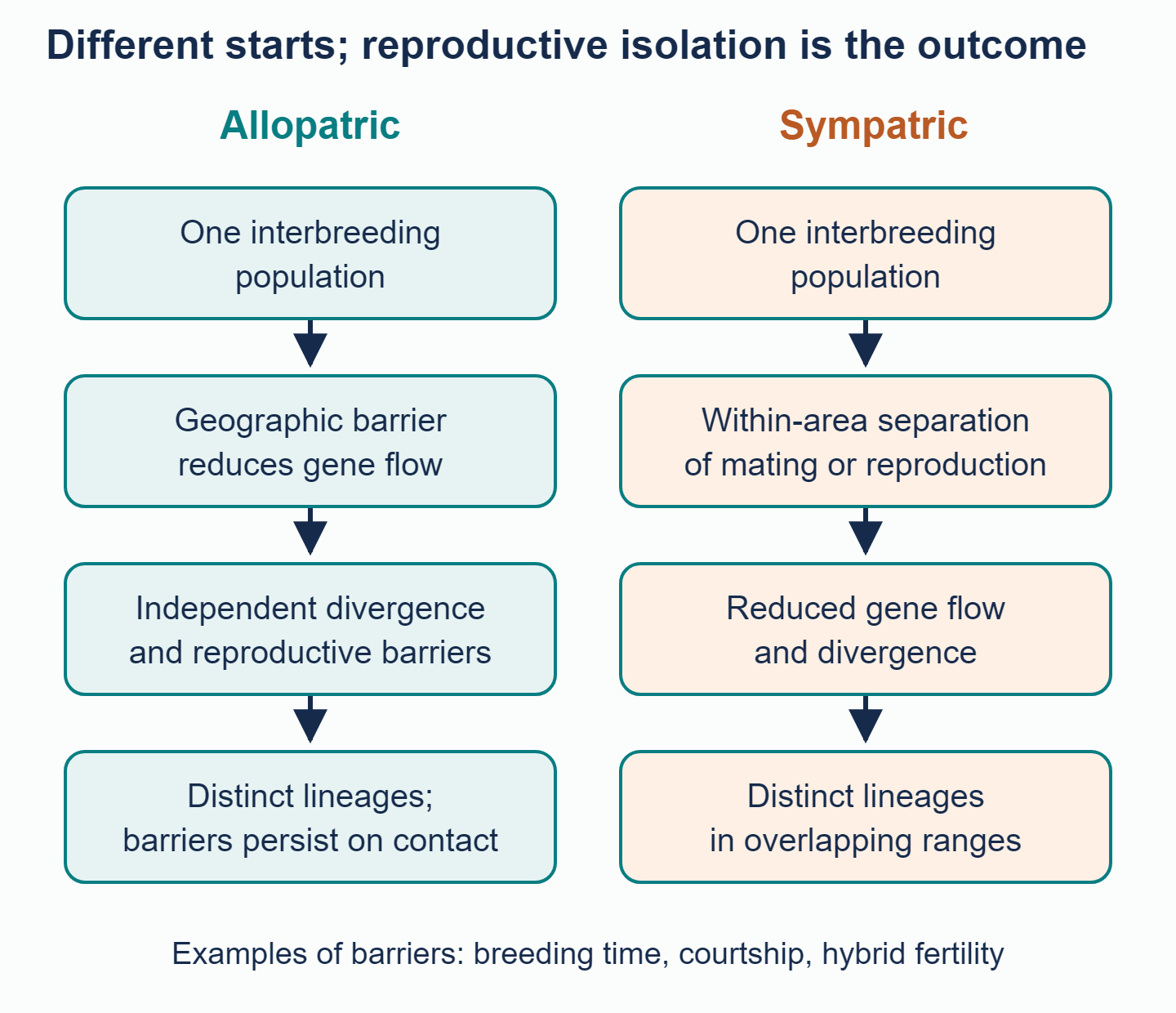
These simplified pathways compare speciation after geographical separation with speciation within the same area.
Imagine a valley population of insects divided by a newly formed lake. Movement between the two shores becomes uncommon, reducing gene flow: the transfer of alleles between populations. Mutations, genetic drift (chance changes in allele frequencies) and different selection pressures can then change each population independently. One population might eventually respond to a different courtship signal or breed in a different season. If these barriers remain when the populations meet again, they are now separated reproductively, not just geographically. This is an allopatric route.
A barrier does not instantly create two species. Recently separated populations may still interbreed successfully if brought together. To judge whether speciation has occurred, ask whether they can still reproduce together and whether they have evolved separately, rather than just measuring the distance between them.
For sympatric speciation, consider insects in the same region that feed and mate on different host plants. Host preference can reduce encounters between subgroups. If host use, mating preference and breeding time become associated, gene flow may decline even though the groups' ranges overlap. Differences must persist despite opportunities for interbreeding; two feeding habits alone do not establish two species.
Polyploidy, having extra complete sets of chromosomes, offers another route, especially in plants. A tetraploid plant has four sets and may form diploid gametes with two sets. Crossing it with a diploid plant producing haploid gametes can yield triploid offspring, with three sets. These chromosome sets often separate unevenly during meiosis. The resulting low hybrid fertility may isolate the tetraploid group if it can reproduce with other tetraploids or by self-fertilisation. An odd number of chromosome sets commonly reduces fertility; it does not mean that meiosis is always impossible.
Named barriers help make either explanation precise:
| Before fertilisation | After fertilisation |
|---|---|
| Different breeding times: temporal isolation | Hybrid embryos develop poorly: reduced viability |
| Different courtship signals: behavioural isolation | Hybrids survive but have low fertility |
| Incompatible gametes: gametic isolation | Later hybrid generations have reduced fitness |
The two columns distinguish prezygotic barriers, acting before fertilisation, from postzygotic barriers, acting afterwards. Allopatric and sympatric instead tell you where the groups are as they evolve apart.
Explore these different routes in the speciation questions in the Biology Unity and Diversity questionbank. Build an explanation for each route that connects the initial separation or chromosome change to reduced gene flow and reproductive isolation.
Answered by Revision Village IB Expert
Explore More IB Biology Resources
Over 80% of IB students globally are experiencing the power of Revision Village