Question
Biology
How do bat and butterfly wings illustrate the difference between analogous and homologous traits?
Answer
Biology
Expert Answer
Bat and butterfly wings are analogous as flight structures: both enable flight, but the wings evolved independently in the mammalian and insect lineages. By contrast, a bat's wing and a human arm are homologous as vertebrate forelimbs, because their underlying skeletal pattern was inherited from a common ancestor.
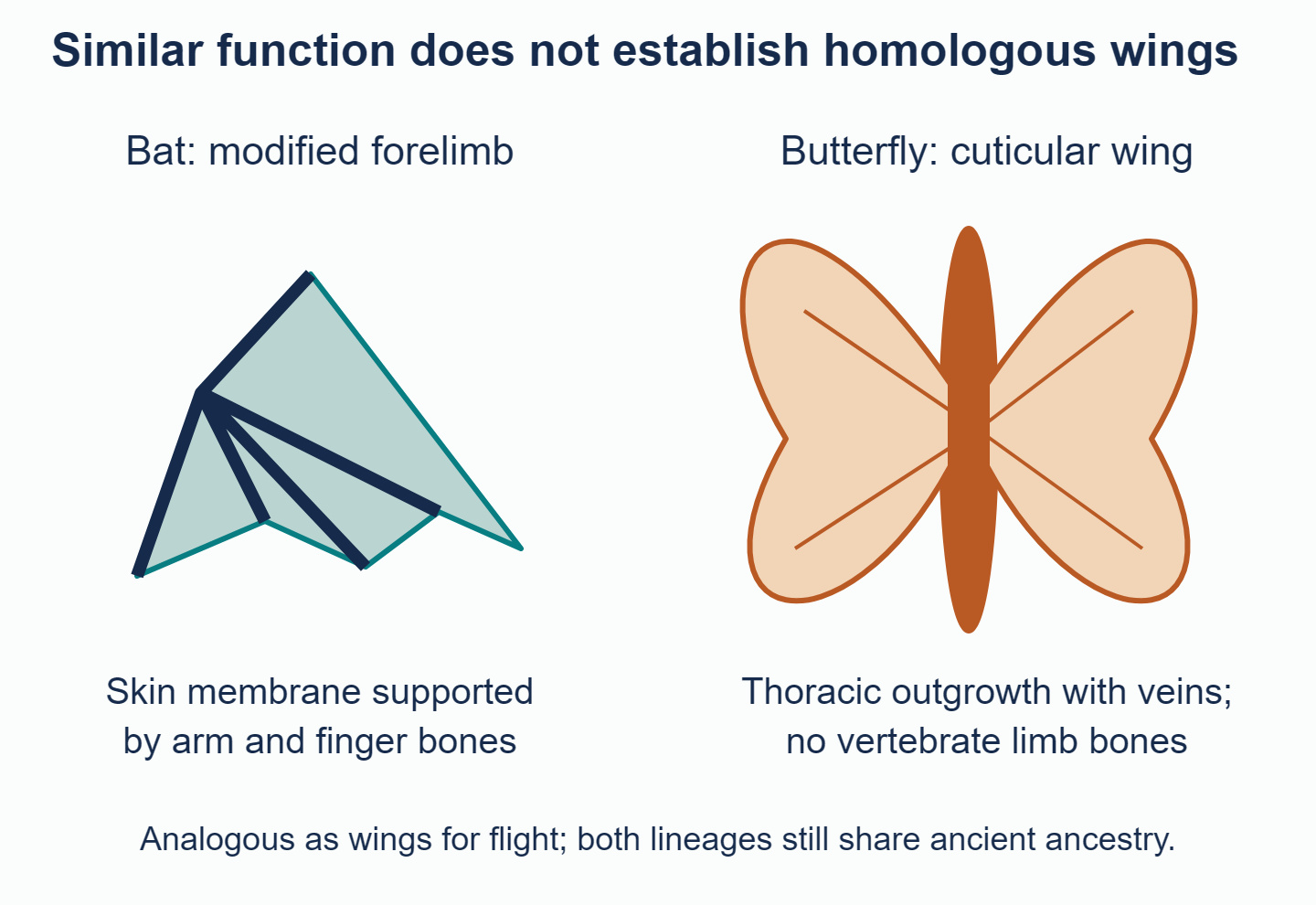
The wings have similar functions but different origins; the bat's forelimb shares its basic structure with other vertebrate forelimbs.
A bat wing is a modified forelimb. Its skin membrane is supported by greatly lengthened fingers as well as the arm bones. A butterfly wing grows out from the thorax and is made of cuticle, the insect's outer covering. Its veins support the wing and contain internal structures. It has no humerus, radius, ulna or finger bones. The wings have a similar use, but their anatomy shows that they developed and evolved in different ways.
This illustrates convergent evolution: similar traits evolve independently in different groups. In each group, inherited differences affecting movement and survival were acted on by natural selection. Over generations, different structures became adapted for flight. An individual animal did not grow wings because it needed them, and the organisms did not consciously solve the same problem.
Use three questions to classify a similarity:
| Question | What it tells you |
|---|---|
| What precisely is being compared? | "Wings for flight" and "forelimb bones" are different traits. |
| Is the internal organisation inherited from the same ancestral structure? | Shared ancestry of the structure supports homology. |
| Does a similar function have separate origins? | That supports analogy for the functionally similar structure. |
Function alone cannot decide the answer. A whale flipper and a human arm perform different tasks but retain homologous bones. Conversely, a butterfly wing and a bat wing perform similar tasks without being homologous wings.
It is also inaccurate to say that bats and butterflies have "no common ancestor". They share ancestry far back in animal evolution. The key point is that they did not both inherit their wings from their last shared ancestor. Homology is about the origin of the particular feature you are comparing.
When writing an explanation, name the feature, compare its construction and connect that comparison to ancestry. "Both can fly" describes a function; the contrast between a bony forelimb and a cuticular wing explains why the similarity is analogous.
Take the comparison further with the bat-and-butterfly question in the Biology Unity and Diversity questionbank. Explain why similar flight functions do not make the wings homologous, using their construction and evolutionary origins to support your answer.
Answered by Revision Village IB Expert
Explore More IB Biology Resources
Over 80% of IB students globally are experiencing the power of Revision Village