Question
Biology
How do you interpret a cladogram when DNA and amino-acid evidence differ?
Answer
Biology
Expert Answer
Read each cladogram by tracing shared branch points, then compare the relationships it proposes. Two organisms are more closely related on a tree if they share a more recent common ancestor. Their left-to-right positions and the spacing between their names are not the test.
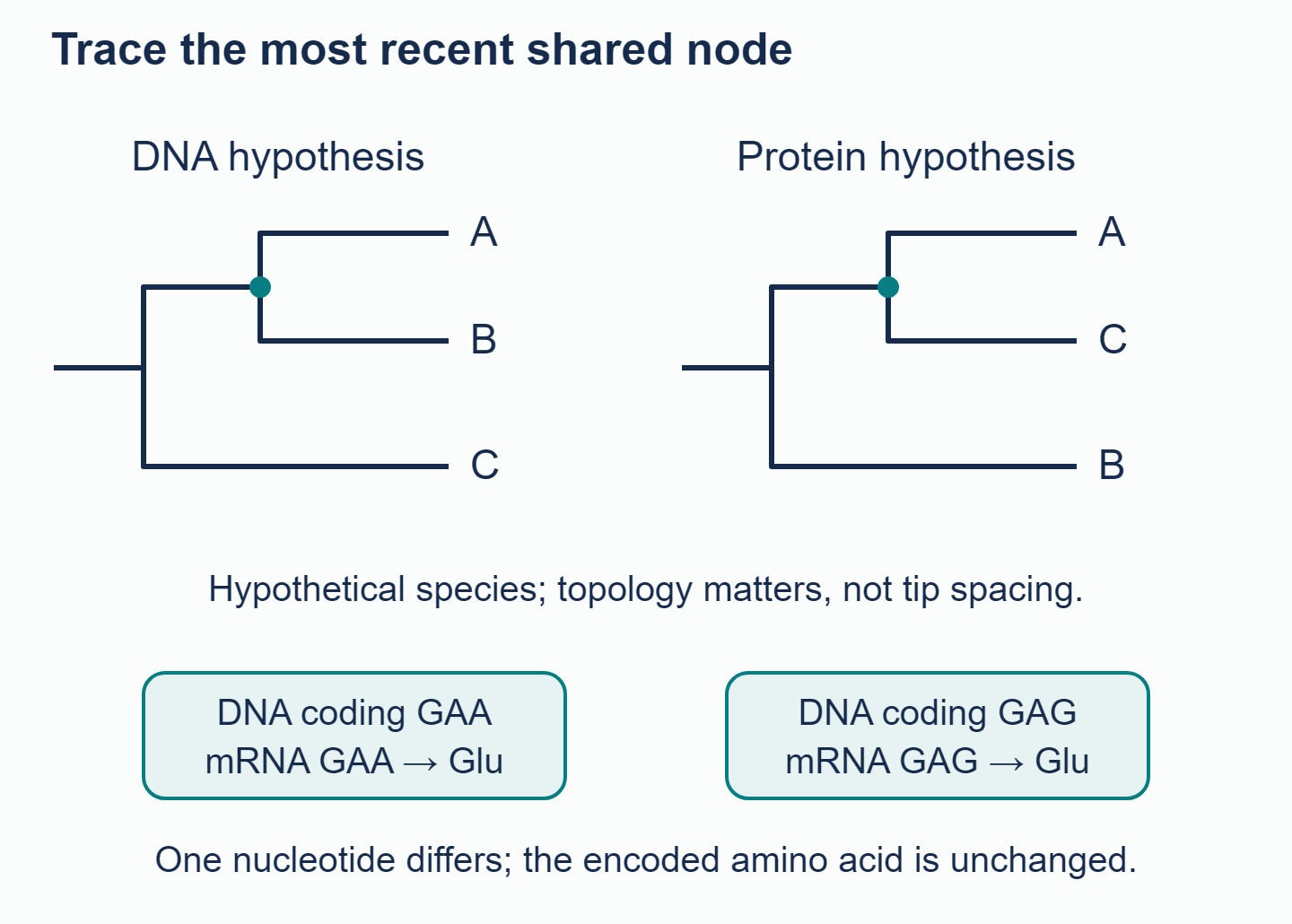
The DNA and protein trees disagree about A's closest relative; some DNA changes leave the protein sequence unchanged.
In the example DNA tree, A and B meet at a node, or branch point, before either joins C. This makes A and B sister groups: each is the other's closest relative on that tree. In the protein tree, A and C join first. The trees therefore propose different relationships; rotating a branch around its node would not remove that disagreement. These are teaching examples, not a claim about any named species' evolutionary history.
Why can the evidence differ? The genetic code is degenerate: several codons can specify the same amino acid. Consider these two DNA coding-strand triplets:
Their corresponding mRNA codons, GAA and GAG, both specify glutamate. The DNA sequences differ at one position, but the protein sequence has no difference there. This is a synonymous substitution: a base change that leaves the amino acid unchanged. You can see the difference when you line up the DNA sequences, but not when you compare their amino-acid sequences.
However, finding extra differences does not automatically give you a better tree. The same position may change more than once, and you must compare corresponding sequences. A short fragment may contain too few useful differences. Different genes can also have different histories. If a DNA tree and a protein tree disagree, examine the evidence and methods rather than concluding that all protein trees are wrong.
Work through a comparison in this order:
- Identify the root or the direction of ancestry and list the same groups of organisms on both trees.
- Find the node that joins the organism you are studying to each possible relative.
- State exactly which sister-group relationship changes.
- Consider sequence length, alignment, synonymous change and support for the disputed branch.
Branch lengths indicate time or genetic change only if the diagram says they do. If a branch point leaves the order of splitting unclear, do not guess an order that the tree does not show.
Morphology, the study of form and structure, still matters, especially for fossils that lack usable DNA. Similarities may be inherited or may have evolved independently through convergence. A strong explanation of evolutionary relationships considers both the sequence data and the relevant anatomy; molecular evidence is not automatically better in every case.
Compare the two primate cladograms in the Biology Unity and Diversity questionbank. Trace the branch points to find the closest relatives shown on each tree, then use the genetic code to explain why DNA can reveal differences that a protein sequence does not.
Answered by Revision Village IB Expert
Explore More IB Biology Resources
Over 80% of IB students globally are experiencing the power of Revision Village