Question
Biology
How can you identify histone proteins in a chromatin diagram?
Answer
Biology
Expert Answer
In a chromatin diagram, histones are the protein components around which DNA is wrapped. A label pointing to the inner protein core identifies histones; a label pointing to the surrounding strand identifies DNA. The whole DNA-plus-core unit is a nucleosome.
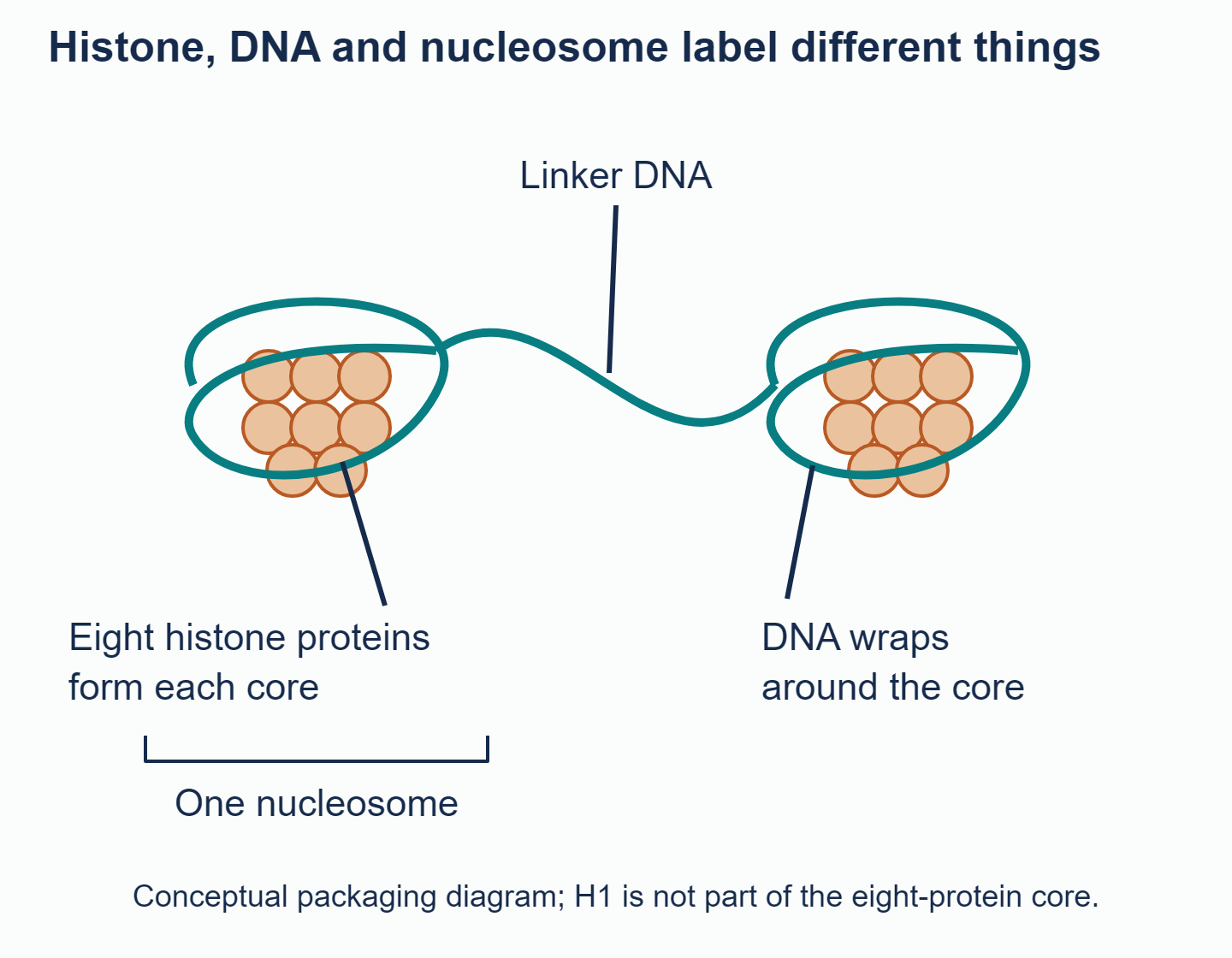
The protein core contains eight histones; the complete wrapped DNA-core unit is a nucleosome, connected by linker DNA.
Start by following the DNA continuously. It winds around one protein core, leaves it as linker DNA, and then wraps around the next. In a "beads-on-a-string" drawing, the beads represent nucleosomes, while the connecting string represents DNA between them. The thread does not change into protein when it passes over a bead.
The nucleosome core contains eight histone molecules: two each of H2A, H2B, H3 and H4. A single histone is therefore only one protein within that core. Approximately 147 base pairs of DNA wrap around the core, although simplified drawings rarely show the actual number of turns or base pairs.
Another histone, H1, often binds where DNA enters and leaves the nucleosome, as well as to linker DNA. It is not one of the eight core histones. If a diagram includes H1, it should show it separately rather than suggesting there is a ninth core protein.
Why does DNA bind to histones? DNA's phosphate backbone is negatively charged, while histones contain many positively charged amino-acid groups. Attraction between them helps package a long DNA molecule into the much smaller space of the nucleus. This packaging also affects how easily proteins can reach particular DNA sequences.
Euchromatin is less tightly packed and easier for proteins to access than heterochromatin. It often contains active or potentially active genes. But a loosely packed region does not prove that every gene in it is being transcribed at that moment: transcription also depends on the signals and proteins that control gene activity.
For a labelled question, follow the endpoint rather than the letter's position. An arrow into the core, one onto the wrapped strand, one between beads and one enclosing the whole bead refer to four different things: histone proteins, wrapped DNA, linker DNA and a nucleosome. That distinction is the main purpose of the diagram.
Try identifying a histone in the chromatin diagram in the Biology Unity and Diversity questionbank.
Answered by Revision Village IB Expert
Explore More IB Biology Resources
Over 80% of IB students globally are experiencing the power of Revision Village