Question
Biology
Why do human, bird and whale forelimbs support common ancestry?
Answer
Biology
Expert Answer
Human arms, bird wings and whale flippers support common ancestry because they contain corresponding bones arranged in the same underlying forelimb pattern. These bones are homologous: they share an evolutionary origin even though they now do different jobs.
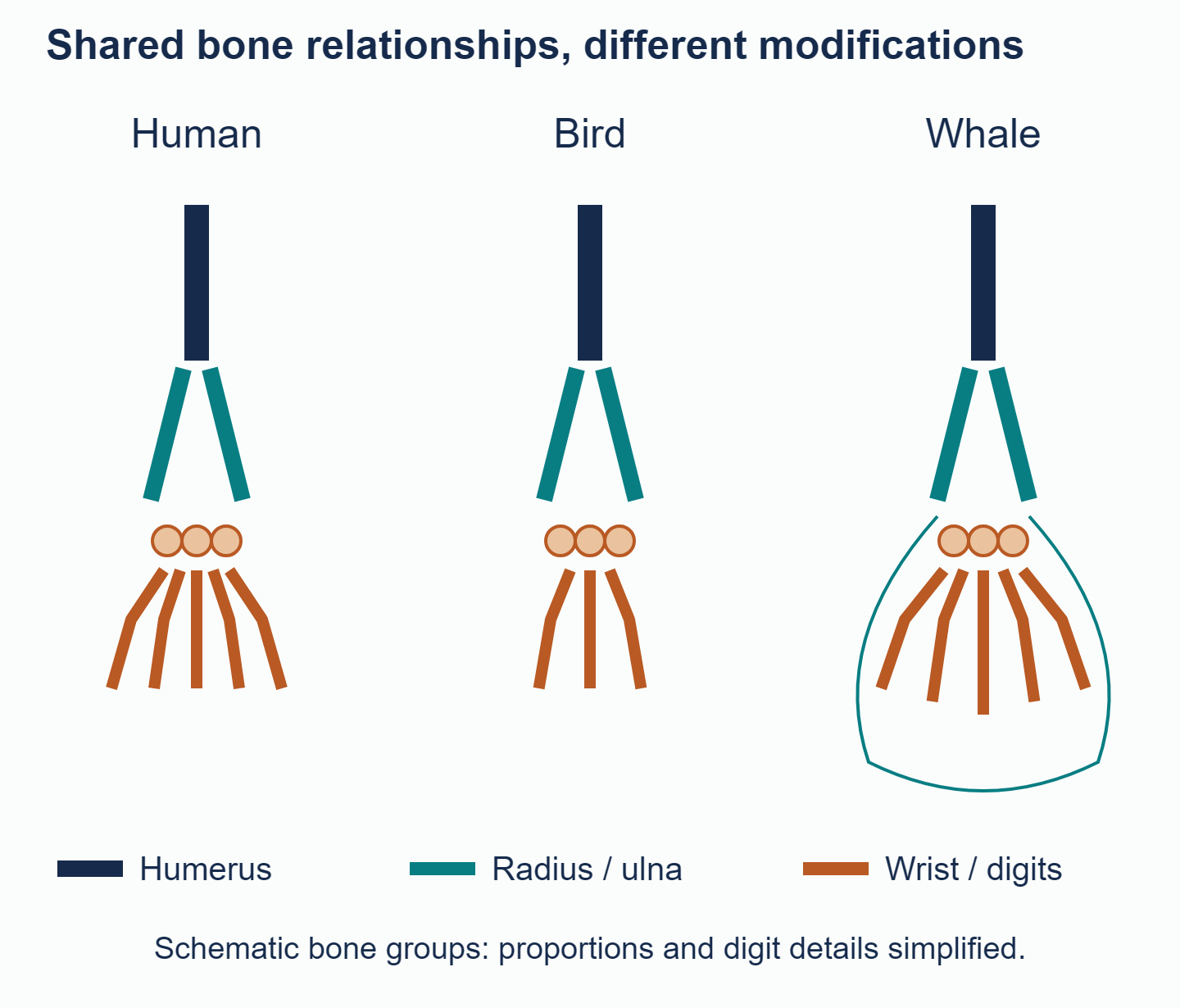
The same basic arrangement of forelimb bones is adapted for grasping, flying and swimming.
Follow the sequence away from the body. There is one upper-limb bone, the humerus; two main forearm bones, the radius and ulna; then wrist elements and the bones of the hand and digits. The relative lengths, shapes and degree of fusion vary, but corresponding elements occupy comparable positions.
In humans, this arrangement supports a mobile arm and grasping hand. In birds, the forelimb forms a wing: some hand bones are reduced or joined together, and feathers help with flight. In whales, the shortened forelimb is enclosed within a flipper used to move and steer in water. Some digits have extra phalanges, the bones within each digit. The diagram simplifies these changes and is not a scale reconstruction of any particular species.
The evolutionary explanation is descent with modification. The descendants inherited the developmental pattern for a forelimb from ancestral vertebrates. Over many generations, inherited changes in growth and proportions produced different forms. Natural selection could favour forms that worked well in each environment, while shared ancestry explains why the same bones remain recognisable.
Consider the alternative explanations. A shared function cannot explain the pattern on its own, because these limbs do different jobs. Human selective breeding cannot explain why the pattern occurs so widely across natural groups of vertebrates and in fossils.
One anatomical comparison is evidence, not the entire argument. Common ancestry is strengthened when the bone pattern agrees with embryological, fossil and molecular evidence. A superficial similarity alone is weaker: the wing of an insect lacks the vertebrate forelimb skeleton despite also enabling flight.
Avoid claiming that a living whale evolved from a modern human or a modern bird. The comparison concerns shared ancestors, followed by branching lineages. Nor does using a limb during an individual's lifetime explain inherited evolutionary modification. The useful answer identifies the shared bone relationships, explains the different modifications and connects both to a branching history of descent.
Test this reasoning with the human, bird and whale forelimb comparison in the Biology Unity and Diversity questionbank. Use the matching bone pattern to choose an evolutionary explanation, then explain why similar function or acquired characteristics would not account for the evidence.
Answered by Revision Village IB Expert
Explore More IB Biology Resources
Over 80% of IB students globally are experiencing the power of Revision Village