Question
Biology
How do you read a karyogram to count chromosomes and determine sex?
Answer
Biology
Expert Answer
To read a karyogram, count chromosomes, group matching autosomes and then examine the sex chromosomes. Autosomes are the chromosomes other than the sex chromosomes. A karyogram shows chromosomes arranged for comparison, not in their original positions in the cell. They are usually photographed during metaphase, when they are condensed and clearly visible.
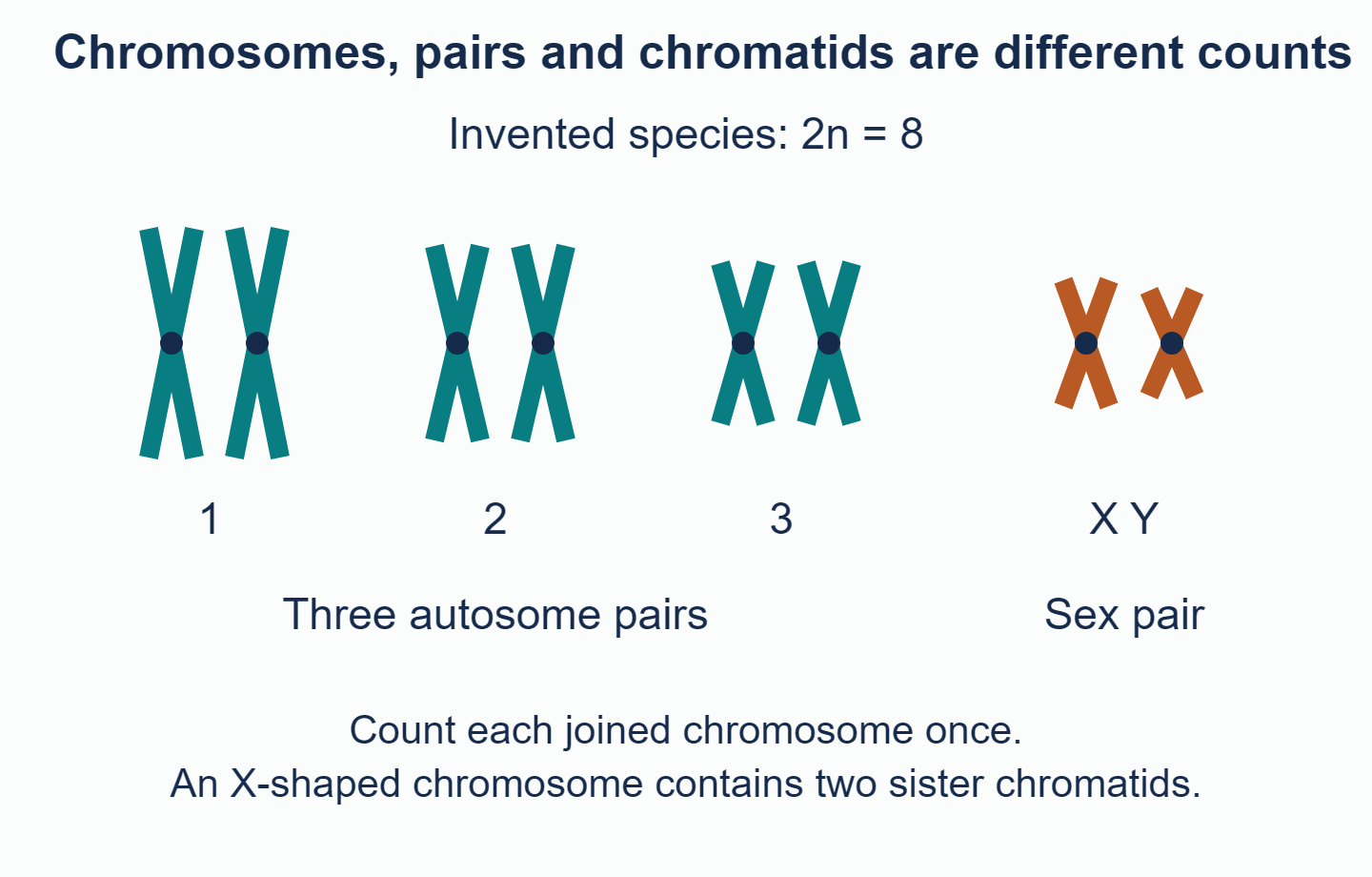
Eight replicated chromosomes are arranged as three autosomal pairs and an X/Y pair in this hypothetical karyogram.
Match chromosomes using length, centromere position and banding pattern. Matching chromosomes, called homologues, carry the same kinds of genes in corresponding positions, although their alleles can differ. They are commonly placed in numbered pairs, broadly from larger to smaller, with the sex chromosomes shown separately.
The invented karyogram contains three autosome pairs and one X/Y pair: eight chromosomes altogether. It illustrates the method and is not a human or rat karyogram. The different sizes of X and Y do not make them an extra autosomal mismatch.
An X-shaped metaphase object is one chromosome consisting of two sister chromatids, joined at its centromere. Do not count its two sister chromatids as separate chromosomes. A typical human somatic (body-cell) metaphase karyogram contains 46 chromosomes in 23 pairs, even though replication has produced 92 chromatids. When sister chromatids separate during anaphase, each is counted as a chromosome in its own right.
In the usual human chromosomal pattern, 22 pairs are autosomes and the remaining pair is XX or XY. An XY result ordinarily indicates the chromosomal pattern associated with male development, while XX ordinarily indicates the pattern associated with female development. State what the image shows: the chromosome complement, meaning the set of chromosomes present. It cannot, by itself, establish every aspect of sexual development or a person's gender.
If an apparent pair has three members, recount carefully and check which chromosome it is before suggesting trisomy, the presence of an extra copy. A missing object could also reflect either a biological difference or an incomplete or poorly prepared image. Diagnosing a person requires proper laboratory assessment; a teaching image is not enough.
Chromosome numbers vary among species, so use the count in the image and verified species information. Do not assume that all mammals have 46 chromosomes or that more chromosomes mean a more complex organism. The most reliable response separates the observations - number, matching patterns and sex-chromosome complement - from the biological interpretation built upon them.
Practise reading the rat karyogram in the Biology Unity and Diversity questionbank. Count and pair the chromosomes from the image itself, then use the sex chromosomes to support your interpretation without counting sister chromatids twice.
Answered by Revision Village IB Expert
Explore More IB Biology Resources
Over 80% of IB students globally are experiencing the power of Revision Village