Question
Biology
How do lytic and lysogenic viral cycles differ in a labelled diagram?
Answer
Biology
Expert Answer
A bacteriophage is a virus that infects bacteria. In a lytic cycle, it produces new particles and eventually breaks open its host cell. In lysogeny, its genome stays inside the bacterium while the cell survives and divides. A phage that can follow either route is called temperate. A change in conditions can trigger it to enter the lytic pathway.
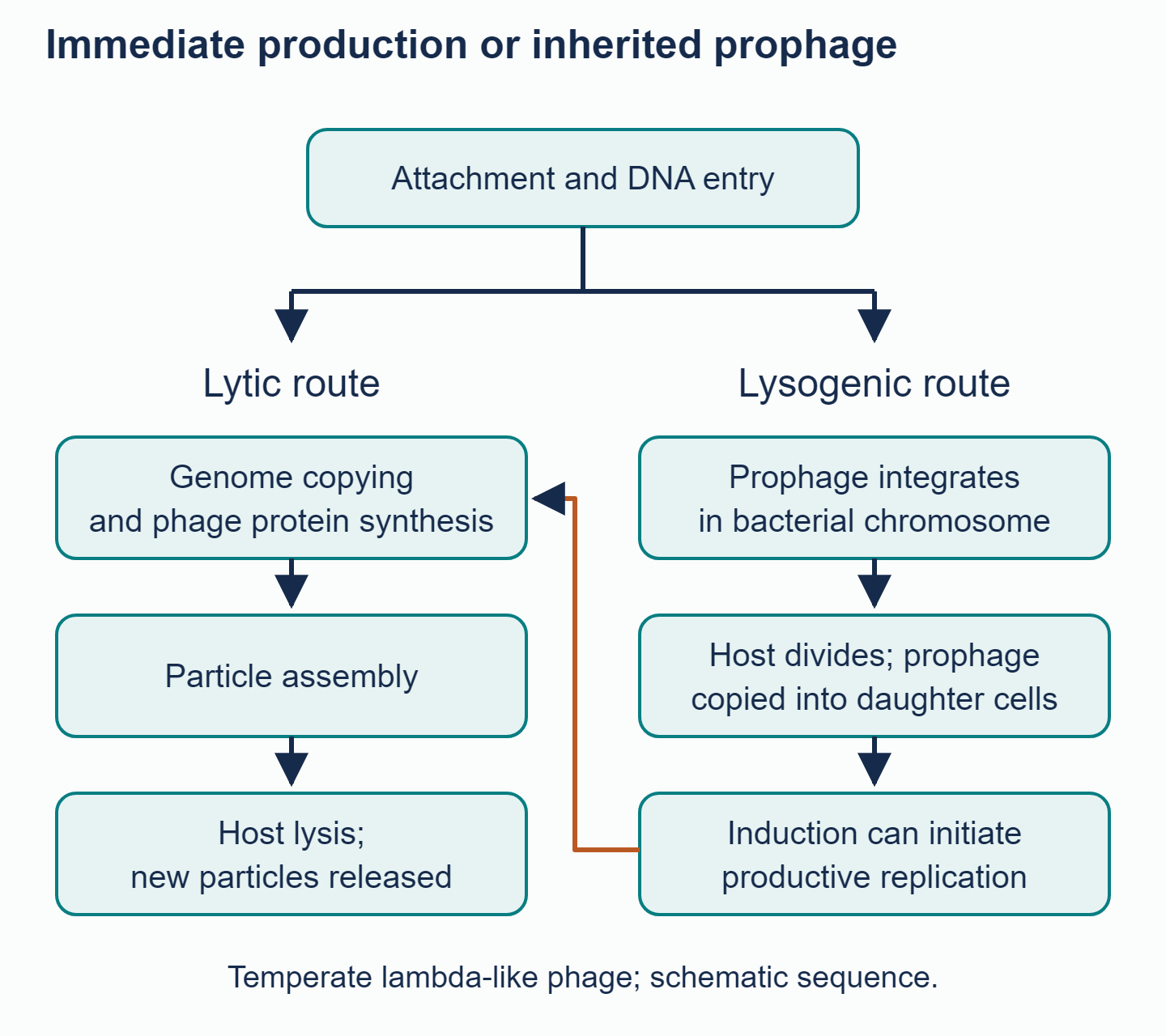
During lysogeny, the phage genome is copied as bacteria divide; induction triggers the switch to the lytic cycle.
For a lambda-like phage, both routes begin when it attaches to a suitable receptor on the bacterial surface and injects its DNA. The protein coat stays outside. Inside the cell, the way the phage's genes are controlled determines which route it follows.
In the lytic route, viral genes are expressed, the genome is copied and phage proteins are made using the host's resources. Genomes are packaged into newly assembled capsids. Proteins that disrupt the bacterial envelope allow the particles to escape through lysis. The cell is destroyed in this release step; it is not simply dividing into viruses.
In the lysogenic route shown, viral DNA integrates into the bacterial chromosome and is called a prophage. Each time the chromosome is copied, the prophage can be copied with it and passed to daughter cells. Immediate production of a large burst of phage particles is suppressed. This is why a bacterium can carry viral genetic information without visibly bursting.
"Dormant" is useful shorthand, but "none of the phage's genes is expressed" is too absolute. Regulatory proteins help maintain lysogeny, and a prophage can affect its host's characteristics. Nor does the bacterium cease reproducing: cell division is how the prophage can spread through a bacterial lineage.
The switch to the lytic route is called induction. It can follow certain forms of DNA damage, for example. The phage genome can cut free from the bacterial chromosome and begin producing new virus particles. This is why the arrow from lysogeny to the lytic route matters.
When comparing the cycles, compare the same features in each: are new particles produced immediately or is the genome retained? Does the host burst or survive during this stage? Is viral material released into the environment or inherited by daughter cells? Both routes depend on a host and pass on viral genetic material.
This diagram describes a temperate bacteriophage. Animal-virus latency and other persistent infections can use different mechanisms, so do not apply every lambda-phage stage to all viruses.
Follow up with the bacteriophage question in the Biology Unity and Diversity questionbank. Build your comparison around what happens to the viral DNA and the host cell, including a similarity as well as differences between the cycles.
Answered by Revision Village IB Expert
Explore More IB Biology Resources
Over 80% of IB students globally are experiencing the power of Revision Village