Question
Biology
How do the labelled structures of a mitochondrion support aerobic respiration?
Answer
Biology
Expert Answer
A mitochondrion supports aerobic respiration by combining compartments containing enzymes with an inner membrane that controls what passes through it. Electron transport builds up a proton gradient across this membrane. ATP synthase uses the gradient to produce ATP.
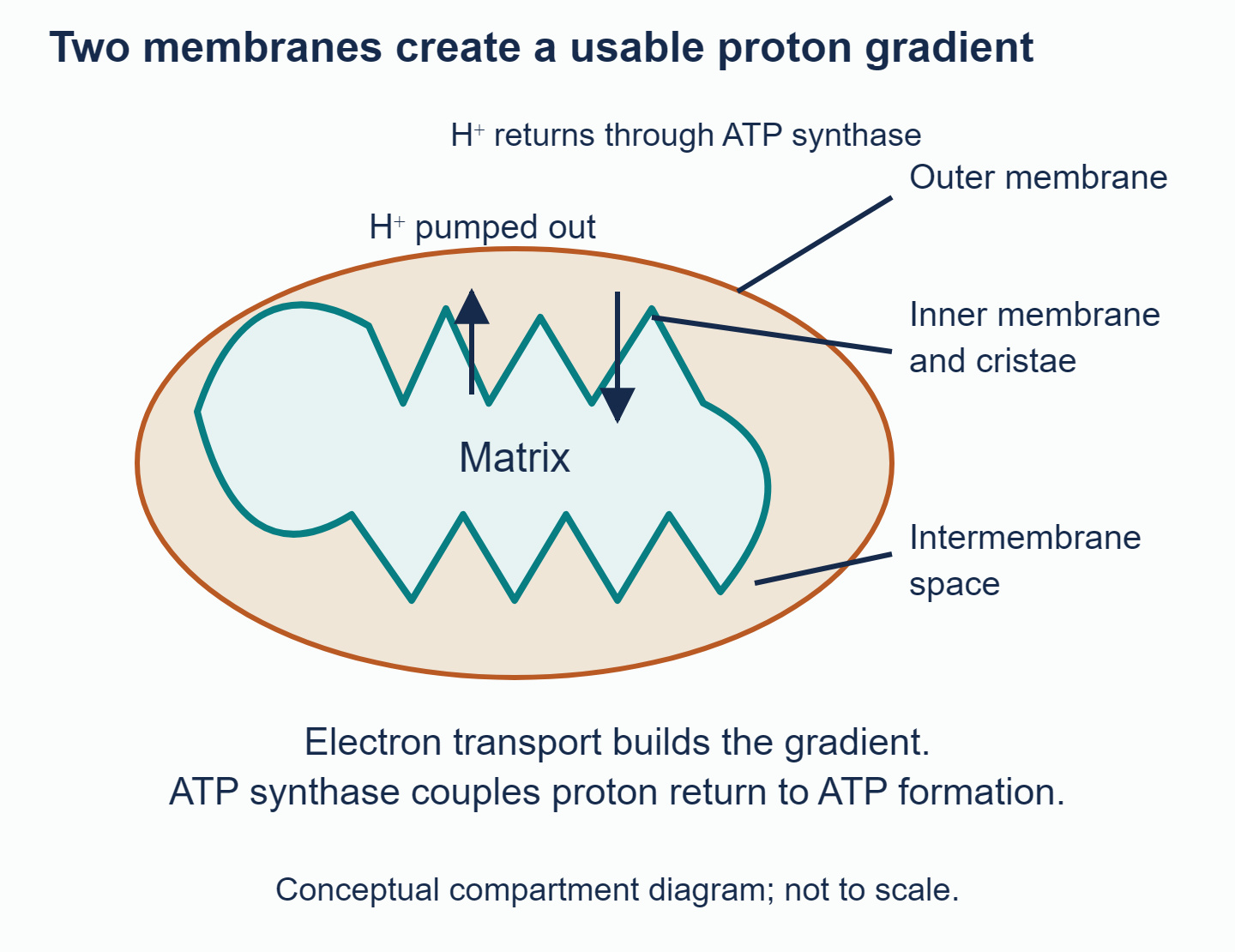
Protons move from matrix to intermembrane space through pumps and return to the matrix through ATP synthase.
The outer membrane separates the organelle from the cytoplasm and contains channels and transport components. The inner membrane lies inside it and folds into cristae. These folds provide more membrane area on which respiratory proteins can operate. The inner membrane is relatively impermeable to protons, an essential condition for maintaining the gradient.
The matrix is the space enclosed by the inner membrane. It contains enzymes for pyruvate oxidation and the citric acid cycle. These reactions produce reduced electron carriers such as NADH, which carry electrons to the electron transport chain. Glycolysis takes place in the cytosol, outside the mitochondrion, so a diagram should not place every stage of respiration in the matrix.
The intermembrane space is between the two membranes, including the space within cristae. Electron transfer along the respiratory chain releases energy that drives proton pumping from the matrix into this space. The electron transport chain ultimately transfers electrons to oxygen, which is reduced to water.
Protons return to the matrix through ATP synthase. They move down an electrochemical gradient, driven by differences in both proton concentration and electrical charge. This movement powers the formation of ATP from ADP and phosphate. Check the two arrow directions: proton pumps move protons out of the matrix; ATP synthase allows them to return. Showing both processes in the same direction would miss how the gradient is built and then used.
Mitochondria also contain DNA and ribosomes, which help produce some of their components. Most mitochondrial proteins, however, are encoded by genes in the nucleus and imported. A mitochondrion therefore depends on the rest of the cell for much of its genetic information and the materials it needs.
To apply the diagram, imagine that protons could suddenly pass freely through the inner membrane. Electron transfer might still occur, but the gradient would break down, so less ATP could be made through ATP synthase. More crista membrane can provide space for more respiratory proteins, although a still image alone cannot tell you how much ATP is being produced.
A useful annotation explains what each structure makes possible: the matrix contains enzymes for reactions, the inner membrane supports electron transport and limits proton leakage, the cristae add membrane area, and the intermembrane space allows protons to build up. Naming a structure is the first step; linking it to its role explains how the mitochondrion works.
Put these connections into practice with the mitochondrion drawing task in the Biology Unity and Diversity questionbank. Try drawing it without looking at the diagram above, then add annotations that explain how each labelled structure supports respiration.
Answered by Revision Village IB Expert
Explore More IB Biology Resources
Over 80% of IB students globally are experiencing the power of Revision Village