Question
Biology
What does the chemical composition of the Murchison meteorite imply about prebiotic chemistry?
Answer
Biology
Expert Answer
Murchison's organic compounds show that chemistry relevant to life can occur outside living organisms and outside Earth. Some prebiotic ingredients, the chemicals involved before life arises, could therefore have come from space. This does not show that the meteorite contained life or that life itself arrived in it.
The linked resource's pie chart labels water, amino acids, alkanes, purines and pyrimidines, iron, and other compounds. "Other compounds" is the largest category; among the named categories, iron occupies the largest sector. Amino acids, alkanes and nucleobases are organic compounds, whereas iron is an element. So the categories describe different kinds of substances, not just different elements or different molecules.
The chart does not label the sectors with numbers or say what the proportions measure. Use it to compare categories, not to report exact amounts. Before calculating from a chart, check whether its proportions refer to mass, numbers of atoms or only a selected part of the sample. If a different chart explicitly gives 12%, that sector's angle is ; this is not a measured Murchison value.
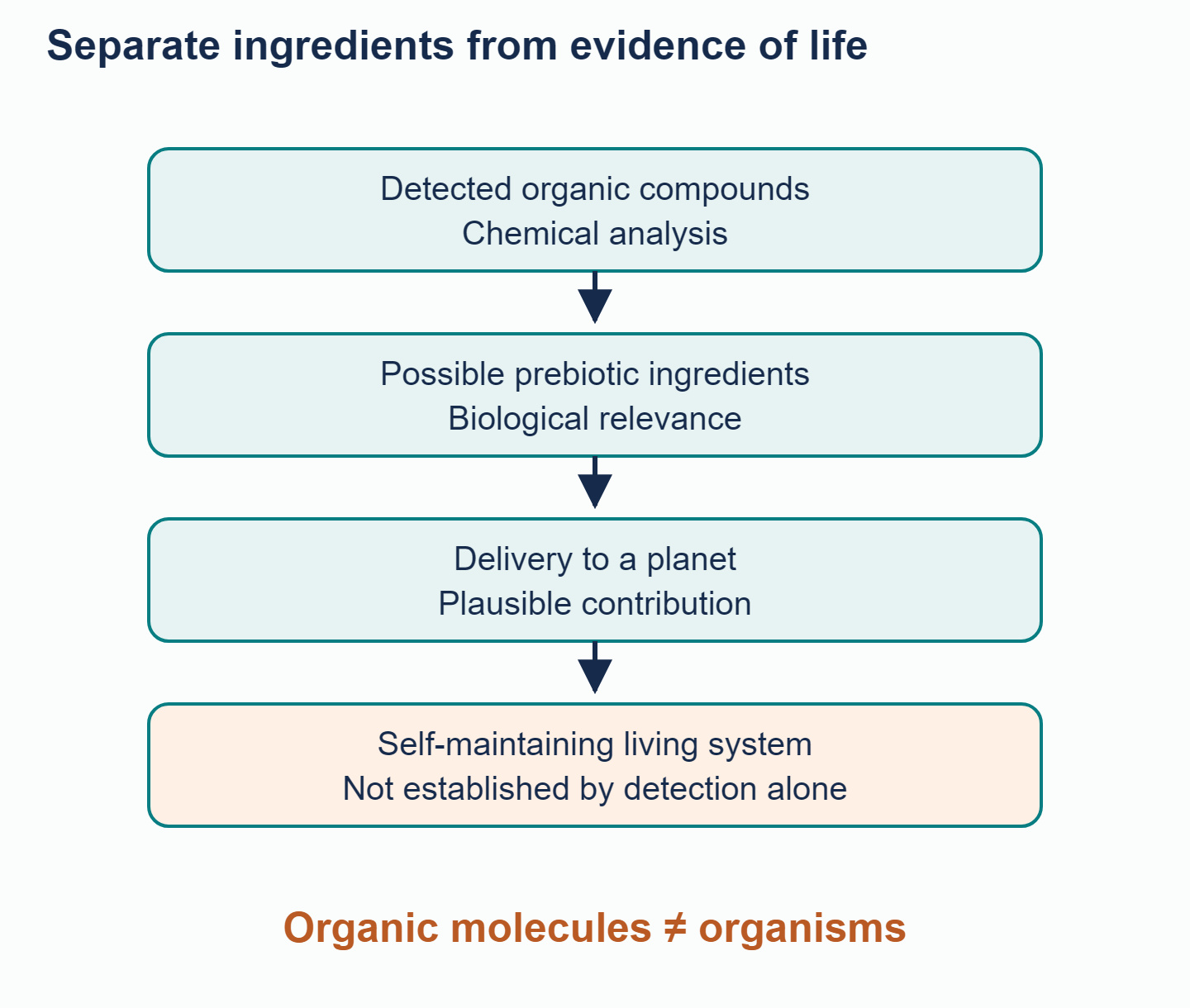
Meteorite chemistry supports the possibility that ingredients formed without life and arrived from space; it does not show an organism.
The crucial evidence for prebiotic chemistry comes from chemical identification, not the pie shape itself. Kvenvolden and colleagues reported evidence for extraterrestrial amino acids and hydrocarbons in Murchison. Amino acids are relevant because some are used to build proteins, but a mixture of amino acids is not a protein, a genome or a cell. Many organic compounds have non-biological origins.
How can researchers tell whether a compound came with the meteorite rather than contaminating it on Earth? They examine the mix of molecules and the proportions of isotopes, forms of an element with different neutron numbers, while also controlling contamination during handling. Martins and colleagues' nucleobase analysis used isotope evidence to investigate whether compounds relevant to DNA and RNA chemistry came from space. Finding a compound and establishing its origin are separate questions.
Carbonaceous meteorites also contain hydrated minerals, formed through interaction with water. These help researchers investigate water in the bodies the meteorites came from and its possible delivery to planets. They do not show that all Earth's water came from one meteorite class, or that every present-day sample contains pools of liquid water.
Keep the steps separate: ingredients can form abiotically, without living organisms; some can survive inside small Solar System bodies; and meteorites may deliver them to planets. Further processes would still be needed to make living systems that maintain themselves and pass on inherited information. The meteorite supports the early steps, not a complete explanation of how life began.
Explore the Murchison composition question in the Biology Unity and Diversity questionbank. Choose a listed substance relevant to life and explain its role, then consider what its presence can and cannot tell you about life's origins.
Answered by Revision Village IB Expert
Explore More IB Biology Resources
Over 80% of IB students globally are experiencing the power of Revision Village