Question
Biology
How do you draw and label a nucleotide and distinguish DNA from RNA?
Answer
Biology
Expert Answer
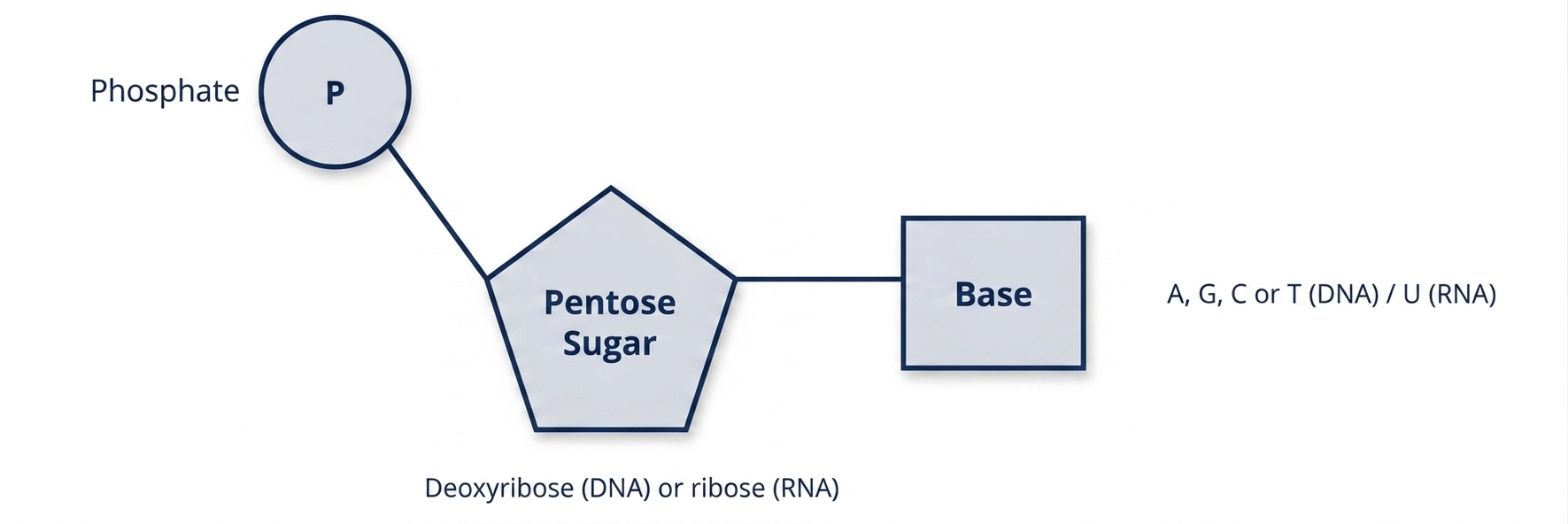
Draw a nucleotide as three connected components: a phosphate group, a five-carbon sugar and a nitrogen-containing base. Put the sugar between the phosphate and base. The base attaches at the sugar's carbon; the phosphate is associated with its carbon.
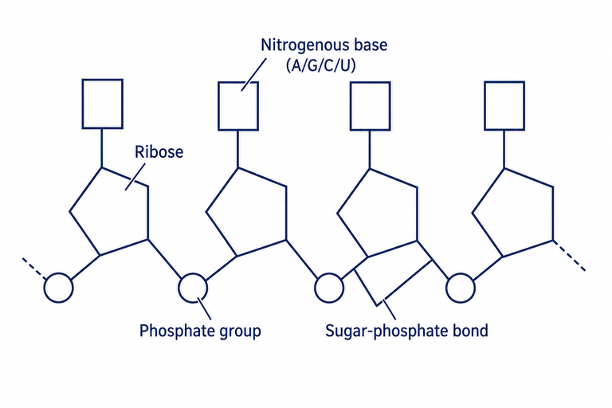
Nucleotide (top), RNA (bottom)
:::center
 :span[[© Revision Village 2026]]{style="font-size:14px; line-height:1"}
:::
The prime mark after a carbon number tells you that it belongs to the sugar, rather than the base. A pentagon is a useful simplified sugar symbol, but it is not a complete chemical structure: the sugar ring contains an oxygen atom, and the carbon lies outside the ring.
DNA and RNA differ at the carbon. Ribose, the sugar in RNA, carries an group there; deoxyribose, in DNA, carries . Both have the hydroxyl, or OH group, needed to extend the chain. So deoxyribose has one fewer oxygen atom per sugar; it does not lack oxygen altogether.
The bases provide a second distinction. Both nucleic acids use adenine, guanine and cytosine. Standard DNA uses thymine, whereas RNA uses uracil. These differences concern the nucleotide's chemistry; the fact that DNA is usually double-stranded and RNA usually single-stranded describes how the polymers are organised.
To turn the nucleotide drawing into an RNA chain, connect the position of one ribose to the phosphate of the next nucleotide. The covalent connection is a - sugar-phosphate bond. Repetition produces the sugar-phosphate backbone, with bases projecting from it. A chain has direction because its two ends are chemically different.
In a school-level monomer diagram this is often described as condensation. Inside a cell, the enzyme RNA polymerase adds each new nucleotide to the existing end, so the strand is synthesised . The diagram shows how the parts end up connected, not every substance involved in the reaction.
Check a drawing with two questions. Does each base attach to a sugar, rather than directly to a phosphate? Does each backbone connection join a sugar to a phosphate? Hydrogen bonds between complementary bases are a separate interaction: they can hold strands or folded regions together, but do not make the covalent backbone.
Try drawing your own nucleotide before opening the DNA-and-RNA question in the Biology Unity and Diversity questionbank. Use the exercise to check your labels, compare the sugars and explain how the nucleotides join into an RNA backbone.
Answered by Revision Village IB Expert
Explore More IB Biology Resources
Over 80% of IB students globally are experiencing the power of Revision Village