Question
Biology
Which structures in a human ovum help prevent polyspermy?
Answer
Biology
Expert Answer
The cortical granules and zona pellucida help prevent polyspermy, in which more than one sperm enters and fuses with a human egg. After sperm-egg fusion activates the egg, cortical granules release substances that change the surrounding zona, reducing further sperm binding and penetration.
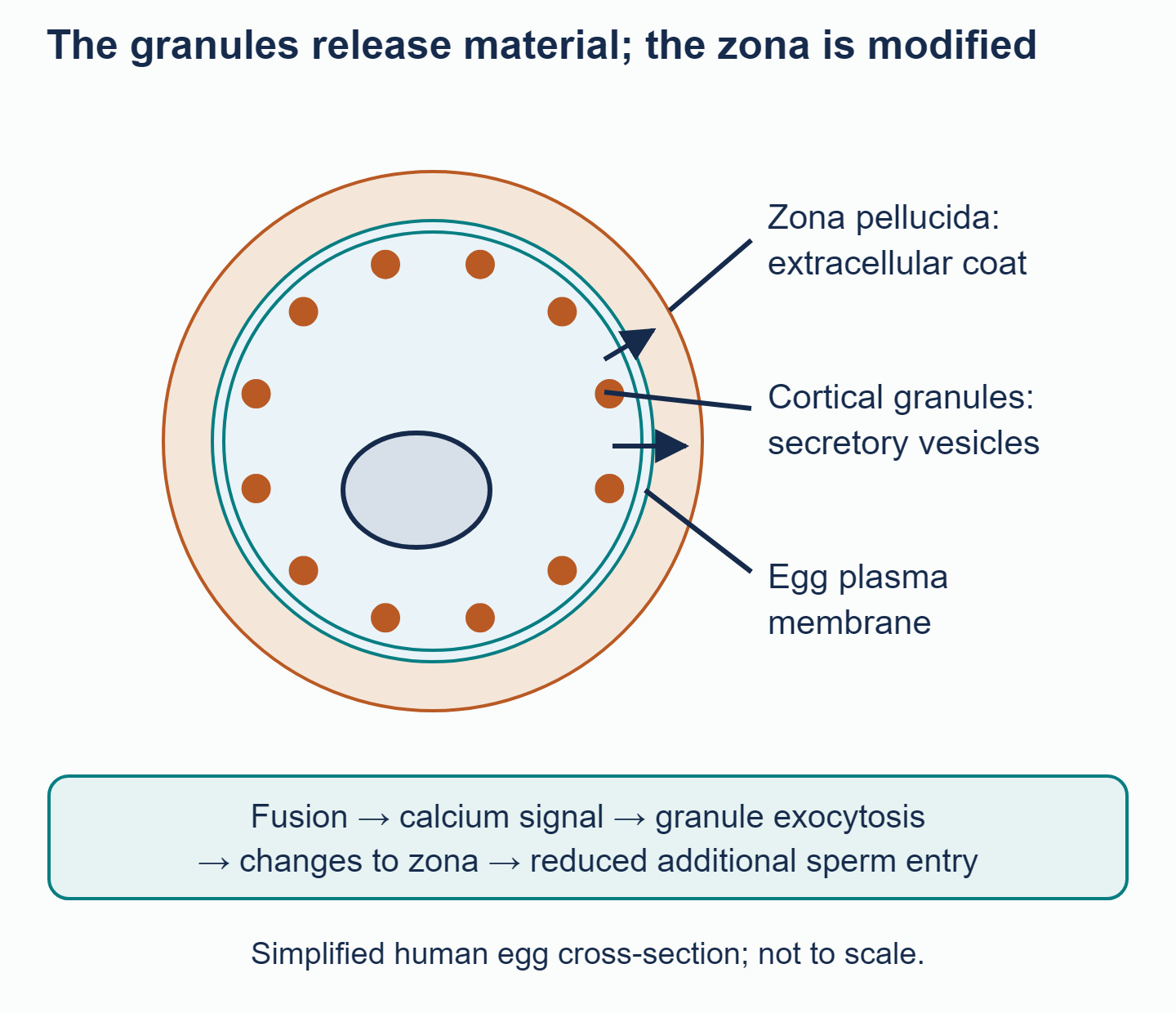
Cortical granules lie inside the egg membrane and release their contents towards the zona pellucida outside it.
The zona pellucida is a coat of glycoproteins, proteins with attached carbohydrate groups, outside the egg's plasma membrane. Before fertilisation it helps sperm interact with the egg. Its position matters: a sperm must pass through the zona before reaching and fusing with the egg membrane. The zona is therefore different from both the plasma membrane and the surrounding follicle cells.
Cortical granules are small membrane-bound sacs, or vesicles, just beneath the egg membrane. When the egg is activated, changes in calcium in the cytoplasm trigger the granules to fuse with the membrane and release their contents outside it. This release is called exocytosis. The released molecules change the zona's properties. These events are the cortical reaction, followed by the zona reaction.
The two structures have different jobs. Granules supply the released material; the zona is the barrier outside the cell that this material changes. A label pointing to the thick outer coat and a label pointing to small vesicles near the cell's edge should therefore receive different names.
Changes in the egg membrane also help limit additional sperm fusion. Scientists are still studying how much each membrane and zona mechanism contributes in mammals. Do not assume that the rapid electrical block described for sea urchin eggs is a standard human mechanism: mammalian fertilisation differs from some other animal examples.
Polyspermy gives the egg an abnormal amount of genetic material from sperm and usually disrupts normal development. It does not mean that fertilisation fails to happen at all. The problem is contributions from multiple sperm rather than the absence of a sperm contribution.
The egg's chromosomes and mitochondria have other essential functions, but they are not the two structures responsible for this granule-to-zona mechanism. Do not confuse a cortical granule with the acrosome: the acrosome belongs to the sperm and helps it interact with the egg's coverings.
The pathway in the diagram is simplified and not to scale. Its useful order is fusion → calcium signalling → granule exocytosis → zona modification, with each step explaining how the first successful sperm changes the conditions faced by subsequent sperm.
Try identifying the structures that help prevent polyspermy in the ovum question in the Biology practice exam. Use each structure's role as well as its position to justify your choice, then trace what changes after the first sperm fuses with the egg.
Answered by Revision Village IB Expert
Explore More IB Biology Resources
Over 80% of IB students globally are experiencing the power of Revision Village