Question
Biology
How do alternative platypus cladograms change the inferred evolutionary history?
Answer
Biology
Expert Answer
Moving the platypus branch on a cladogram changes which groups are shown as its closest relatives. This changes our explanation of where traits arose, were retained or were lost during evolution. It does not mean that the platypus physically moved through the other groups.
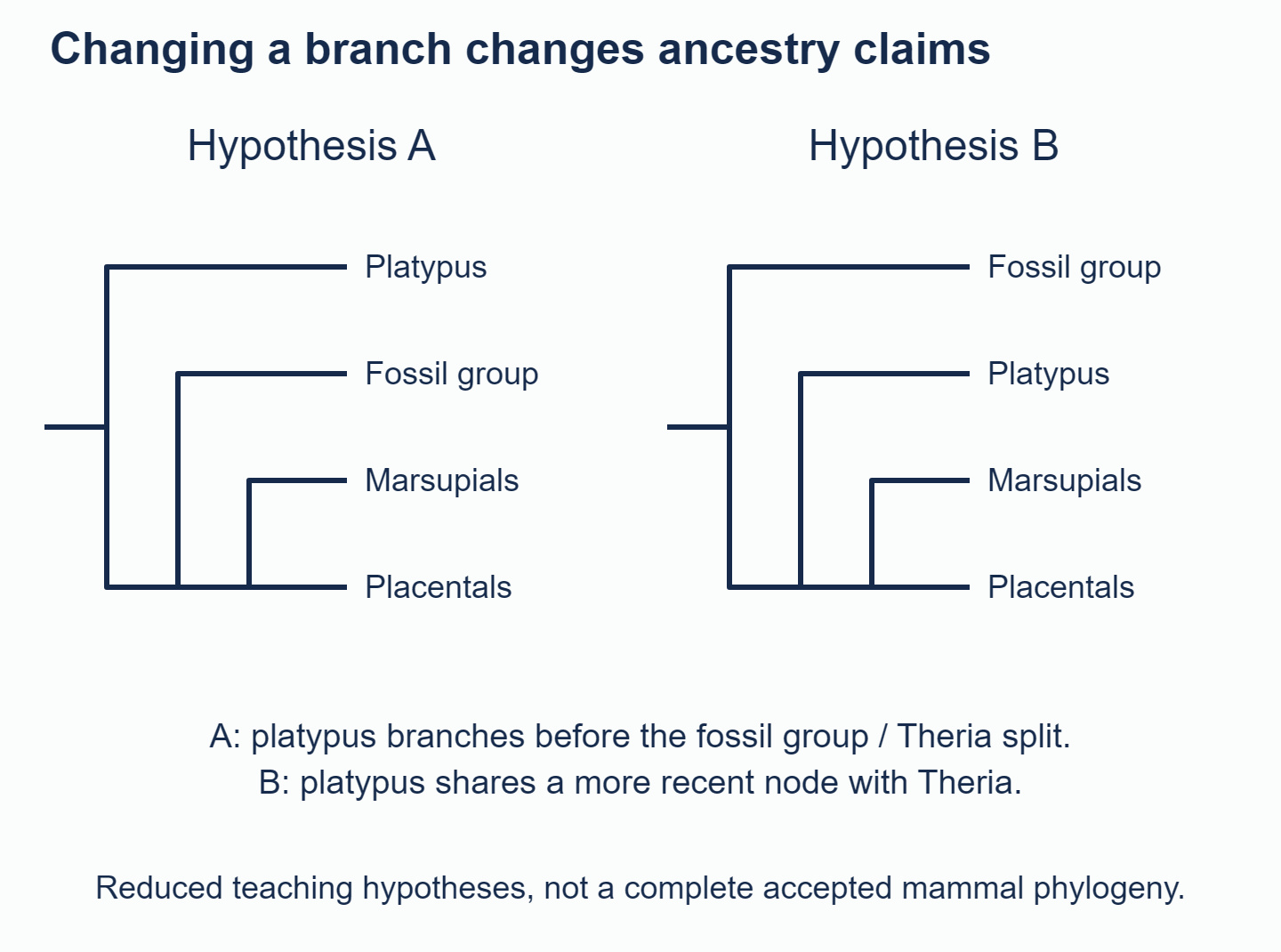
Marsupials and placental mammals remain closest relatives in both trees; the platypus placement changes which other lineage joins them first.
The two diagrams show simplified hypotheses about evolutionary relationships. In A, the platypus branches before the fossil lineage and Theria separate. In B, it shares a more recent common ancestor with Theria than with the fossil lineage. In both, marsupials and placental mammals remain grouped within Theria. Read the branch points, or nodes, rather than the horizontal distance between names.
Next ask what evidence would help choose between the hypotheses. A shared derived character is particularly useful: a feature that arose in a particular ancestor and was inherited by its descendants. If the platypus and therians share such a feature that the fossil lineage lacks, this may favour B. However, the feature must be homologous, meaning inherited from a common ancestor rather than evolved independently. Researchers also compare outgroups, organisms outside the group being studied, to help work out what the ancestral feature was like.
A similar-looking adaptation can be misleading. Webbed feet could evolve independently in separate lineages adapting to life in water. Likewise, several tooth features linked to one feeding adaptation may not count as fully independent pieces of evidence. Celik and Phillips's analysis of Mesozoic mammals examined how evidence from different body regions can suggest conflicting evolutionary relationships.
For living mammals, researchers can compare corresponding DNA sequences from many genes. If independent DNA regions support the same relationship, confidence in it increases. Fossils provide evidence of body structures and where organisms lived, but ancient extinct groups often leave incomplete skeletons and no recoverable DNA. We therefore cannot expect DNA evidence from every fossil on a Mesozoic tree.
The best-supported hypothesis should explain the available evidence using a suitable model of evolution. It should also make clear which branch placements remain uncertain. If a structure cannot be seen in an incomplete fossil, that does not prove it was absent in the living organism: it may simply not have been preserved.
Finally, egg laying in the platypus does not make it a surviving ancestor of other mammals or "less evolved". Living monotremes have their own long evolutionary history and specialised traits. Changing a branch placement changes the proposed relationships; every living group at a tree's tips has continued evolving since its shared ancestors.
Explore the alternative platypus placements in the Biology Unity and Diversity questionbank. Trace the relationships from the branch points, then suggest evidence that would help you choose between the proposed placements.
Answered by Revision Village IB Expert
Explore More IB Biology Resources
Over 80% of IB students globally are experiencing the power of Revision Village