Question
Biology
How do you estimate stomatal density from a leaf impression?
Answer
Biology
Expert Answer
Stomatal density is the number of stomata per unit leaf-surface area. Count the pores, each surrounded by guard cells, in an impression with a known scale. Divide that count by the actual area you examined.
An impression copies the surface pattern of the leaf onto a material you can view under a microscope. Choose clear fields of view using a consistent sampling method. Find each actual size of the field using a stage micrometer, a slide with a known measuring scale, or a reliable scale bar. The magnification of the objective alone does not tell you the field's area.
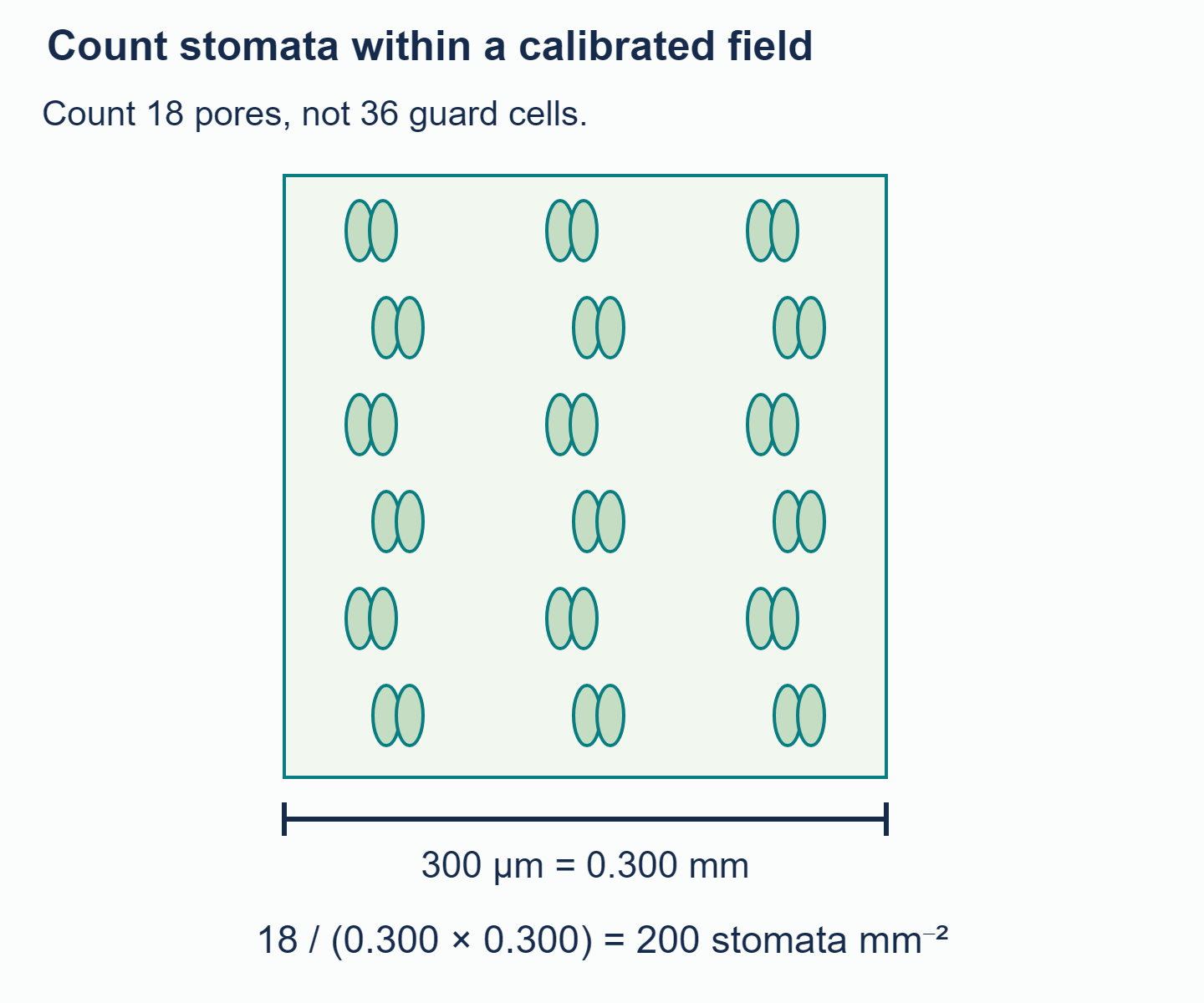
The invented square field contains eighteen stomata; converting length before squaring gives the correct area.
For an original example, suppose a square field measures along each side and contains 18 stomata. Convert the length before squaring:
Then
For a circular field, use , taking care not to substitute the diameter for . Area conversion is squared: , not .
One field may not represent the leaf. Suppose five equal-area fields give counts of . The mean count is 19, producing a mean density of about . Individual field densities range from about to . This range shows how your observations vary. It is not a confidence interval, which would estimate uncertainty in a population value.
Use a fixed edge rule, such as including pores on the top and left boundaries and excluding those on the bottom and right. This avoids systematically double-counting boundary objects. Count one pore as one stoma, not its two guard cells separately. Reject unclear fields by a stated rule rather than choosing whichever images support the expected result.
For comparisons, sample several leaves and plants at similar stages of development. Record whether each impression came from the upper or lower surface. Several fields from one leaf give you more information about that leaf, but they do not count as samples from several independent plants.
Density also differs from stomatal index, which expresses stomata relative to the number of epidermal cells. Higher density does not guarantee higher transpiration: how widely the pores open, humidity, temperature and air movement also affect water loss.
Apply the calculation to the leaf-impression investigation in the Biology HL mock exam. Check your area conversion and density units, then consider how the results help explain the leaves' loss of mass.
Answered by Revision Village IB Expert
Explore More IB Biology Resources
Over 80% of IB students globally are experiencing the power of Revision Village