Question
Biology
How can a water strider stand on water without sinking?
Answer
Biology
Expert Answer
A water strider is supported mainly by surface tension acting at its water-repellent legs. Its small weight is spread along long legs, so the legs press into the water surface without breaking through it.
Water molecules attract one another through hydrogen bonding. This attraction, called cohesion, pulls the molecules at the surface together and produces surface tension. Molecules at the surface have no water molecules above them, so they are pulled inwards and sideways by their neighbours, which makes the surface behave as if it were stretched.When a leg presses down, it forms a small dip. Surface tension acts along the curved surface, and because the surface is curved, part of that pull is directed upwards, supporting the leg.
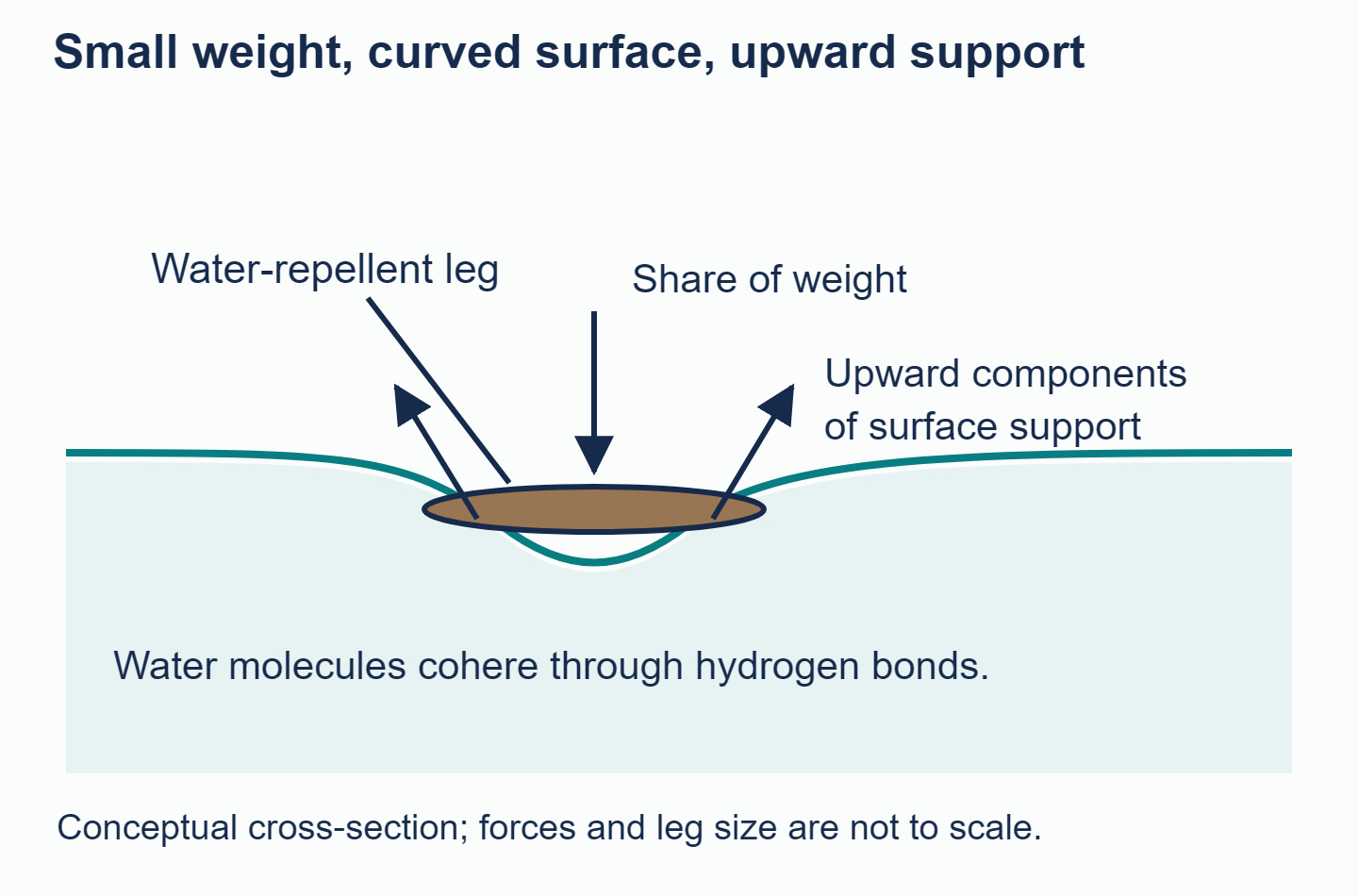
The leg pushes the surface down; surface tension along the dip supports the insect's weight.
The surface is not a solid skin. The molecules continue moving, and the dip changes as the insect moves. The useful connection is hydrogen bonding → cohesion → surface tension → a supporting force at the curved water surface.
Leg structure matters as much as the liquid. Tiny hairs and grooves trap air and help keep the legs dry. The importance of this fine structure was demonstrated in Gao and Jiang's investigation of water-strider legs. Simply describing the legs as waxed leaves out the role of these tiny structures.
Surface tension can only support very light animals. This is why surface-tension support is limited to small animals such as water striders, rather than larger ones.
Finally, distinguish this mechanism from adhesion in plant vessels. The strider benefits from legs that resist wetting. Water transport along xylem walls involves water interacting with a wettable surface. Both involve intermolecular interactions, but the biological roles are different.
Have a go at the water-strider question in the Biology Unity and Diversity questionbank. Explain the insect's support by linking the behaviour of water molecules to the forces acting at its legs, rather than just naming surface tension.
Answered by Revision Village IB Expert
Explore More IB Biology Resources
Over 80% of IB students globally are experiencing the power of Revision Village