Question
Biology
Which xylem vessel adaptations improve water transport?
Answer
Biology
Expert Answer
Xylem vessels transport water effectively because their hollow interiors offer little resistance to flow, while strengthened walls keep them open as the water is pulled under tension. Pits provide routes between neighbouring water-conducting cells and surrounding tissues.
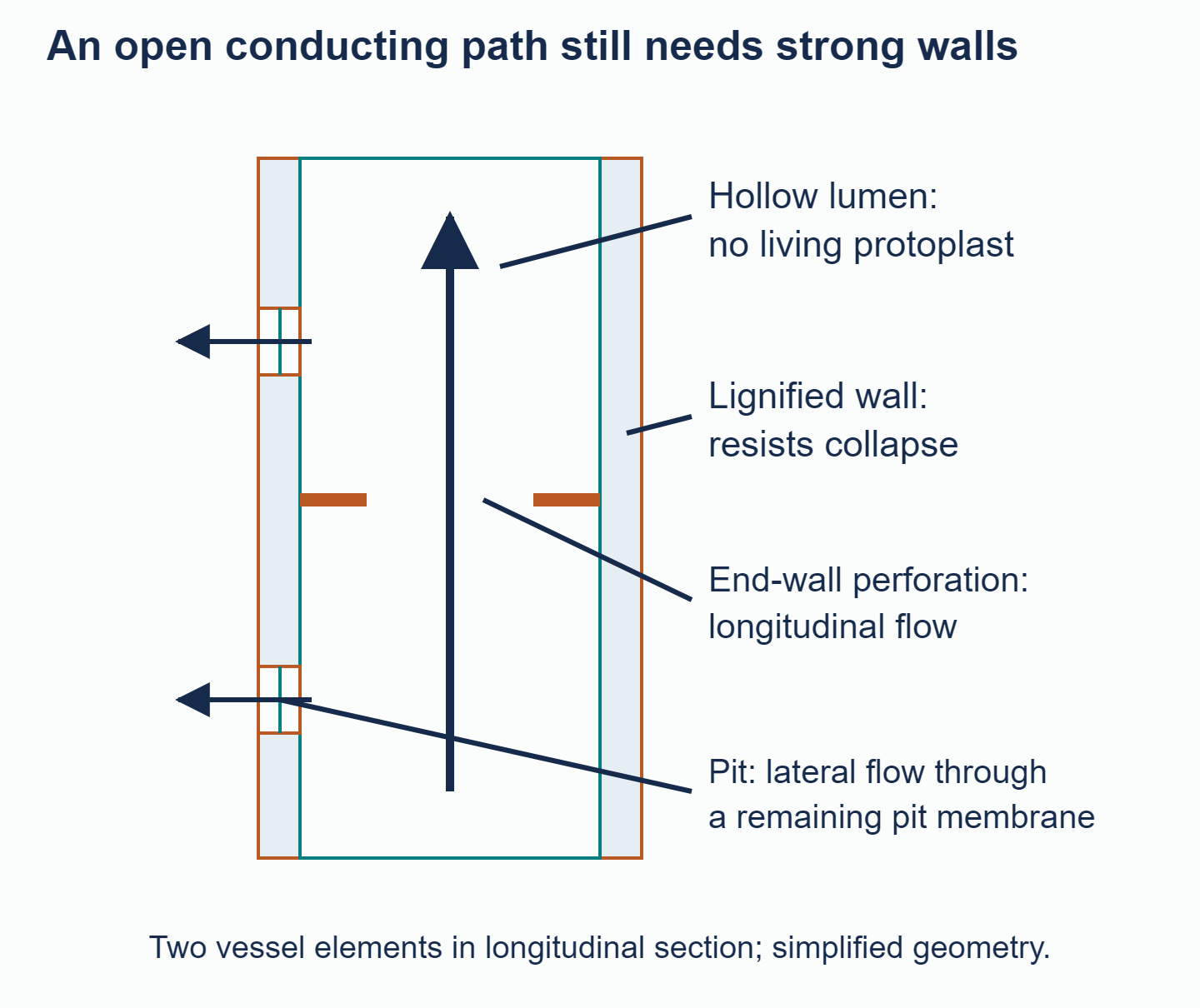
End-wall openings allow flow along the vessel; pits allow sideways exchange while retaining a thin pit membrane.
Vessel elements join end to end to form a vessel. When mature and conducting water, they are dead and have lost their living contents. Their end walls have perforations, ranging from simple openings to more complex perforation plates. Together these features create a relatively continuous pathway for water and dissolved mineral ions.
| Structural feature | How it helps water transport |
|---|---|
| No living cell contents in the mature lumen | Removes cytoplasm and organelles that would obstruct the conducting path. |
| Perforated end walls | Allows water to pass along the vessel from one element to the next. |
| Lignified secondary walls | Reinforces the vessel against collapse as the water is placed under tension. |
| Bordered pits or other pit regions | Allow sideways movement through thinner wall regions, linking water-conducting cells and neighbouring tissues. |
Distinguish perforations from pits. A perforation creates an opening in an end wall. Where two pits face each other between water-conducting cells, the secondary wall is absent, but a thin pit membrane remains. This consists mainly of primary wall and middle lamella, the material between neighbouring cell walls. It is therefore inaccurate to draw every side-wall pit as a completely empty hole through the wall.
The structural features work together. A hollow lumen, the space inside the vessel, is of little use if its walls collapse. Strong walls alone are of little use if the internal route remains blocked. Sideways connections allow water to move between pathways, although gas blockages called embolisms can still reduce the flow of water.
The driving force mainly comes from transpiration at the leaf and the resulting pressure gradient through the connected water. Cohesion helps transmit tension through the liquid. The vessel elements themselves do not use ATP to pump water upward: they are dead at maturity.
When matching an adaptation to an advantage, explain exactly how it helps. Lignin mainly strengthens the walls, while removing cell contents mainly clears the flow path. Pits mainly allow sideways exchange, while end-wall perforations allow flow along the vessel. Pairing those roles correctly explains more than saying that every feature simply "helps transport".
This description concerns xylem vessels. Tracheids are also water-conducting cells, but they lack the end-wall perforations found in vessel elements. Do not assume that every water-conducting xylem cell has exactly the same structure.
Test these structure-function links with the xylem adaptation question in the Biology practice exam. Choose the correctly matched pair, then explain why the other pairs confuse flow along the vessel, sideways exchange and wall support.
Answered by Revision Village IB Expert
Explore More IB Biology Resources
Over 80% of IB students globally are experiencing the power of Revision Village