Question
Chemistry
How does fractional distillation separate crude oil into useful fractions?
Answer
Chemistry
Expert Answer
Fractional distillation separates crude oil into mixtures with different boiling ranges. The heated crude oil enters a column that is warmer at the bottom and cooler towards the top. More volatile hydrocarbons, which vaporise more readily, remain in the vapour for longer and can reach higher, cooler sections before being collected.
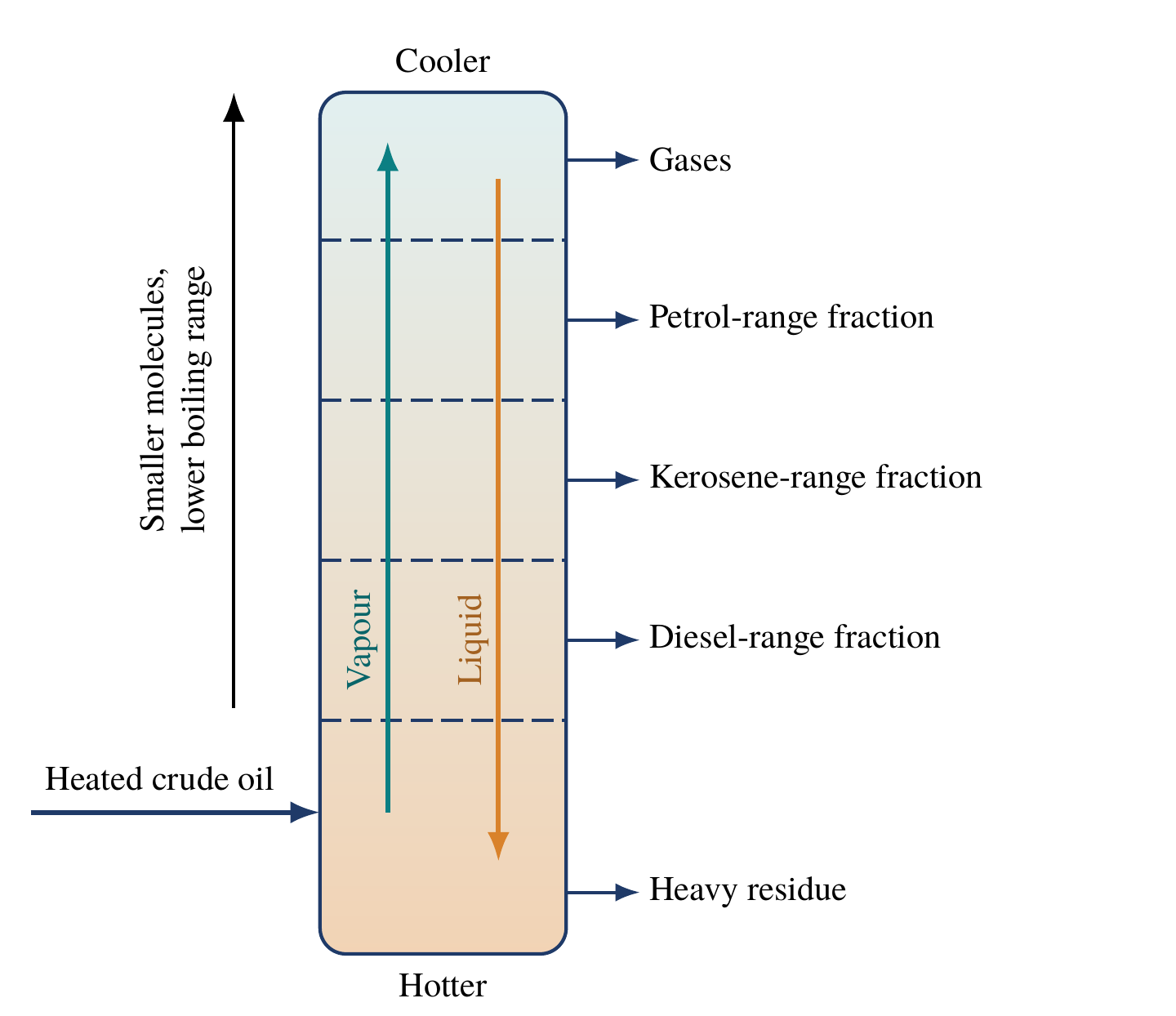
Repeated contact between vapour and liquid separates components by how readily they vaporise. Fraction boundaries vary by refinery.
Heating the crude oil vaporises much of it. As the vapour rises, it meets cooler liquid on trays or packing, materials that provide surfaces for contact. Some material condenses, while some of that liquid vaporises again. After repeated contact, the rising vapour contains a greater proportion of the more volatile components, while the descending liquid contains more of the less volatile components.
Small hydrocarbons that are gases at ordinary temperatures therefore leave near the top. Petrol-range material is collected relatively high in the column; kerosene- and diesel-range fractions come from lower regions. Very heavy material remains near the base. These positions are a general guide: the exact collection temperatures and products depend on the refinery's process.
Why do the boiling ranges differ? In broadly comparable hydrocarbon molecules, increasing molecular size generally increases the strength of London dispersion forces. More energy is then required to separate the molecules into the vapour. Branching and molecular shape also affect volatility, so chain length alone does not determine an exact boiling point.
A fraction is still a mixture. Kerosene, for example, does not have one precise boiling point in the way a pure compound does. It boils over a range of temperatures, the ranges of neighbouring fractions overlap, and industrial separation does not produce pure substances.
Distillation changes the distribution of molecules between phases and outlets; it does not normally break their carbon-carbon bonds. Cracking is a separate chemical process that converts larger hydrocarbons into smaller molecules. This distinction explains why a distillation column can sort the hydrocarbons already present but cannot, by separation alone, manufacture extra short-chain molecules from a heavy residue.
A well-annotated column shows the temperature gradient, the direction of vapour movement and the relative positions of fractions. An upward arrow labelled simply 'heat' is misleading: material rises as vapour, while heat is transferred through the system.
Take the particle explanation further with the crude-oil question in the Models of the Particulate Nature of Matter Questionbank. Explain why heating allows molecules to enter the gas phase and why different boiling behaviour lets the mixture be separated.
Answered by Revision Village IB Expert
Interested in diving deeper into this concept?
Explore More IB Chemistry Resources
Over 80% of IB students globally are experiencing the power of Revision Village