Question
Chemistry
How can a polymer repeat-unit diagram reveal its monomers?
Answer
Chemistry
Expert Answer
The backbone of the repeat unit shows how the polymer formed, which determines how to work backwards. A backbone of only carbon atoms points to an addition polymer, whereas amide or ester links point to a condensation polymer. Reversing the reaction then gives the monomers.
| Polymer type | Backbone | How to find the monomers | Monomers |
|---|---|---|---|
| Addition | Only carbon atoms | Restore the C=C bond | One alkene, in the simplest case |
| Condensation | Amide or ester links | Cut each link and restore the functional groups | Usually two, each with two functional groups |
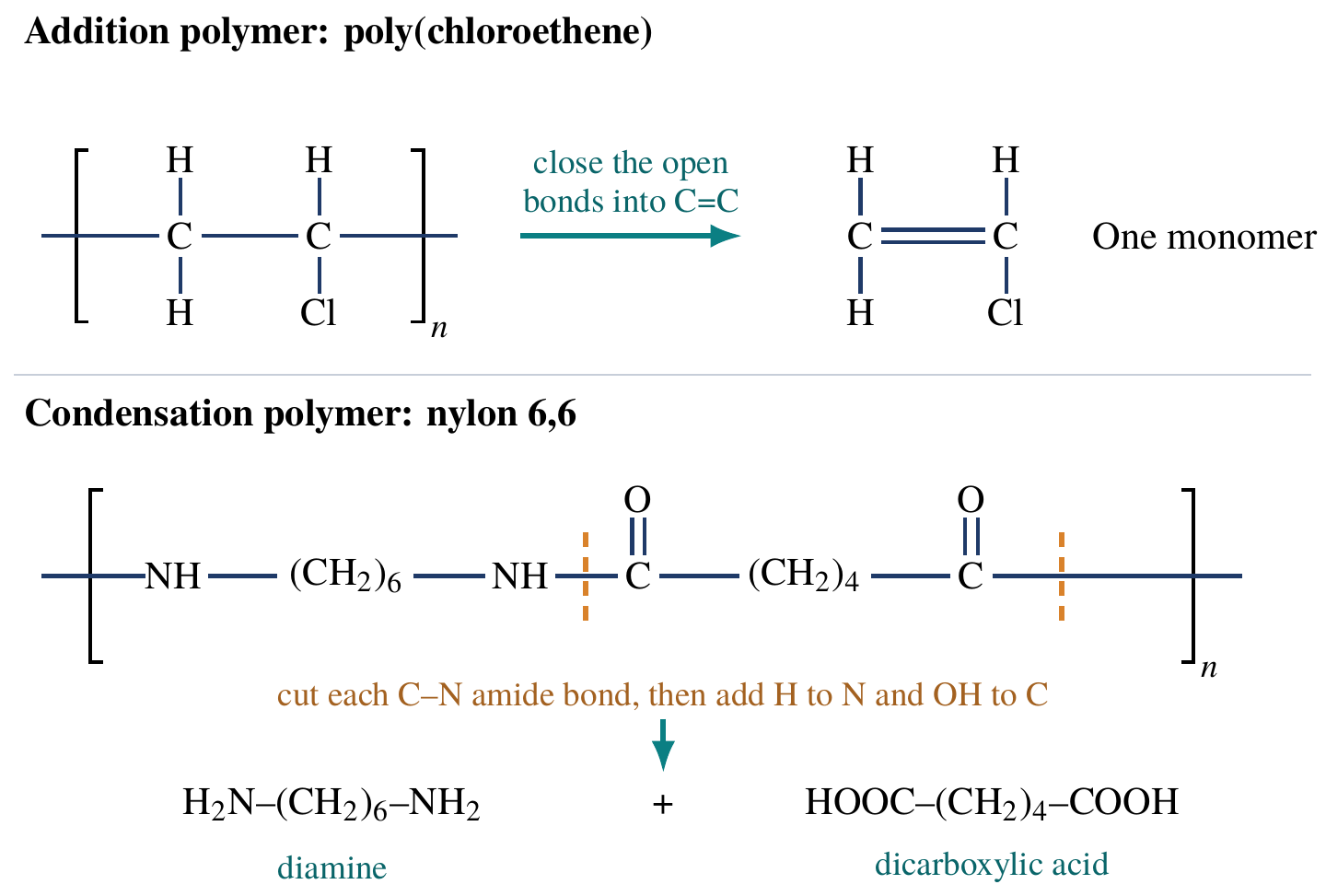
An addition polymer needs its C=C bond restored, while a condensation polymer needs each link cut.
Addition polymers. The repeat unit of poly(chloroethene) has a backbone of two carbon atoms, with a chlorine atom on one of them. The two carbon atoms formed the C=C bond of the monomer, and the bonds extending outside the brackets were formed when that double bond opened. Removing these and restoring the double bond gives chloroethene, . Every atom in the monomer ends up in the polymer, and no small molecule is lost.
Condensation polymers. The repeat unit of nylon 6,6 contains amide links, . Each link formed when an amine group and a carboxylic acid group joined and lost water, so reversing this means cutting each C–N bond, then adding H to the nitrogen and OH to the carbonyl carbon. This gives two monomers:
These are hexane-1,6-diamine and hexanedioic acid. Each has a functional group at both ends, which allows the chain to keep growing. A monomer with only one such group would stop the chain at that end. A polyester works in the same way, with each ester C–O link cut and the groups restored to give a diol and a dicarboxylic acid.
Carbon counts are easy to get wrong. Hexanedioic acid has six carbon atoms in total, because the two carbonyl carbon atoms are additional to the four in the group.
A check confirms the result. Joining the monomers forwards should reproduce the links and the carbon chains in the repeat unit. For an addition polymer, opening the C=C bond should give the backbone. For a condensation polymer, each new link should form with the loss of one water molecule.
Work backwards through more polymers in the From Models to Materials Questionbank. Decide on the type of polymerization first, then join your monomers on paper to see whether the links and carbon chains match the repeat unit.
Answered by Revision Village IB Expert
Explore More IB Chemistry Resources
Over 80% of IB students globally are experiencing the power of Revision Village