Question
Economics
How do leakages and injections change the circular flow of income?
Answer
Economics
Expert Answer
Leakages reduce how much income is spent on goods and services produced within the economy, while injections add spending from other sources. If planned injections exceed planned leakages at the current income level, firms face pressure to produce more. If planned leakages are larger, they face pressure to produce less.
In this simplified model, leakages are saving , net taxes and imports . Net taxes are taxes paid minus transfer payments received from the government. Injections are investment , government purchases and exports .
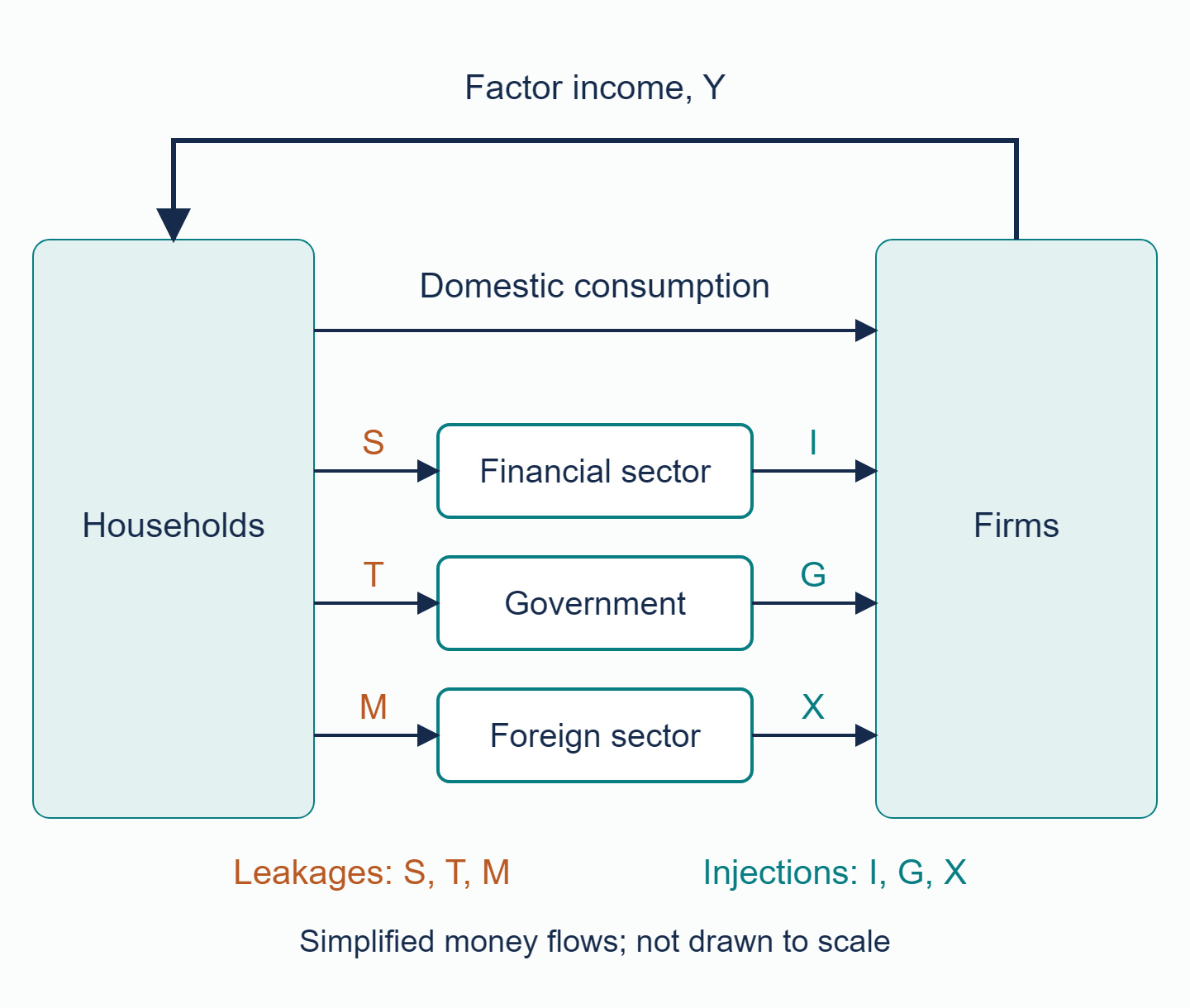
Saving, net taxes and imports leave the spending flow; investment, government purchases and exports add to it.
The arrows show money flows. Households earn factor income, such as wages for their work, from production. They then divide this income between consumption, saving and net taxes. In this example, all imports are household purchases. Spending on imports goes to overseas producers, while exports bring spending to domestic firms.
Investment here means spending on newly produced capital goods, such as machinery, and changes in inventories, or stocks of goods. It does not mean buying shares of stock. Government transfers are not purchases of current output, so the model allows for them in net taxes. Although the arrows appear in pairs, saving need not equal investment, taxes need not equal government purchases, and imports need not equal exports individually.
Suppose income is 1,000 million currency units during a period, with the following plans:
| Leakages | Million | Injections | Million |
|---|---|---|---|
| Saving | 200 | Investment | 180 |
| Net taxes | 150 | Government purchases | 160 |
| Imports | 50 | Exports | 90 |
| Total | 400 | Total | 430 |
Households plan total consumption of , of which 50 is imported. Domestic consumption spending is therefore 600. Planned spending on domestic output is
This exceeds current output by 30. If firms meet the extra demand by selling goods from stock, their inventories fall unexpectedly. They may then increase orders, production and employment. When the economy has spare capacity, higher income usually increases saving, tax receipts and imports, narrowing the initial gap. The eventual income change need not equal 30: each round of new spending and leakage affects what happens next.
The flow is in equilibrium when planned leakages equal planned injections:
Keep one distinction clear: the imbalance above concerns planned flows. The national accounts record what actually happens, and these recorded flows still balance. Here, the unexpected inventory reduction of 30 lowers actual investment from the planned 180 to 150. This makes actual injections equal leakages at the original output level. Inventory investment is included when calculating GDP from spending.
Finally, more spending does not guarantee a matching rise in real output, the quantity of goods and services produced. If production is already near capacity, extra demand may mainly increase prices or imports. State your assumptions about spare capacity and prices when explaining expansion.
Try the circular-flow question in the Economics Foundations Questionbank. Use a labelled diagram to explain how a gap between planned leakages and injections can change output and income.
Answered by Revision Village IB Expert
Explore More IB Economics Resources
Over 80% of IB students globally are experiencing the power of Revision Village