Question
Environmental Systems and Societies
How does CITES regulate international trade in endangered species?
Answer
Environmental Systems and Societies
Expert Answer
CITES, the Convention on International Trade in Endangered Species of Wild Fauna and Flora, regulates trade by listing species in three appendices and requiring permits whenever a listed animal, plant or product crosses a border. The more threatened the species, the stricter the rules. The convention came into force in 1975. As of January 2026 it had 185 Parties and covered over 40,900 species, about 6,610 animals and 34,310 plants, according to the US Congressional Research Service.
The three appendices
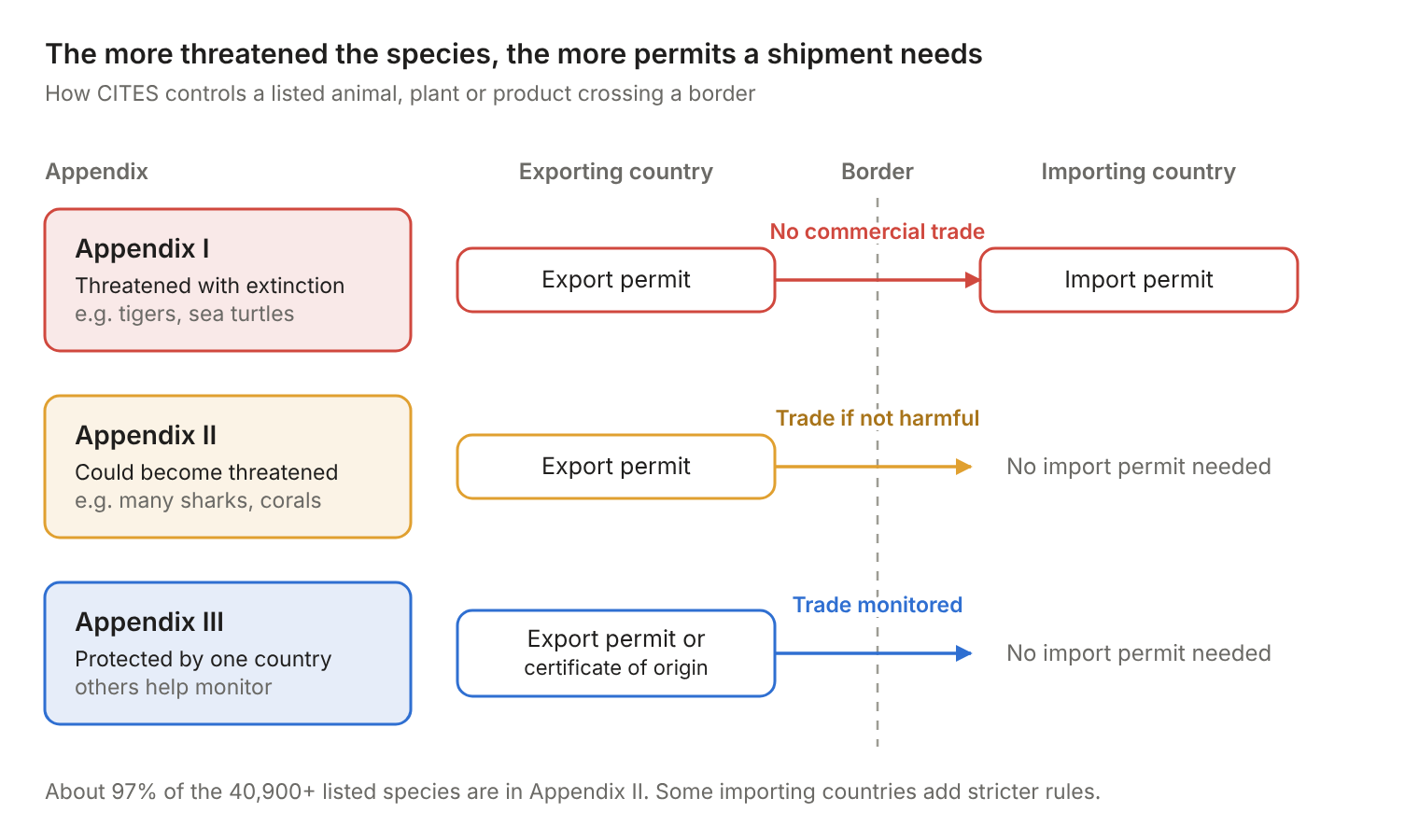
- Appendix I lists species threatened with extinction, such as tigers, gorillas and sea turtles. Commercial trade is banned. Trade for science or breeding programmes needs both an export permit and an import permit.
- Appendix II lists species that are not yet threatened with extinction but could become so if trade is not controlled, such as many sharks, corals and big-leaf mahogany. Trade is allowed with an export permit, as long as it does not harm the species in the wild. About 97% of listed species are here.
- Appendix III lists species that one country protects and asks others to help monitor. Trade needs an export permit or a certificate of origin.
Each Party sets up a Management Authority, which issues permits, and a Scientific Authority, which advises whether a trade will harm the species. That advice is known as a non-detriment finding. Customs officers check permits at the border and can seize shipments without them.
The Parties meet every two to three years at a Conference of the Parties to vote on adding, moving or removing species. A two-thirds majority is needed to change a listing.
What CITES does not cover
CITES deals only with trade between countries. It does not control buying and selling within a country, and it does nothing directly about habitat loss, which is the main threat to most species. Each Party writes its own laws and sets its own penalties, so enforcement varies widely.
Does it work?
There are clear successes. The vicuña, a wild relative of the llama, was close to extinction when it was listed in Appendix I in 1975. Its numbers recovered so well that some populations were moved to Appendix II, allowing a controlled trade in its fine wool that now earns money for Andean communities.
Elsewhere, results are mixed. African elephants were moved to Appendix I in 1989, banning the international ivory trade, yet poaching for illegal markets continues. CITES can set the rules. Whether they hold depends on the money and effort each country puts into enforcing them.
Follow the process into practice with the CITES question in the Environmental Systems and Societies questionbank.
Answered by Revision Village IB Expert
Explore More IB Environmental Systems and Societies Resources
Over 80% of IB students globally are experiencing the power of Revision Village