Question
Environmental Systems and Societies
How would consequentialist and rights-based ethics judge a conservation decision?
Answer
Environmental Systems and Societies
Expert Answer
Consequentialist ethics judges a conservation decision by its outcomes: the right choice is the one that does the most good overall. Rights-based ethics judges it by whether it respects the rights of those affected, whatever the outcome. The two often agree. They split when a decision helps many by harming a few, and removing invasive predators to protect native birds is a clear example.
Consequentialist ethics
A consequentialist asks what will happen and who will be better or worse off. Utilitarianism, the best-known form, aims for the greatest good for the greatest number. In conservation, the good might be counted in species saved, ecosystems restored, carbon stored or jobs protected.
This approach works well with evidence and lets you compare options. Its weakness is that it can justify serious harm to a minority if the total comes out ahead, and the costs and benefits are often hard to measure.
Rights-based ethics
A rights-based thinker asks whose rights are at stake. Rights act as limits that good outcomes cannot override. In conservation, they might include the rights of Indigenous peoples to their land, the rights of local people to make a living and, for some philosophers, the right of individual animals not to be killed.
This approach protects those who would lose out under a sum of costs and benefits. Its weakness is that rights can clash, and it gives little guidance on which should win.
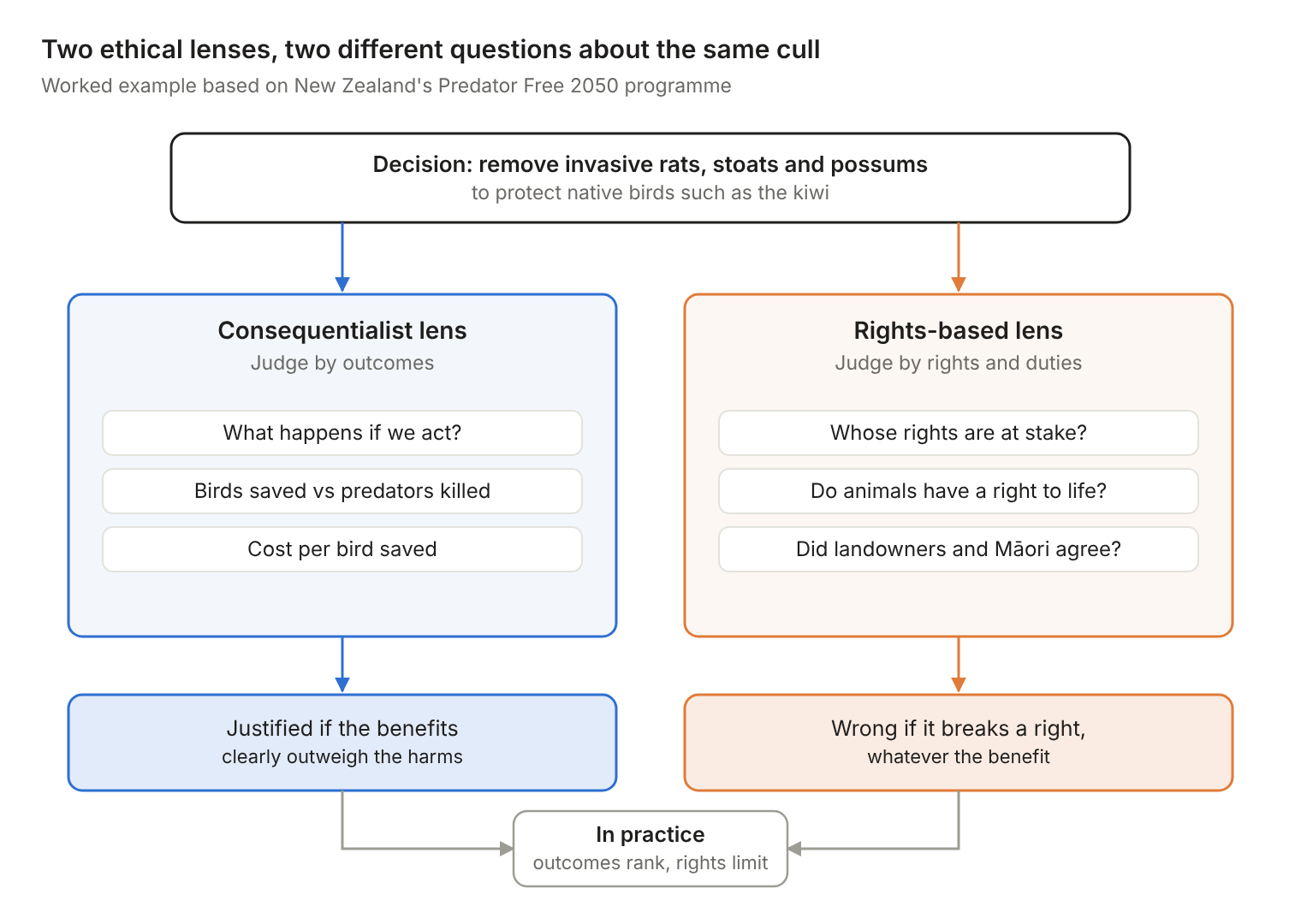
Worked example: removing invasive predators
New Zealand's Predator Free 2050 programme aims to remove rats, stoats and possums, which were brought to the islands by people and kill native birds such as the kiwi.
A consequentialist view weighs millions of native birds and several unique species against the deaths of introduced predators. If the programme works at a reasonable cost, the benefits are large and lasting, so the cull is justified. A consequentialist would also compare methods and pick whichever saves the most birds per dollar.
A rights-based view depends on whose rights count. If animals have a right to life, killing stoats is wrong whatever the benefit, and only non-lethal methods such as fences or fertility control are acceptable. A rights view focused on people would ask whether landowners and Māori communities agreed to traps and poison on their land.
Most real decisions borrow from each. Consequences help rank the options. Rights set the lines that no option should cross. A good conservation plan can usually say how it meets both tests, and where it does not, it should say so openly.
Put both approaches into your own words with the ethics comparison question in the Environmental Systems and Societies questionbank.
Answered by Revision Village IB Expert
Explore More IB Environmental Systems and Societies Resources
Over 80% of IB students globally are experiencing the power of Revision Village