Question
Environmental Systems and Societies
Why do ecological footprints differ between countries?
Answer
Environmental Systems and Societies
Expert Answer
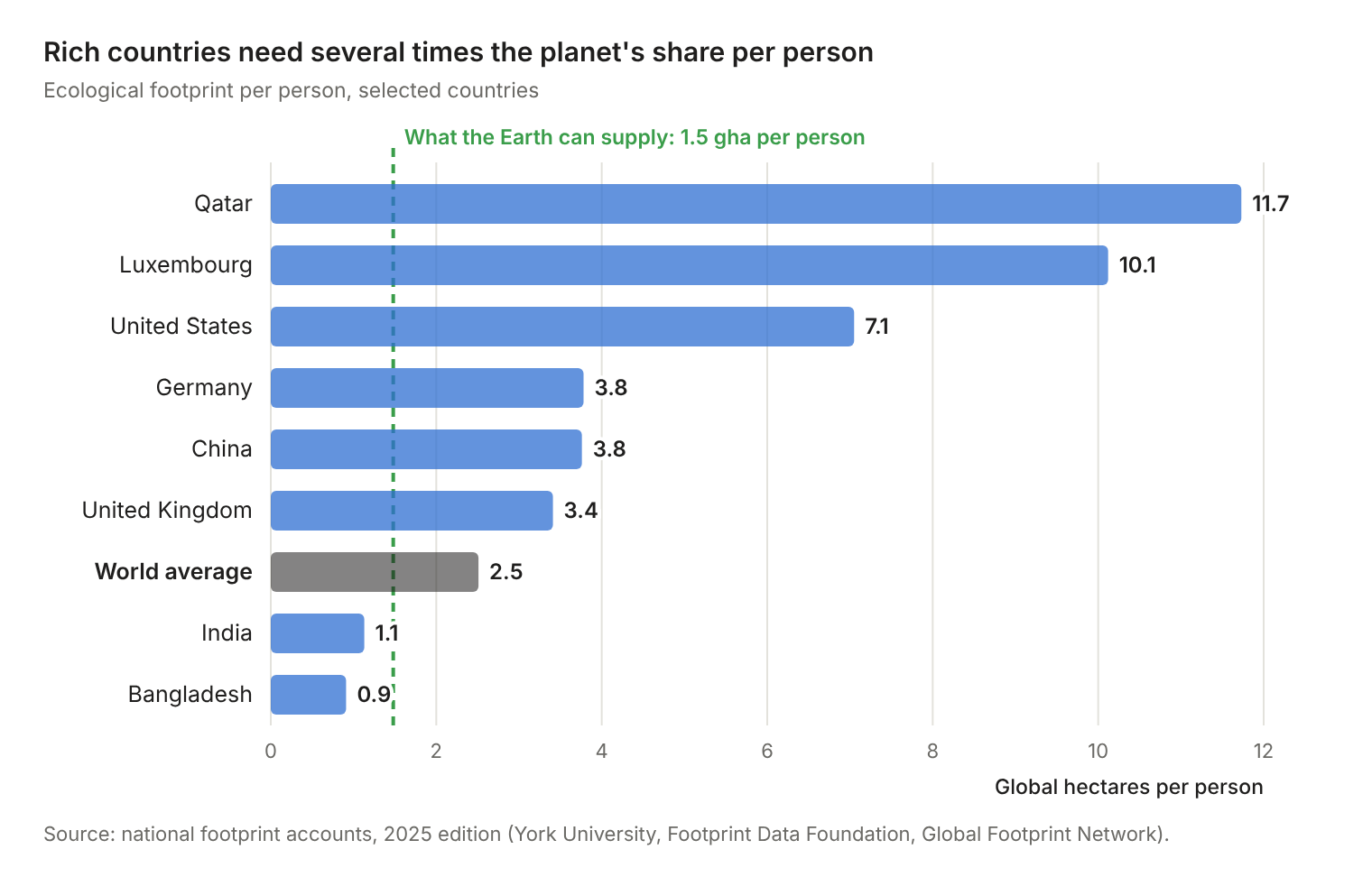
An ecological footprint measures how much biologically productive land and sea a population needs to supply what it uses and to absorb its carbon dioxide. It is counted in global hectares (gha) per person. Footprints differ between countries mainly because of income, energy sources, diet and lifestyle. Richer countries buy more, burn more fossil fuel and import more goods, so each person needs more of the planet.
What the footprint measures
The footprint adds up six kinds of area: cropland, grazing land, fishing grounds, forest for timber, built-up land, and the forest needed to absorb carbon dioxide. That last part, the carbon footprint, is the largest. Burning fossil fuels makes up 61% of humanity's footprint, according to the Global Footprint Network.
The planet's capacity to regrow what we use is called biocapacity. In 2026, humanity used nature 73% faster than it could regenerate, as if we lived on 1.73 Earths. Earth Overshoot Day, the date when that year's budget runs out, fell on 30 July.
Why footprints differ
- Income. More money buys more goods, bigger homes, more travel and more meat. Income is the strongest single link to footprint size.
- Energy sources. A country that runs on coal and gas has a larger carbon footprint than one that runs on hydropower or wind. In Qatar, gas powers the air conditioning and the desalination plants that supply drinking water.
- Diet. Beef and dairy need far more grazing land and cropland than grains, beans and vegetables.
- Climate and geography. Very hot or cold countries use more energy for cooling or heating. Large, spread-out countries drive more.
- Trade. A footprint is counted where goods are used, not where they are made. China makes many goods for export, so part of that footprint lands on the buyers' accounts.
- How cities are built. Dense cities with good public transport need less energy per person than car-based suburbs.
Footprint against biocapacity
A large footprint is not the whole story. What matters is how it compares with the land a country has. The United States uses 7.1 gha per person but has 3.7 gha of biocapacity, so it runs an ecological deficit. India's footprint is small, but with 1.4 billion people its biocapacity is even smaller, at 0.4 gha per person, so it runs a deficit too.
The limits of the measure
The footprint leaves out water use, pollution other than carbon dioxide, and direct damage to wildlife. A national average also hides big gaps between rich and poor within a country, and the data lag a few years behind the present.
Try the ecological-footprint comparison of low- and high-income countries in the Environmental Systems and Societies questionbank. As you build your explanation, check whether each point concerns an average person's footprint or a country's total, rather than mixing the two.
Answered by Revision Village IB Expert
Explore More IB Environmental Systems and Societies Resources
Over 80% of IB students globally are experiencing the power of Revision Village