Question
Environmental Systems and Societies
How do you draw a systems diagram for an ecosystem?
Answer
Environmental Systems and Societies
Expert Answer
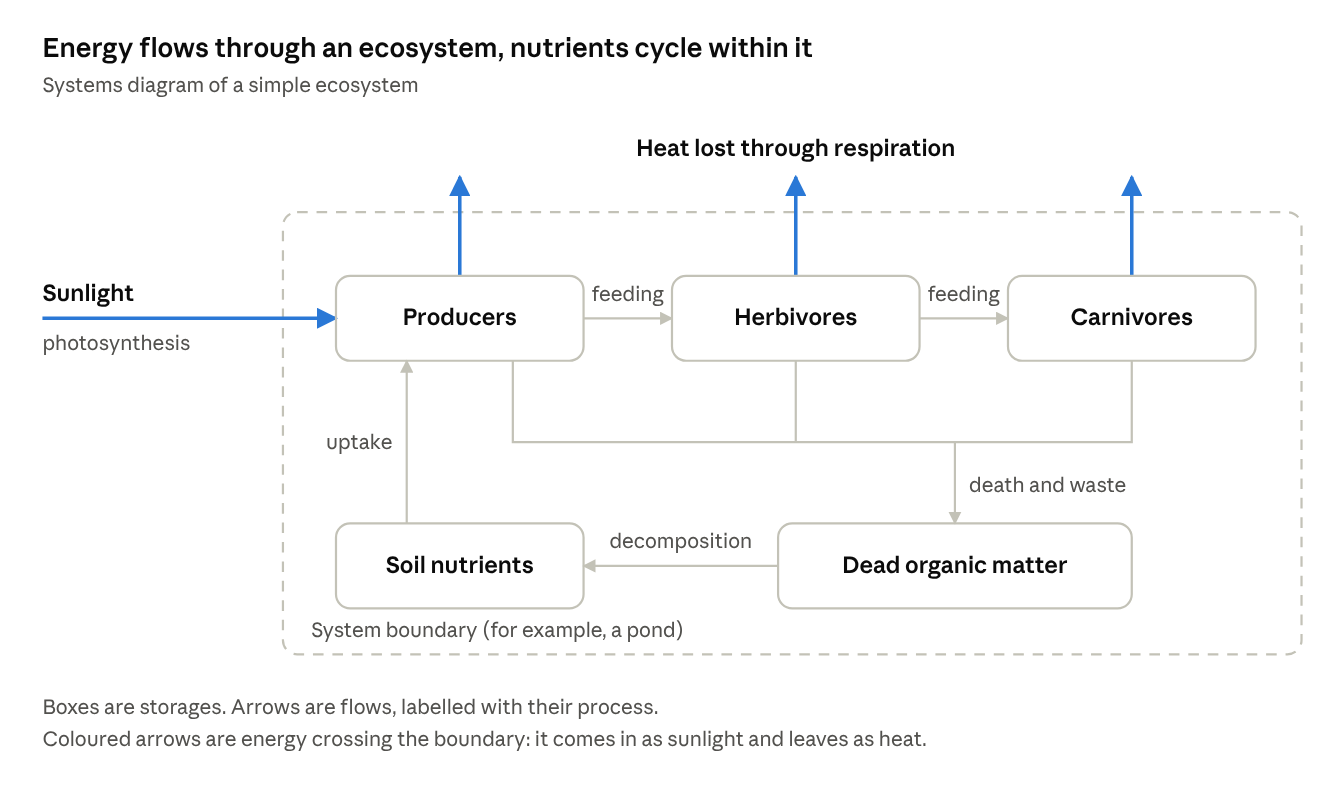
A systems diagram shows an ecosystem as a set of storages linked by flows. Storages, such as plants or soil nutrients, go in boxes. Flows, such as feeding or decomposition, are arrows between the boxes, each labelled with the process that moves energy or matter. A line around the whole thing marks the system boundary, and arrows that cross it show what enters and leaves.
Before you start
Pick one ecosystem small enough to picture: a pond, a patch of woodland, a rock pool. The diagram is a model, so it leaves things out on purpose. Decide what it should show, such as how energy moves along the food chain or where nutrients go after something dies.
Step 1: Draw the boundary
Draw a large box or a dashed outline and name the system. Everything inside belongs to the ecosystem. Everything outside is its surroundings.
Step 2: Add the storages
Put each store of energy or matter in its own box. Producers, herbivores, carnivores, dead organic matter and soil nutrients cover most ecosystems. Use nouns. A box holds a thing, never a process.
Step 3: Connect them with flows
Draw an arrow for each flow and write the process on it. Herbivores get energy from producers by feeding. Every living store passes matter to dead organic matter through death and waste. Decomposition returns nutrients to the soil, and plants take them up through their roots.
Some flows are transfers: matter or energy moves to a new place but keeps its form, as when a rabbit eats grass. Others are transformations, where the form changes. Photosynthesis turns light energy into chemical energy stored in sugars.
Step 4: Show inputs and outputs
An ecosystem is an open system. Sunlight enters across the boundary and drives photosynthesis. Heat leaves every living store through respiration. Draw both arrows crossing the boundary line.
Common mistakes
- Energy drawn as a cycle. Energy passes through an ecosystem once and leaves as heat. Nutrients are what cycle.
- Unlabelled arrows. An arrow without a process name tells the reader nothing.
- No dead organic matter or decomposers. Without them, the nutrient loop has a gap.
- Processes in boxes. Photosynthesis is a flow, so it belongs on an arrow.
Going further
To show amounts, draw box sizes and arrow widths to match the quantities. In a forest, a wide arrow from producers to dead organic matter next to a thin one to herbivores shows at a glance that most plant material is never eaten.
Compare different ecosystems in the Environmental Systems and Societies questionbank. Choose a boundary for each, then practise identifying stores, transfers and transformations of both matter and energy.
Answered by Revision Village IB Expert
Explore More IB Environmental Systems and Societies Resources
Over 80% of IB students globally are experiencing the power of Revision Village