Question
Environmental Systems and Societies
How do the Montreal and Kyoto Protocols differ?
Answer
Environmental Systems and Societies
Expert Answer
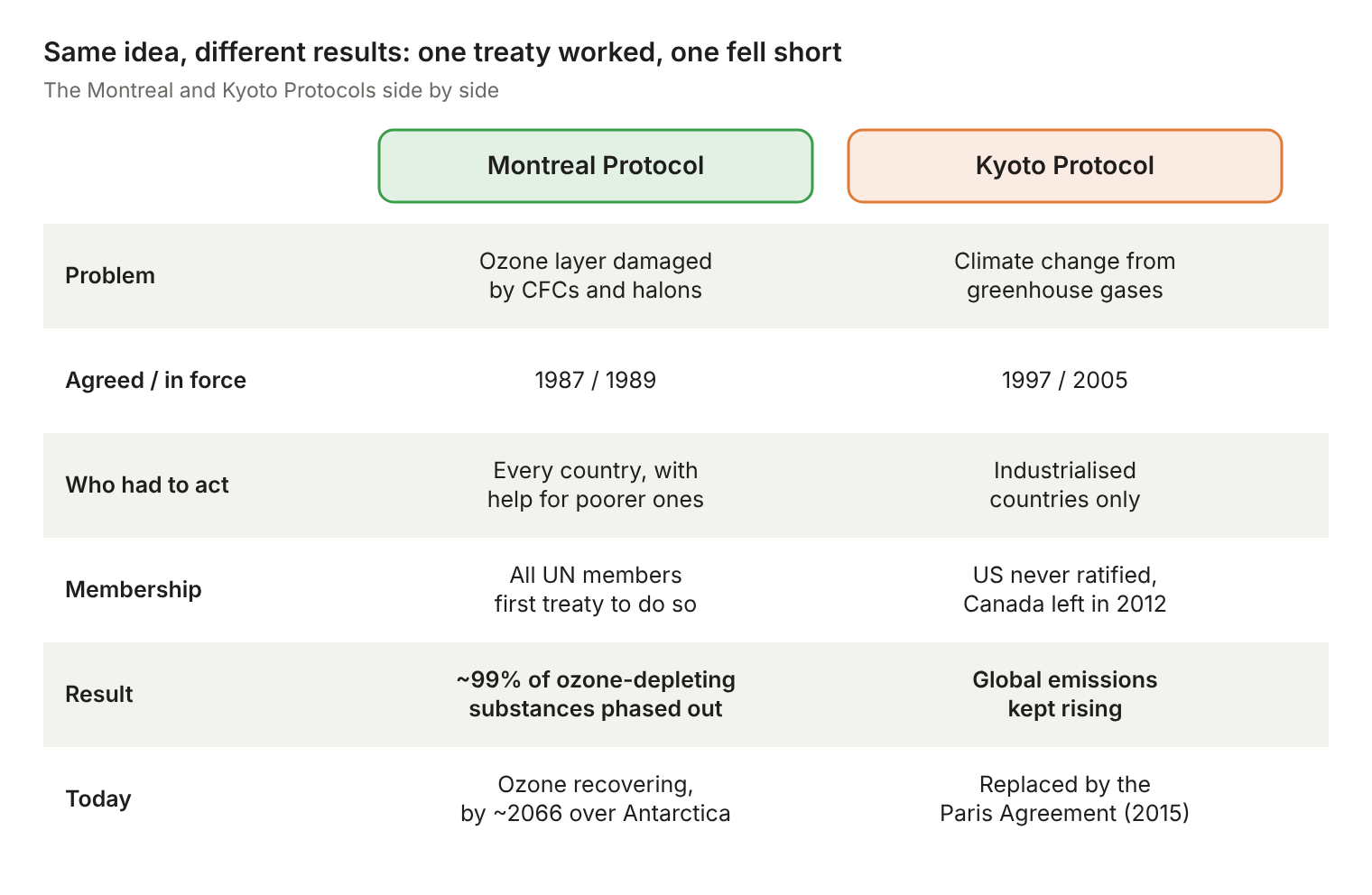
The Montreal and Kyoto Protocols are both international environmental treaties, but they tackled different problems and had very different results. The Montreal Protocol, agreed in 1987, phases out chemicals that destroy the ozone layer, such as CFCs. The Kyoto Protocol, agreed in 1997, set targets to cut the greenhouse gases that cause climate change. Montreal is often called the most successful environmental treaty ever: nearly 99% of ozone-depleting substances have been phased out. Kyoto set targets for rich countries only, lost key members and did little to slow global emissions.
 The Montreal Protocol
The treaty came into force in 1989. In 2009 it became the first treaty in UN history to be ratified by every country. It controls about 100 chemicals, including CFCs from old fridges and aerosols, halons from fire extinguishers and HCFCs. Every country had to phase them out, but developing countries got extra time and money from a shared fund.
It is working. The scientific assessment published in 2023 found that, if current policies hold, the ozone layer will return to 1980 levels by about 2040 over most of the world, 2045 over the Arctic and 2066 over Antarctica, as reported by the International Institute of Refrigeration. The 2016 Kigali Amendment added HFCs, gases that do not harm ozone but trap heat. It could avoid 0.3 to 0.5°C of warming by 2100.
The Kyoto Protocol
Kyoto came into force in 2005. It gave binding targets only to industrialised countries: together they had to cut six greenhouse gases to about 5% below 1990 levels, on average, between 2008 and 2012. Developing countries, including China and India, had no targets. The idea was that rich countries had caused most of the problem, so they should act first.
The United States signed but never ratified the treaty, and Canada withdrew in 2012. Many countries that stayed met their targets, partly because heavy industry had collapsed in the former Soviet bloc after 1990. Meanwhile, emissions rose fast in countries without targets, so global emissions kept climbing. The Paris Agreement of 2015 replaced Kyoto's approach with national pledges from every country.
Why Montreal worked and Kyoto struggled
- A narrower problem. A few chemicals, made by a few companies, with substitutes ready. Carbon dioxide comes from almost every power station, car and factory.
- A visible threat. Scientists reported the Antarctic ozone hole in 1985, two years before Montreal was signed.
- Duties for everyone. Every country had to act, with help for poorer ones and trade limits on countries that stayed out.
- Room to tighten. Montreal's schedules were strengthened again and again as the science improved.
The contrast shows that a treaty's design matters as much as its goal.
Put the two treaties side by side with the comparison question in the Environmental Systems and Societies questionbank. Practise explaining both a similarity and a difference, then use the dated evidence above to judge what each agreement achieved.
Answered by Revision Village IB Expert
Explore More IB Environmental Systems and Societies Resources
Over 80% of IB students globally are experiencing the power of Revision Village