Question
Environmental Systems and Societies
How can the precautionary principle guide a biodiversity decision?
Answer
Environmental Systems and Societies
Expert Answer
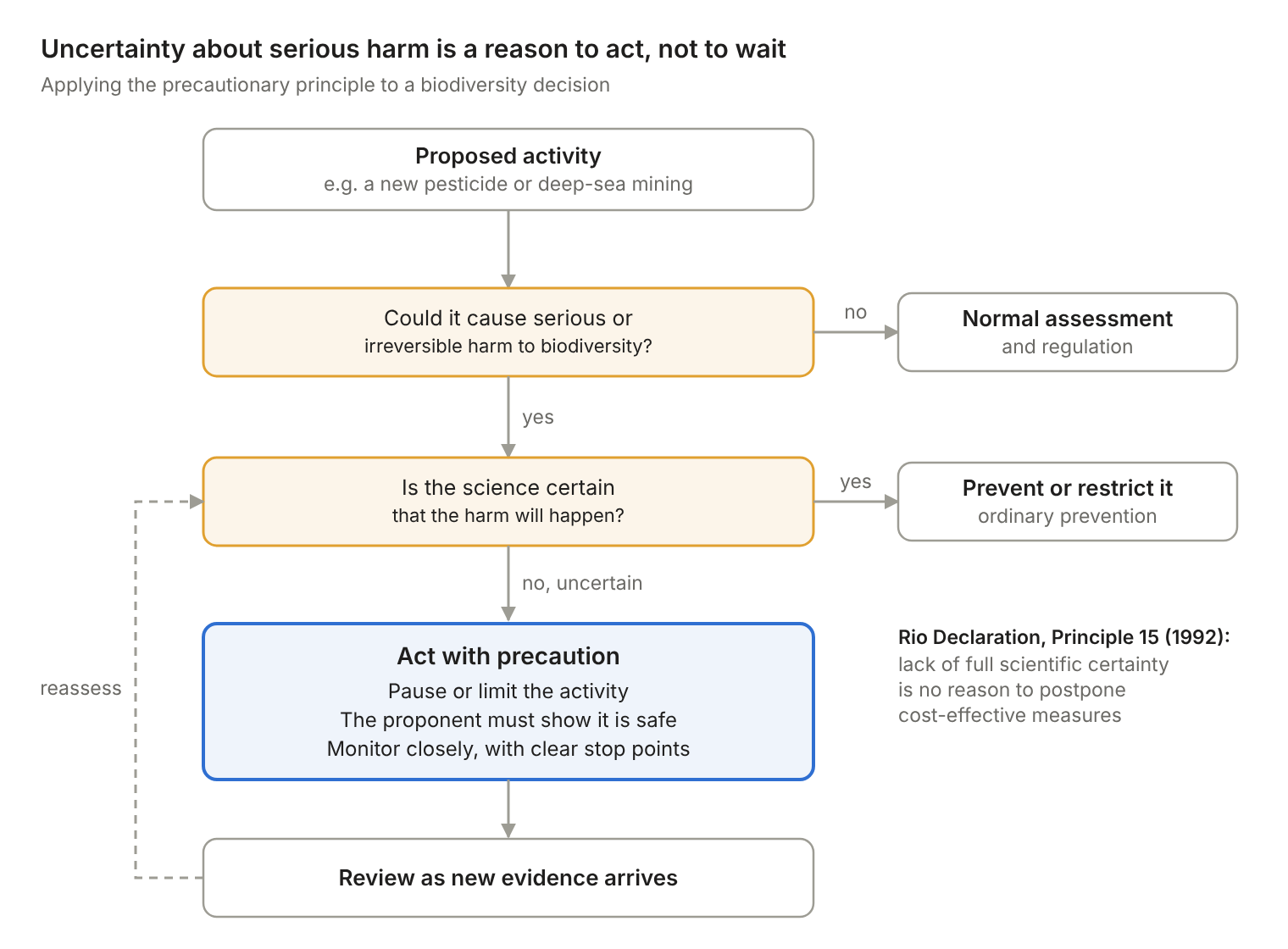
The precautionary principle says that when an activity could cause serious or irreversible harm to the environment, a lack of full scientific certainty should not be used as a reason to delay action that would prevent it. For biodiversity, that means not waiting until a species has gone before acting. It often shifts the burden of proof too: the people proposing an activity should show it is safe, rather than others having to prove it is harmful.
Where it comes from
The best-known version is Principle 15 of the 1992 Rio Declaration on Environment and Development: "Where there are threats of serious or irreversible damage, lack of full scientific certainty shall not be used as a reason for postponing cost-effective measures to prevent environmental degradation." The Convention on Biological Diversity, agreed the same year, uses the same reasoning.
How to apply it
- Identify the possible harm. Could it be serious, or impossible to undo? Extinction is the clearest case of irreversible harm.
- Be honest about the uncertainty. What is known, what is not, and how long would it take to find out?
- Choose a proportionate response. That might be a pause, limits on scale, extra research, or close monitoring with clear points at which to stop.
- Decide who must provide the evidence. Usually the developer or user must show the risk is acceptable.
- Review the decision as evidence arrives. A precautionary measure is not meant to be permanent if the science later shows the risk is small.
Example: neonicotinoid pesticides and bees
Neonicotinoids are insecticides that became widely used on crops in the 2000s. Studies began to suggest they harmed bees and other pollinators, but the evidence was debated. The European Union restricted three neonicotinoids in 2013 and, after a further scientific review, banned their outdoor use in 2018. It did not wait for proof that pollinator populations were collapsing, because by then the damage could be very hard to reverse.
A live case today is deep-sea mining. Companies want to mine metal-rich nodules from the ocean floor, where many species have not yet been described and recovery from disturbance may take decades or longer. Several governments have called for a precautionary pause until the science catches up.
Criticisms
The principle is open to interpretation. Critics argue it can block useful activities, ignore the risks of doing nothing, or be used to delay decisions for other reasons. A pesticide ban, for example, can push farmers towards older chemicals that are also harmful.
The answer is proportion. The principle works best when the harm would be severe and permanent, the uncertainty is real, and the measures chosen are sensible for the size of the risk. Biodiversity loss often meets all three tests, because a species that is gone cannot be brought back.
Explore the precautionary-principle question about biodiversity treaties in the Environmental Systems and Societies questionbank. Practise deciding when a risk calls for preventive action despite incomplete evidence, and explain why the response should match the seriousness of the possible harm.
Answered by Revision Village IB Expert
Explore More IB Environmental Systems and Societies Resources
Over 80% of IB students globally are experiencing the power of Revision Village