Question
Environmental Systems and Societies
How can renewable energy improve a country's energy security?
Answer
Environmental Systems and Societies
Expert Answer
Energy security means a country can get the energy it needs, reliably and at a price it can afford. Renewable energy improves it mainly by replacing imported fossil fuels with power made at home from wind, sun, water and heat from the ground. A country that produces its own electricity is less exposed to price spikes, supply cuts and political pressure from fuel exporters. Renewables also bring new risks, such as output that depends on the weather, which have to be planned for.
The problem with imported fuel
Many countries buy most of their oil, gas or coal from abroad. That leaves them exposed to events they cannot control. After Russia invaded Ukraine in 2022, gas prices in Europe hit record highs, and governments scrambled to replace Russian supplies. Households and factories paid the price.
How renewables help
- Home-grown supply. Sunlight and wind cannot be blocked at a border or held back by another government.
- Stable prices. Wind and solar have no fuel costs. Once a wind farm is built, the cost of its power hardly changes, whatever happens on world markets.
- More, smaller sources. A grid fed by thousands of turbines and solar farms is less exposed to one breakdown or attack than a grid that depends on a few large power stations.
- Local power. Rooftop solar and batteries can keep homes, hospitals and schools running when the main grid fails.
Iceland shows what this can look like. Almost all its electricity comes from hydropower and geothermal plants, so its power supply does not depend on fuel imports at all.
Problems with renewables
- Weather. Solar output falls at night and in winter, and wind drops on calm days. Batteries, pumped hydro, links to neighbouring grids and flexible demand all help fill the gaps.
- Supply chains. Most solar panels and batteries are made in a small number of countries, and many depend on minerals such as lithium and cobalt that are mined in only a few places. A country can swap one dependence for another.
- The grid. Wind and solar farms are often far from cities. New power lines are expensive and slow to build.
- Climate itself. Droughts cut hydropower, as dry years in parts of Europe, China and South America have shown.
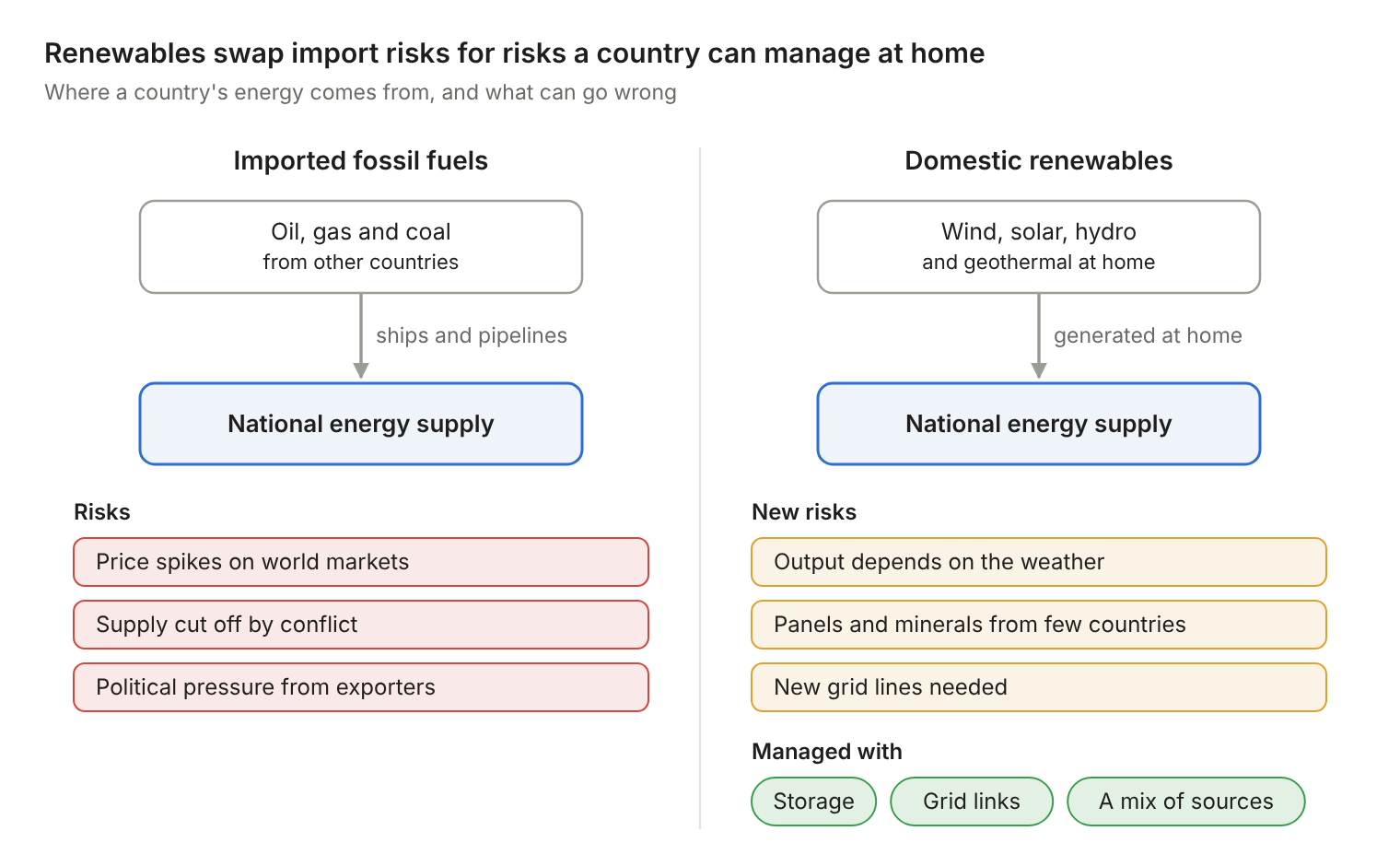
The most secure systems mix several renewable sources with storage and strong grid links, and keep some backup while the transition happens. Energy efficiency counts too. Every unit of energy a country does not need is a unit it does not have to import or generate.
Choose a real country for the renewable-energy security question in the ESS SL mock exam paper. Look beyond the resources it has: explain what would keep supplies reliable when demand is high or renewable output is low.
Answered by Revision Village IB Expert
Explore More IB Environmental Systems and Societies Resources
Over 80% of IB students globally are experiencing the power of Revision Village