Question
Environmental Systems and Societies
How do you draw soil as a system of stores and flows?
Answer
Environmental Systems and Societies
Expert Answer
To draw soil as a system, put a boundary around the soil and show what it holds inside: organic matter, minerals, water, air and living organisms. Then add arrows. Inputs come in from above and below, such as fallen leaves, rain and weathered rock. Outputs leave, such as nutrients washed out by leaching or topsoil carried off by erosion. Arrows inside the boundary show transfers, which move material, and transformations, which change it into something else.
The stores
- Organic matter: dead leaves, roots and humus, the dark material left after decomposition.
- Minerals: sand, silt and clay particles that came from rock.
- Water: held in the spaces between particles.
- Air: fills the spaces that water does not, and supplies oxygen to roots and soil life.
- Organisms: bacteria, fungi, earthworms and insects.
Inputs
- Organic matter from leaf litter, dead roots and animal waste.
- Water from rain, snowmelt and irrigation.
- Minerals from the weathering of the rock beneath the soil.
- Nitrogen from the air, fixed by bacteria.
Outputs
- Leaching: water carries dissolved nutrients below the reach of roots.
- Erosion: wind and running water remove topsoil.
- Uptake: plant roots take up water and nutrients.
- Evaporation: water returns to the air from the surface.
- Respiration: soil organisms release carbon dioxide.
Transfers and transformations
Transfers move material without changing it. Water infiltrates from the surface into the soil. Earthworms drag leaves down and mix the layers. Clay particles wash down from upper layers to lower ones.
Transformations change material into something new. Decomposers turn dead leaves into humus and release nutrients. Weathering turns rock into clay. Bacteria turn ammonium into nitrate.
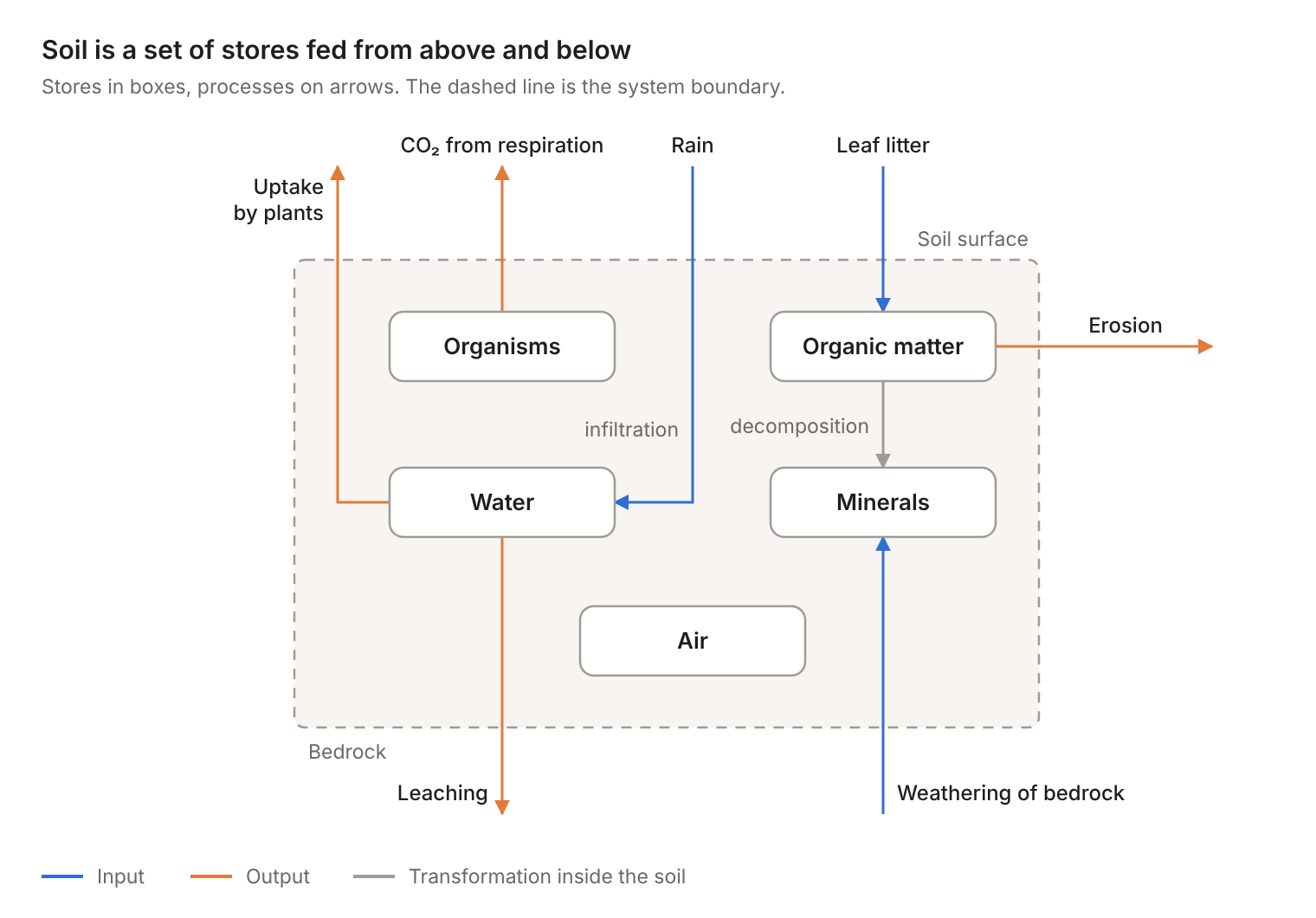 Tips for a clear diagram
- Draw the boundary at the soil surface and at the bedrock, so inputs and outputs cross a line.
- Write each store as a noun in a box, and each process as a label on an arrow.
- Show inputs entering from both directions: from above for litter and rain, from below for weathered rock.
- If you have data, make arrow widths match the amounts. A sandy soil drains fast, so its leaching arrow is wide. A clay soil holds water, so its water store is large.
Why it helps
Seeing soil as a system shows where it can go wrong. Remove the litter input by clearing the forest, and the organic matter store shrinks. Increase the erosion output by ploughing a slope, and the soil gets thinner every year.
Build on your knowledge of systems diagrams with questions in the Environmental Systems and Societies questionbank.
Answered by Revision Village IB Expert
Explore More IB Environmental Systems and Societies Resources
Over 80% of IB students globally are experiencing the power of Revision Village