Question
Environmental Systems and Societies
How can models guide sustainable fishing decisions?
Answer
Environmental Systems and Societies
Expert Answer
Fisheries models guide sustainable fishing by estimating how big a fish stock is, how fast it grows and how many fish can be caught each year without shrinking it. Managers use the results to set catch limits, net sizes and closed seasons. The best-known idea is maximum sustainable yield (MSY): the largest catch that can be taken year after year while the stock still replaces what is removed.
The basic model
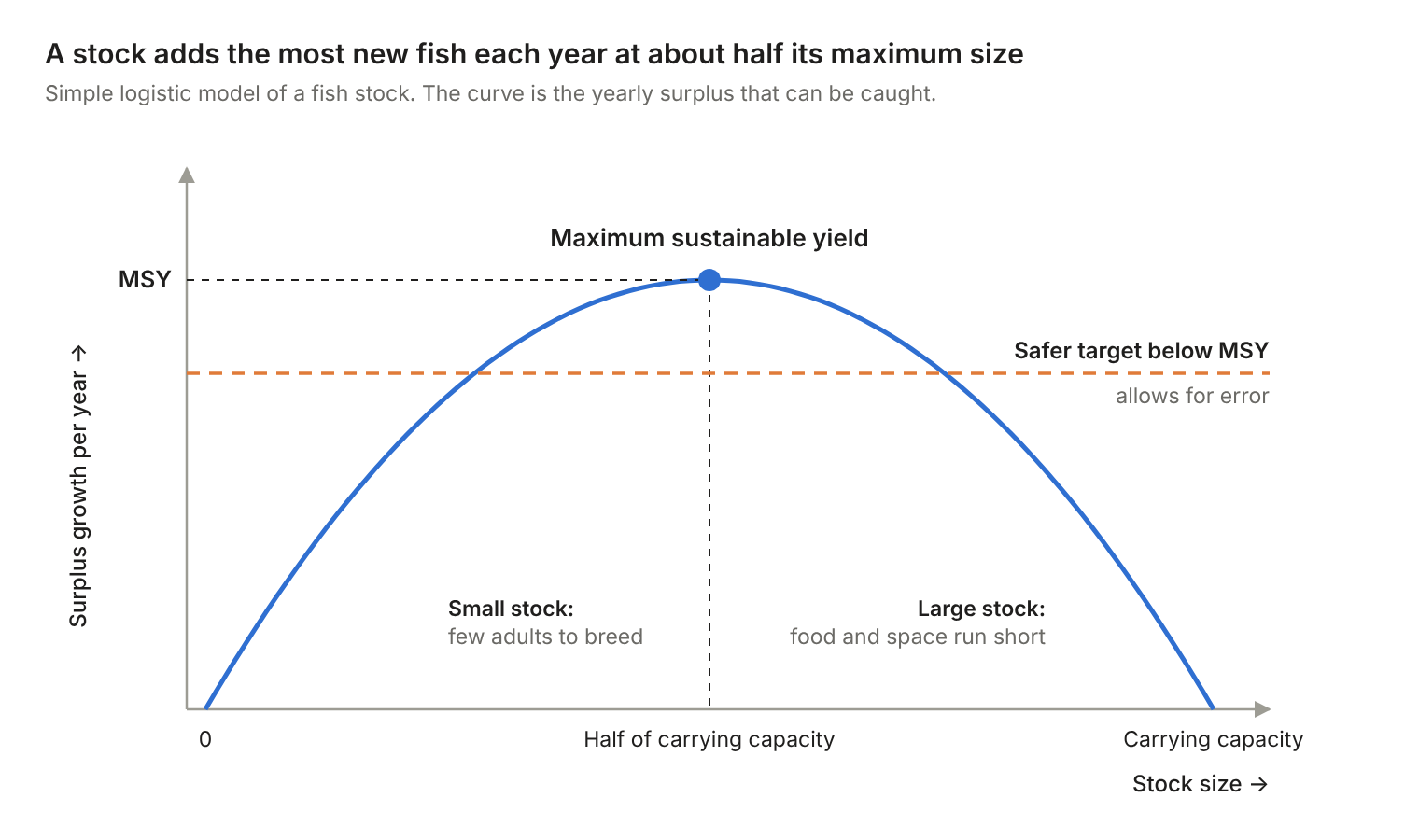
A fish stock grows slowly when it is small, because there are few adults to breed. It also grows slowly when it is very large, because food and space run short. It adds the most new fish each year somewhere in between. In the simplest model, that peak comes at about half the largest size the environment can support.
That yearly surplus is what can be caught. Take less than the surplus and the stock grows. Take more and it shrinks, and next year's surplus shrinks with it.
From model to catch limit
Real stock assessments go much further than one curve. Scientists combine catch records, research surveys at sea, and the ages and sizes of fish landed. The model estimates how many fish are in the sea and how hard they are being fished. From that, managers set a total allowable catch for the coming year and divide it among fleets or countries as quotas.
Why managers aim below MSY
- The numbers are uncertain. Counting fish in the open sea is hard. If the stock is smaller than the model thinks, fishing at "MSY" overfishes it.
- Nature varies. Water temperature and food supply change how many young fish survive from year to year.
- Other species depend on the fish. Seabirds, seals and larger fish need prey, and nets also catch species nobody was targeting.
The collapse of Atlantic cod off Newfoundland shows the cost of getting it wrong. Catch limits were set on stock estimates that turned out far too high. Canada closed the fishery in 1992, putting tens of thousands of people out of work, and the stock has still not fully recovered.
Where world fish stocks stand
According to the FAO's State of World Fisheries and Aquaculture 2026, 62.4% of assessed marine fish stocks are fished within biologically sustainable levels, down from 64.5% in the previous report. Those stocks supply 72.6% of the catch.
Tools that follow from the models
- Quotas that cap the total catch
- Minimum mesh and landing sizes, so young fish can breed first
- Closed seasons during spawning
- Marine protected areas where no fishing is allowed
Each one is a way of keeping the catch below what the stock can replace.
Use the fishing-models question in the Environmental Systems and Societies questionbank to weigh up what a model can and cannot offer.
Answered by Revision Village IB Expert
Explore More IB Environmental Systems and Societies Resources
Over 80% of IB students globally are experiencing the power of Revision Village