Question
History
Why did the Great Leap Forward fail?
Answer
History
Expert Answer
The Great Leap Forward failed because ambitious production targets and political pressure were combined with disruptive economic policies and unreliable information. As food output fell, officials continued to demand grain based on exaggerated expectations. Punishing criticism made the danger worse by discouraging warnings. Environmental difficulties added to the crisis, but do not alone explain how severe it became or why some areas suffered more than others.
Launched in 1958, the campaign aimed to transform the economy quickly by mobilising large numbers of people, organising farmers into agricultural communes and pushing for more industrial output. Moving workers towards projects such as small-scale steel production could leave less time and labour for farming. Unrealistic agricultural methods and targets also made results difficult to judge honestly.
The crucial connection was between incentives, reports and grain demands. Officials under pressure to show success had reasons to exaggerate production. Higher reported harvests could encourage the state to demand more grain. When the real harvest did not match the report, procurement, or state collection of grain, could leave rural communities with too little. Fear of admitting failure then made it harder to correct the policy.
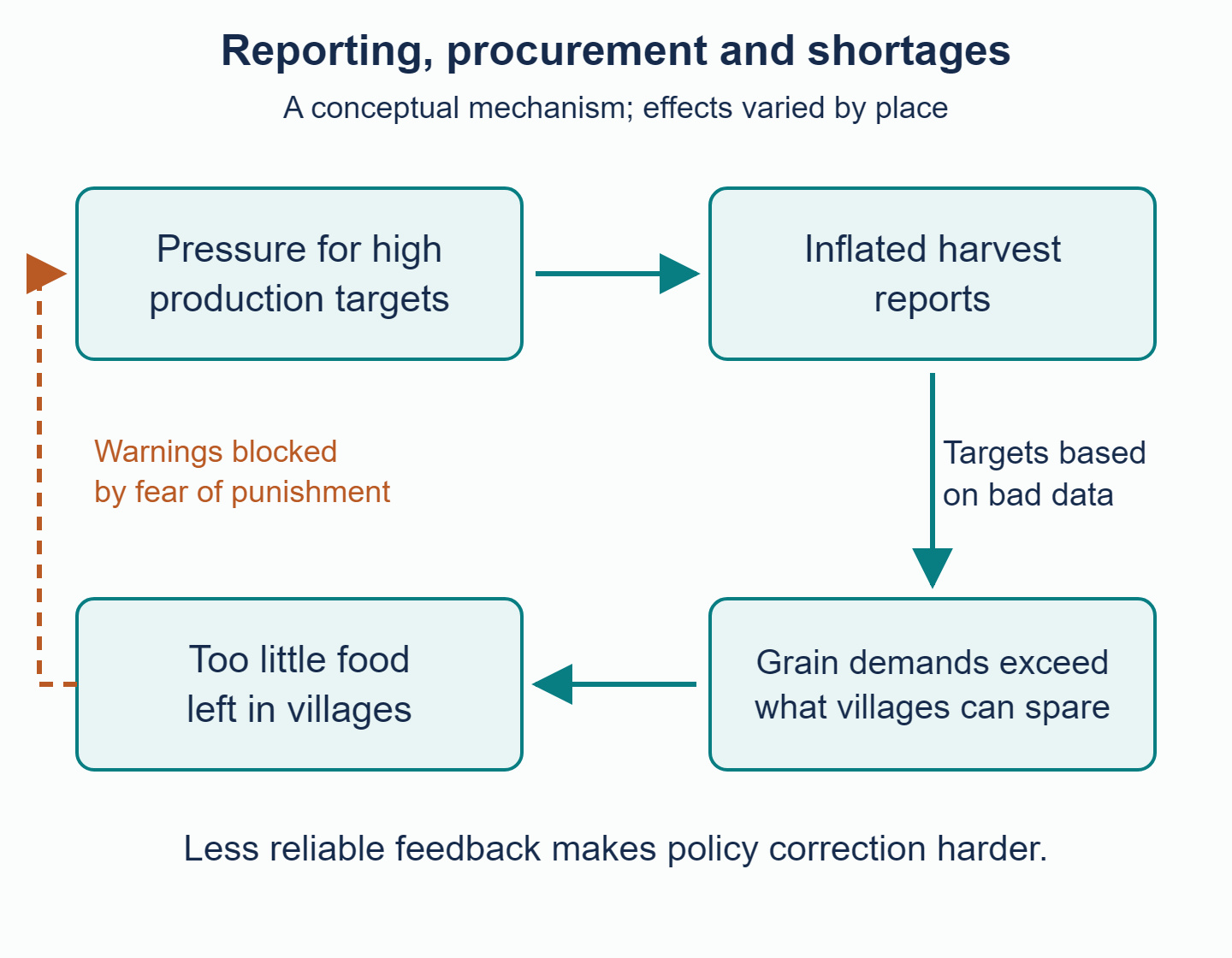
Political pressure could distort harvest reports used to decide how much grain to collect and silence warnings of shortages.
Peng Dehuai's letter to Mao of 14 July 1959 gives criticism from within the leadership at the time. He identified exaggerated grain claims and poor coordination of industrial production. This supports an explanation based on information and planning failures. It is not a complete survey of local conditions, and one letter cannot explain every consequence of the famine. The letter is reproduced in his published memoirs.
Later research can compare what happened in different places. Xin Meng, Nancy Qian and Pierre Yared's study, The Institutional Causes of China's Great Famine, 1959-1961, uses evidence about regional production and deaths to examine how procurement and failures to respond to new information contributed to famine. Unlike Peng's letter, it tests an explanation across regions using reconstructed data. Its conclusions still depend on its assumptions and the limits of those data.
Weather and sudden falls in harvests belong in the explanation, but 'bad weather caused famine' skips the question of who could still obtain food. Compare local conditions, state demands and access to relief before deciding how much weight to give each cause. Production, distribution and political response all matter.
Finally, the attack on Peng after the Lushan Conference made criticism of the campaign more dangerous. Rewarding optimistic reports and punishing warnings could keep harmful policies in place. The failure was not only that targets were missed: rewards and threats of punishment made it harder for leaders to learn about shortages and respond.
Read the excerpt from Peng Dehuai's letter in the Great Leap Forward source questions. Identify the reasons he gives for failure, then check that your response uses his evidence rather than causes you know from other sources.
Answered by Revision Village IB Expert
Explore More IB History Resources
Over 80% of IB students globally are experiencing the power of Revision Village