Question
History
How did the Group Areas Act and Native Resettlement Act enforce apartheid?
Answer
History
Expert Answer
The Group Areas Act and the Natives Resettlement Act enforced apartheid through related but different powers. The first allowed racial controls on who could live, run businesses or own property in designated areas. The second created powers and an organisation to remove African residents from specified areas around Johannesburg. Together with other laws and government decisions, they enabled the state to enforce racial separation across cities.
The dates are important: the original Group Areas Act was passed in 1950, while the Natives Resettlement Act dates from 1954. The latter's formal title uses 'Natives', although it is sometimes shortened in discussion.
| Date | Development | Mechanism |
|---|---|---|
| 1950 | Group Areas Act, No. 41 | Allowed areas to be designated for particular racial groups, restricting occupation and property rights. |
| 1954 | Natives Resettlement Act, No. 19 | Established a board and removal powers for the Johannesburg resettlement scheme. |
| February 1955 onwards | Forced removal from Sophiatown | African residents were moved to places including Meadowlands; homes and community networks were uprooted. |
The original Group Areas Act shows the legal powers. The Natives Resettlement Board's report records how removals were organised. Because the board was carrying out the scheme, its account alone cannot establish whether residents agreed to move or what they lost. Residents' accounts offer evidence of those experiences.
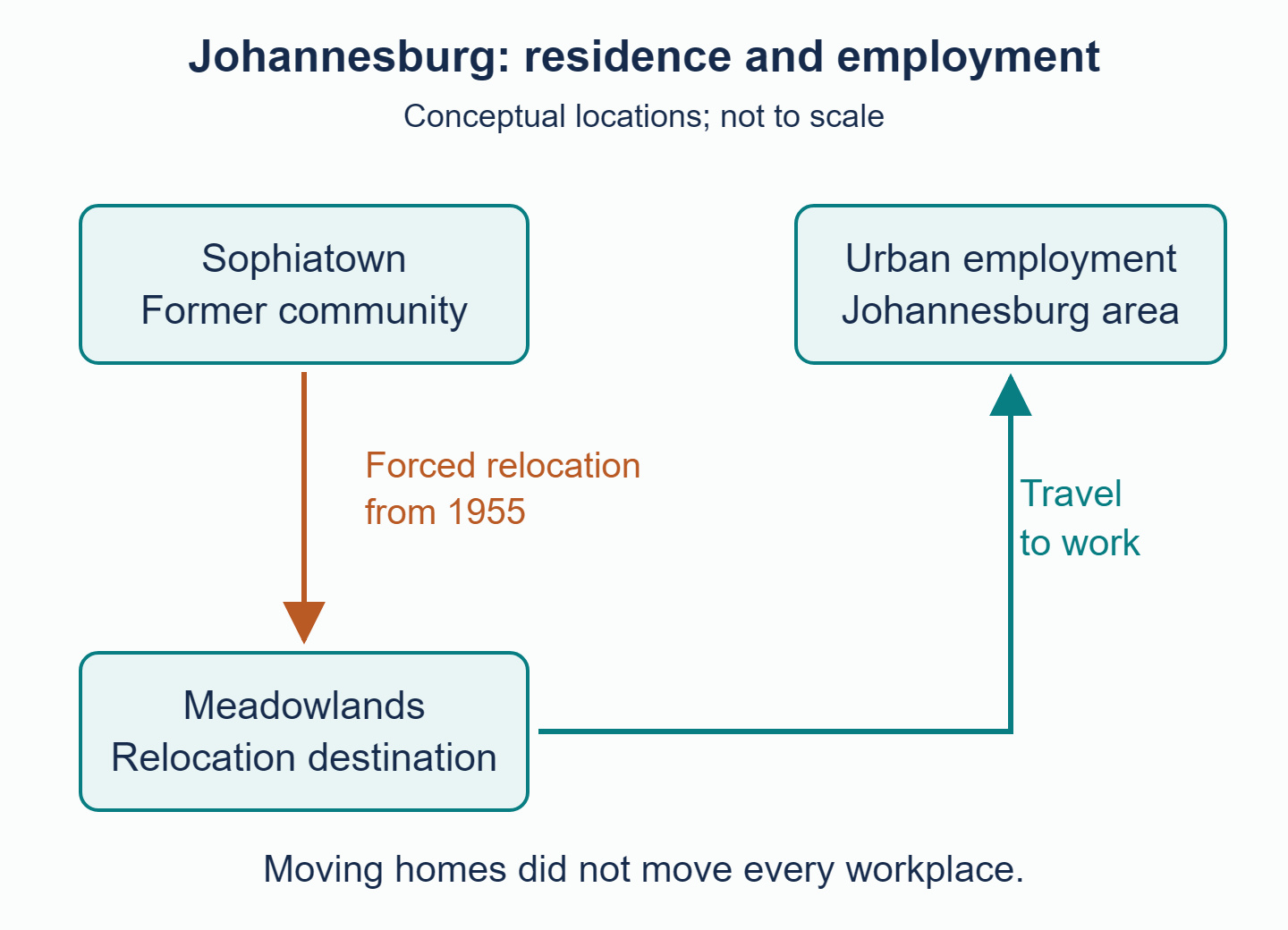
Being forced to move home did not remove the need to travel to work. This is a simplified layout, not a map.
The diagram separates two movements that can otherwise be confused. Forced relocation changed where a household was allowed to live. Travel to work could still take residents to jobs elsewhere in the city. Separating residential areas did not end employers' dependence on African labour; it could instead increase the distance and cost of travelling between home and work.
The consequences therefore went beyond changing addresses. Removal disrupted neighbours' support networks, local businesses and relationships with schools, churches and workplaces. Losses differed between owners and tenants, and between families with different jobs and resources. Avoid assuming that one compensation arrangement or experience applied to everyone.
These laws also applied differently. The Group Areas Act was not simply another name for the Johannesburg removal programme, and the Natives Resettlement Act did not govern every forced removal throughout South Africa. Name the legal power, identify who used it and trace what happened in a particular place. This explains spatial apartheid more accurately than treating the laws as interchangeable.
Try the two-law comparison in the apartheid legislation questions. Keep the Group Areas Act's 1950 date in mind as you explain what each law allowed and where its powers applied.
Answered by Revision Village IB Expert
Explore More IB History Resources
Over 80% of IB students globally are experiencing the power of Revision Village