Question
History
How did Nixon's 1972 China visit affect US-Soviet relations?
Answer
History
Expert Answer
Nixon's February 1972 visit to China improved Washington's bargaining position with Moscow by showing that the United States could deal with both communist powers separately. This supported triangular diplomacy: each state could consider its relationship with the other two when making decisions. It gave Soviet leaders another reason to keep talking to the US, but did not create the Sino-Soviet split or bring about détente, the easing of tensions, on its own.
The triangle existed before the visit. Relations between China and the Soviet Union had deteriorated through ideological and strategic disputes, including border fighting in 1969. China had its own reasons to reduce isolation, while Washington wanted greater flexibility in dealing with both rivals. Kissinger's secret journey to China in 1971 prepared the public presidential visit.
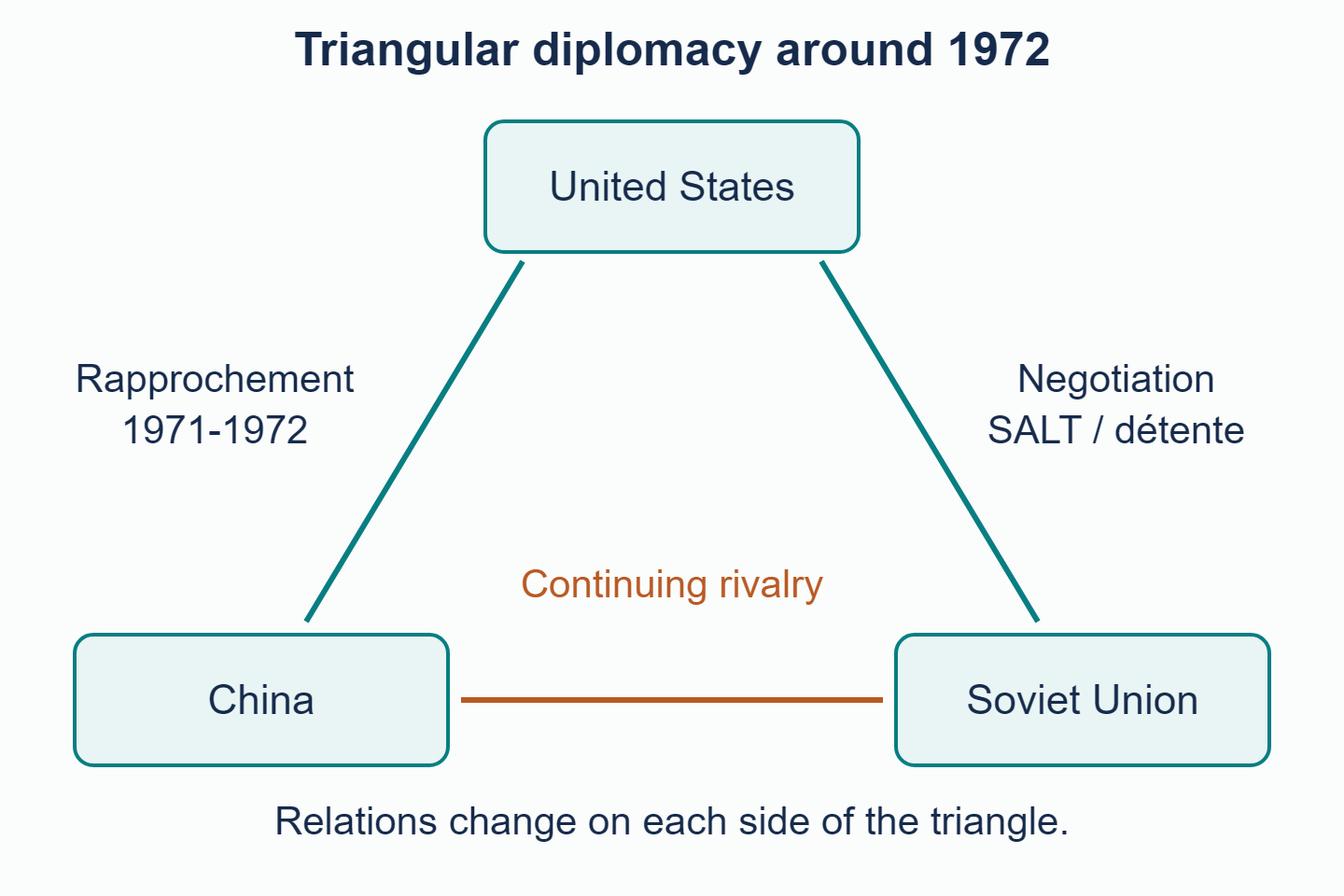
Closer ties with China gave the US more options when negotiating with the Soviet Union.
The visit affected US-Soviet relations in three connected ways:
It gave Washington more options. Soviet leaders now had to consider the possibility of closer US-China cooperation. If Moscow refused to compromise, Washington could seek closer ties with Beijing instead. That possibility gave the US diplomatic leverage, or more bargaining power. It was not a formal US-China military alliance.
It made continued US-Soviet talks more valuable. Moscow had reasons to avoid appearing isolated while Nixon negotiated with Beijing. The Moscow summit in May 1972 showed that Soviet-American talks continued alongside the Chinese opening. The powers could remain rivals while also negotiating with each other.
It contributed to the setting for arms control, without starting it. Formal SALT negotiations had begun in November 1969, well before Nixon's visit. In May 1972 the US and USSR signed the Anti-Ballistic Missile Treaty and an Interim Agreement on strategic offensive arms. Nuclear costs, strategic calculations and years of bargaining also explain these agreements.
The Shanghai Communiqué shows the limits of the Chinese opening. It recorded continuing disagreements as well as areas for contact, and rejected attempts at regional hegemony, or domination. Treating it as a completed alliance against Moscow overstates what was agreed. Full US diplomatic recognition of the People's Republic came later, in 1979.
The strongest conclusion is that the visit strengthened a process already under way. It gave Washington more room to bargain and Moscow more reason to negotiate, but each state kept its own goals. To judge how much the opening changed a particular Soviet decision, compare the communiqué with records of Soviet discussions and negotiations. A later agreement is not, by itself, proof that the China visit caused it.
Try the Nixon-visit exercise in the Cold War diplomacy questions. Explain three effects on US-Soviet relations, checking how earlier Sino-Soviet rivalry and arms-control talks shaped each one.
Answered by Revision Village IB Expert
Explore More IB History Resources
Over 80% of IB students globally are experiencing the power of Revision Village