Question
Physics
How do you calculate impulse from a force-time graph for a bouncing ball?
Answer
Physics
Expert Answer
Impulse is the signed area under a force-time graph. For the net force on a ball, that area equals , including the sign change when the ball rebounds.
Choose rightwards, towards a wall, as positive. A ball arriving at and leaving at has changed velocity by , not by .
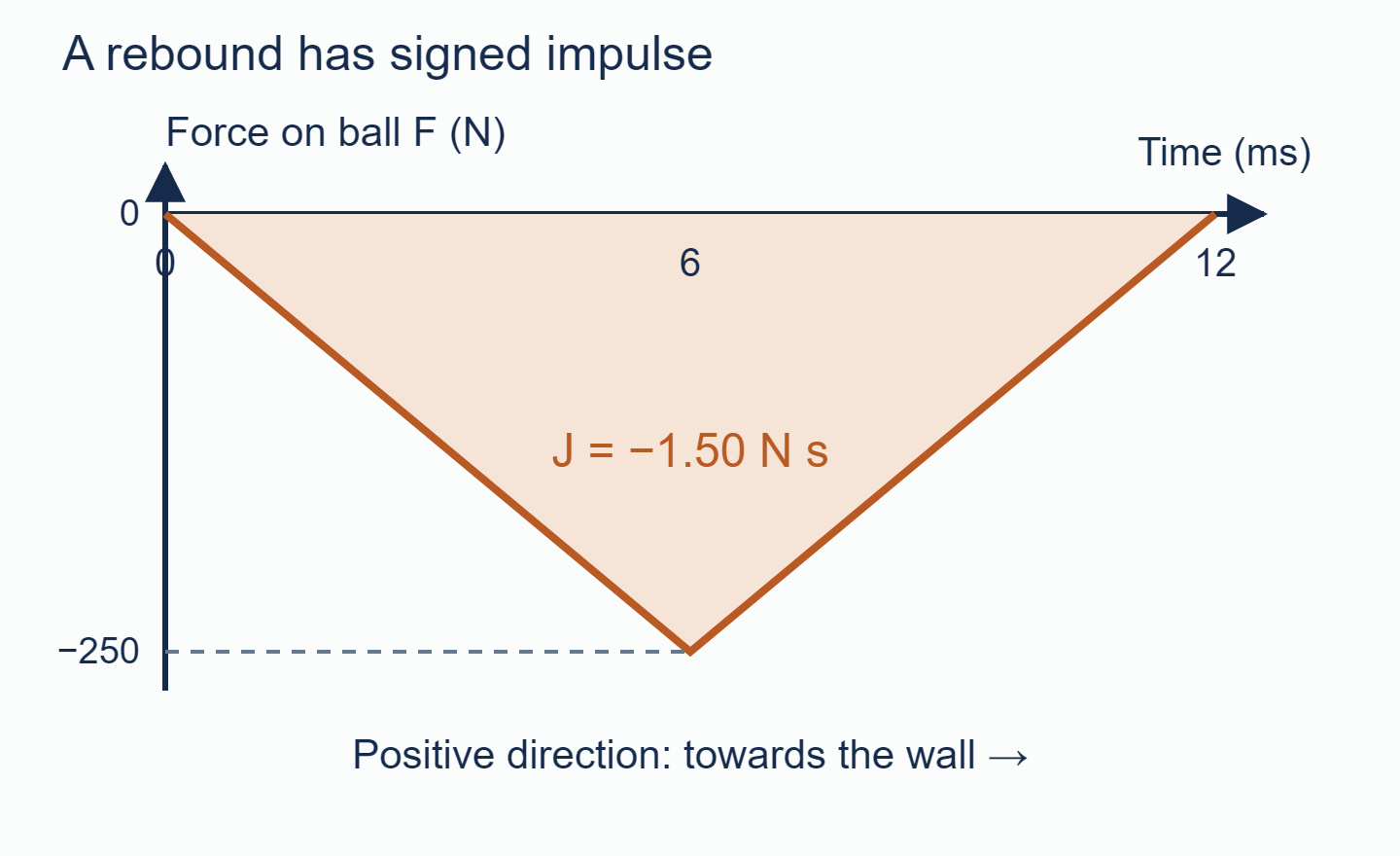
The triangular negative force pulse changes the ball’s velocity from +6 m/s to −4 m/s.
For a ball, the required impulse is
Suppose the collision lasts and the force pulse is triangular. Convert the duration to before finding the area:
Here is the size of the largest force, written as a positive value. Setting the triangular area equal to the impulse gives . The average force is only
The negative sign says the force points away from the wall. A graph labelled "force magnitude" would instead show a positive area of ; its direction must be supplied separately. The ball exerts an opposite force on the wall at every instant.
You can also use the graph to find the final velocity. Find the area first, then use . Multiplying force by total contact time works only if you use the average force, not simply the peak.
A rebound does not by itself prove the collision is elastic: an elastic collision also conserves kinetic energy. In this example,
The ball loses of kinetic energy, transferred to deformation, internal energy, sound and the surroundings. The ball's momentum changes because the wall acts on it. To apply momentum conservation, you need to include the objects exerting those forces and check that the net external impulse on the larger system is negligible.
For a horizontal wall impact, this calculation concerns the horizontal force component. In a vertical bounce, a graph of contact force alone is not a graph of net force: gravity's impulse must also be included.
Explore the ball-and-wall problem in the IB Physics space, time and motion questions (Question 89). Try finding the peak force from the graph, then compare what happens to momentum and kinetic energy when the wall is coated.
Answered by Revision Village IB Expert
Explore More IB Physics Resources
Over 80% of IB students globally are experiencing the power of Revision Village