Question
Physics
How do standing waves form in a pipe open at both ends?
Answer
Physics
Expert Answer
An open pipe supports standing sound waves when waves travelling in opposite directions repeatedly reinforce an allowed pattern. In the ideal open-open pipe, both ends are displacement antinodes and pressure-variation nodes.
The speaker sends a sound wave along the air column. Some sound reflects at each opening because it passes from air confined in the pipe to the surrounding air. This is similar to encountering a change in medium, which causes partial reflection. The incident (incoming) and reflected waves superpose: their displacements add together. Near a resonant frequency, where the pipe responds strongly, repeated reflections build a lasting pattern of nodes and antinodes.
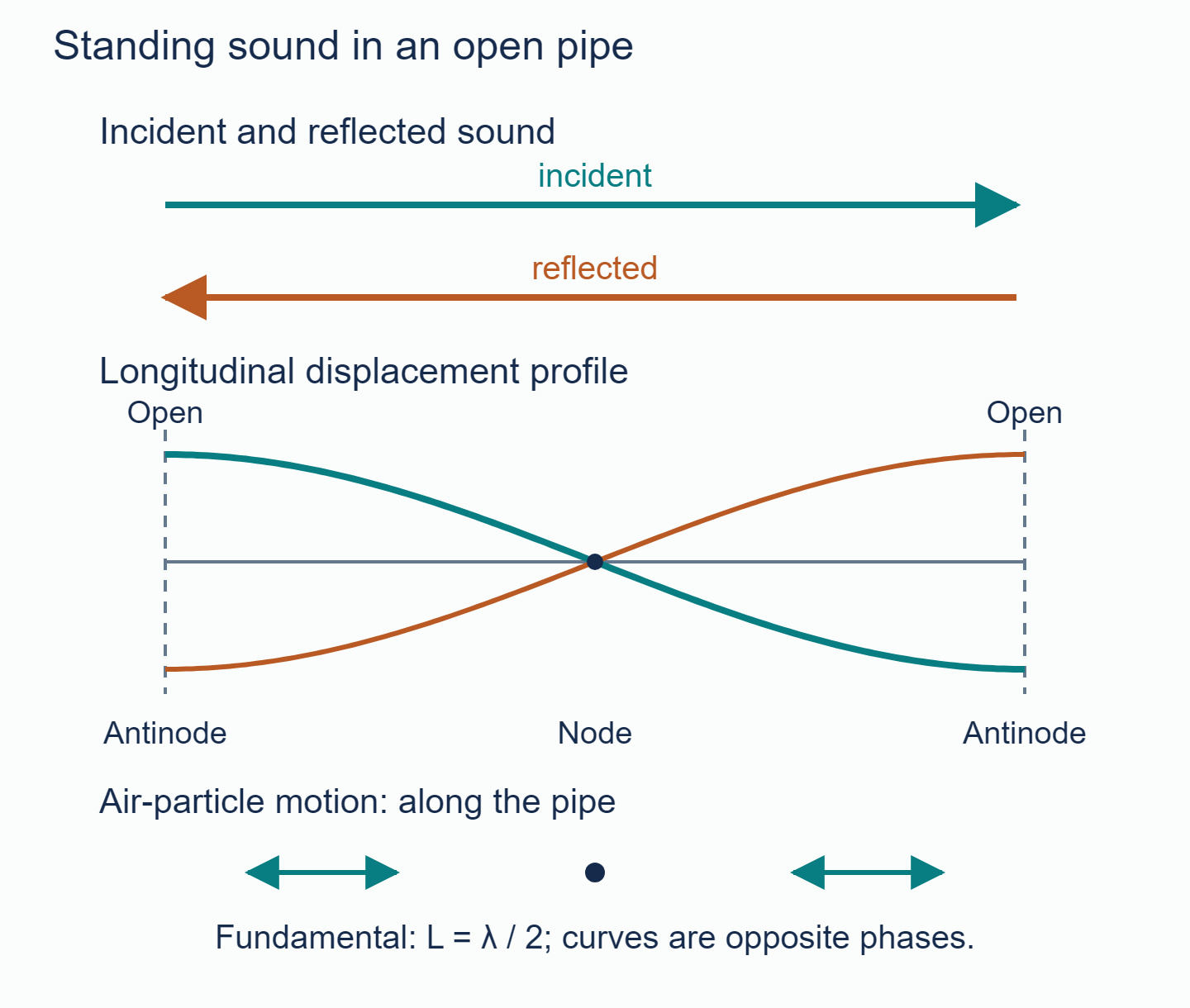
Open ends are displacement antinodes; the plotted curve is a displacement graph, not a transverse air path.
The graph represents air-particle displacement along the pipe, plotted against position. It is not a picture of air moving up and down. At a displacement antinode, particles oscillate back and forth with the largest amplitude; at a displacement node, their oscillation amplitude is zero in the ideal model. Particles on opposite sides of the central node move in opposite directions at the same instant.
For the fundamental, or first harmonic mode, a node lies halfway along the pipe (of length , for example). The pattern between the ends spans half a wavelength:
If a pipe is long, with sound speed , therefore has
An individual particle completes one oscillation in this period. It does not travel the wavelength during that time; it oscillates about its equilibrium position.
Higher-frequency modes fit more half-wavelengths into the pipe while keeping displacement antinodes at both ends:
Thus this model permits , , and so on. An open-open pipe is not restricted to odd harmonics.
When given a diagram, check whether it diagram shows displacement or pressure variation. At an open end, the displacement amplitude is largest, but the pressure varies very little because the air is exposed to atmospheric pressure. At the fundamental's central displacement node, the pressure varies the most. A displacement node is therefore a pressure antinode, and vice versa.
The calculation ignores end corrections: in a real pipe, the wave pattern extends slightly beyond the openings, making the effective acoustic length greater than the pipe's physical length. Use the effective length if the problem supplies it.
Try the open-tube question in IB Physics SL Mock Exam Set One, Paper Two (question 4). Use the particle's displacement-time graph to find its period, then connect that period to the tube's length.
Answered by Revision Village IB Expert
Explore More IB Physics Resources
Over 80% of IB students globally are experiencing the power of Revision Village