Question
Psychology
Why can music with lyrics interfere with studying?
Answer
Psychology
Expert Answer
Music with lyrics can interfere with studying because the song’s words can disrupt the processing of verbal information in working memory. According to the working memory model, remembering study material and processing lyrics can place competing demands on the phonological loop, while following the song can also draw attention away from studying.
How the phonological loop is involved
The phonological loop temporarily maintains verbal and sound-based information. It includes two components:
- The phonological store briefly holds sound-based information, such as spoken words.
- The articulatory rehearsal process keeps information available through repetition, such as silently repeating a phrase. It also allows written words to be converted into a sound-based form.
Imagine a student learning unfamiliar phrases in another language. They read each phrase and silently repeat it to remember its pronunciation and word order. This uses the phonological loop.
If music with lyrics is playing, the student also hears another sequence of words. These irrelevant speech sounds can disrupt their ability to maintain the study phrases, even when they try to ignore the song.
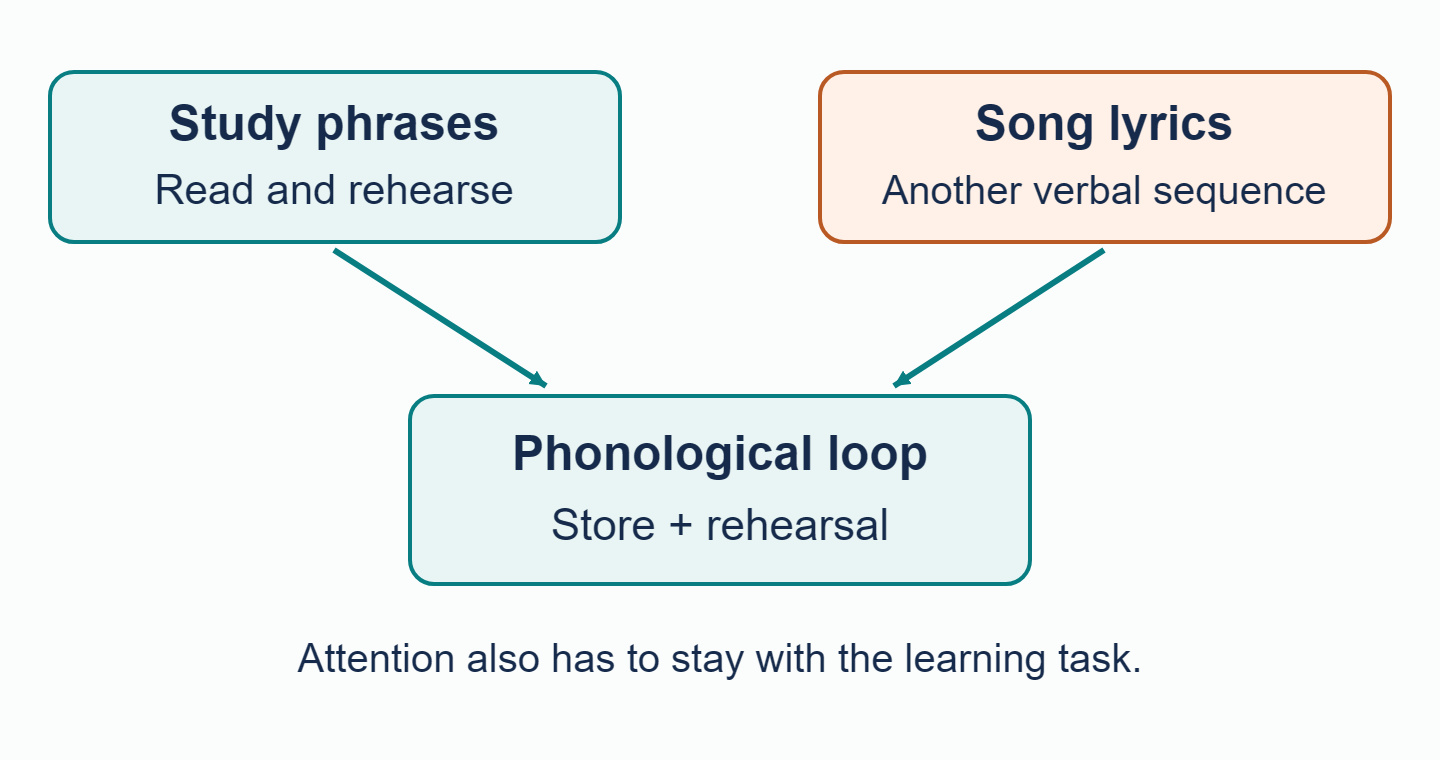
Study phrases and song lyrics both involve verbal information. Lyrics can disrupt the student’s ability to keep the phrases in working memory.
Why this can make learning harder
Working memory has limited capacity. If the student struggles to maintain a phrase long enough to practise and connect it with its meaning, learning becomes more difficult. They may lose track of the word order, need to reread the phrase or remember it less accurately.
The central executive, which directs attention and coordinates working-memory activities, is also involved. If the student follows the lyrics or sings along, attention is drawn away from the study task. The music can therefore interfere both with maintaining verbal information and with staying focused.
Does the type of task matter?
The working memory model proposes different components for different types of information. Lyrics may be particularly disruptive when studying involves verbal processing, such as rehearsing vocabulary or remembering a sequence of words.
A task involving shapes or positions relies more heavily on the visuospatial sketchpad, which temporarily holds visual and spatial information. Lyrics may create less direct competition with this component, although the music can still distract attention.
Would instrumental music be better?
Removing lyrics removes one potential source of verbal interference, so instrumental music may be less disruptive during a verbal learning task. However, it is not guaranteed to be distraction-free. Instrumental music can still attract attention, and its effects depend on the task and the listener.
The key point is that music with lyrics can compete with the verbal processing and attention needed for studying. Enjoying the music or feeling more relaxed does not necessarily mean that the material is being learned more effectively.
Explore Caitlin’s music-and-study scenario in the Psychology cognitive-approach questions.
Answered by Revision Village IB Expert
Explore More IB Psychology Resources
Over 80% of IB students globally are experiencing the power of Revision Village