Question
Psychology
How do psychologists evaluate evidence for reconstructive memory?
Answer
Psychology
Expert Answer
Psychologists evaluate reconstructive memory by asking whether a study distinguishes changes in remembered information from changes in how people answer. A result can establish that reports are influenced without proving that an original memory has been erased or rewritten.
Identify the prediction and the actual test
Loftus and Palmer (1974) investigated whether collision wording changed reports after accident films. Their first experiment used 45 students and five verbs; mean speed estimates were higher for "smashed" than "hit". This result alone allowed a response-bias explanation: uncertain participants might choose a larger estimate without remembering a different event.
A separate second experiment used 150 students, with 50 in each of three conditions: "smashed", "hit", or no speed question. One week later, participants answered a question about broken glass, although none had appeared in the film.
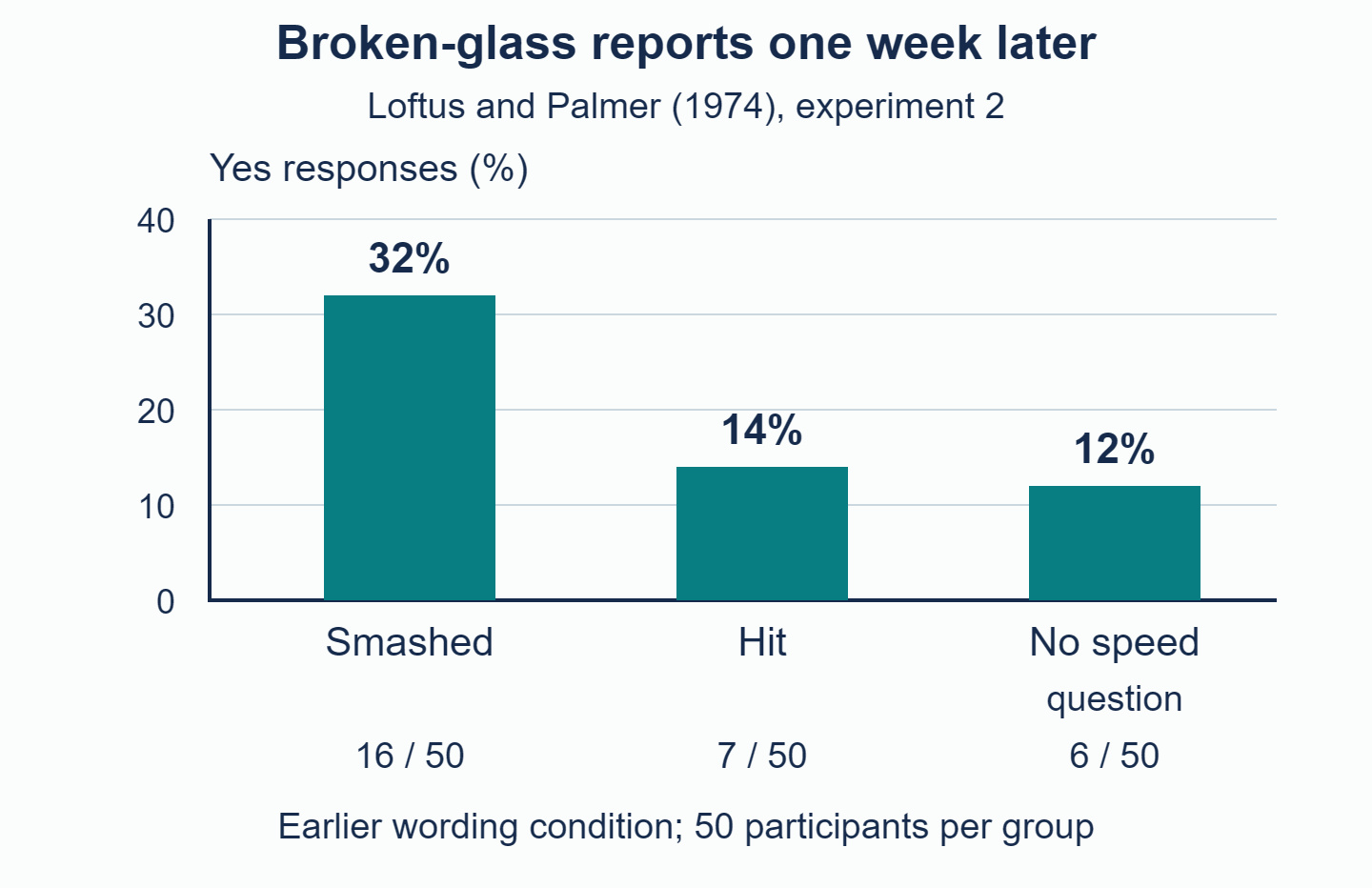
What participants reported differed with the earlier wording; their reports do not directly show what was stored in memory.
The counts were 16, 7 and 6 respectively. The later question provides evidence beyond an immediate numerical estimate, but still measures a report. Comparing wording under controlled conditions strengthens the case that the procedure affected what participants reported; it does not establish whether, or how, the stored memory itself changed.
Compare a competing test
McCloskey and Zaragoza (1985) examined whether misleading information given after an event necessarily damaged memory for that event. Their modified recognition procedure asked participants to choose between the original item and a new alternative, leaving the misleading item out of the answer choices. In the classic tool example, the original hammer was tested against a wrench rather than the suggested screwdriver.
If misinformation had made the original item unavailable in memory, performance should suffer even when the suggested item was absent from the test. Their series of six experiments did not find the drop in performance predicted by that explanation. This challenged the conclusion that choosing the misleading item on a standard test must mean the original memory had been lost.
However, success on a modified recognition test does not establish that every aspect of recollection is unchanged. Someone may recognise the correct answer from choices but struggle with free recall, where they must remember without those choices. A relatively easy choice might also miss smaller changes in memory. The comparison therefore helps distinguish explanations without settling all questions about reconstruction.
Evaluate what follows
When you evaluate a study, explain how each limitation affects what you can conclude. Accident films allow controlled comparison, but witnessing an actual collision involves different emotions and real consequences. Student samples and particular test questions also limit how far the findings apply to other people or situations; they do not make the findings meaningless.
Look for agreement across recall, recognition and source-memory tasks, and across settings. Source-memory tasks ask participants not only what detail they remember, but where they encountered it. The evidence supports the conclusion that later information can influence memory reports. Establishing how much the stored information has changed requires more than a single result from a suggestive question.
Bring these evaluation skills to the reconstructive-memory essay in the Psychology cognitive-approach questions. Choose a study and connect each strength or limitation to what its findings let you conclude about memory.
Answered by Revision Village IB Expert
Explore More IB Psychology Resources
Over 80% of IB students globally are experiencing the power of Revision Village