Choosing the Right IB English Course: A Guide to Literature vs. Language and Literature, SL vs. HL
A family guide to IB English course choice and future careers they can ladder up to
Dave is one of the IB English Subject Leads at RV. Dave has taught English for 30+ years in six countries with 20 years at the IB DP level. He studied at UC Berkeley, holds a Master's in Education, and co-founded IB English Guys with Andrew Cohen.

A common question for students starting their IB journey is how to decide between the two English courses. In this guide below, we break down how each of the subjects differs, the way learners approach each subject differently and the career pathways they ladder up to.
Whether you’re a parent supporting your child through IB subject selection, or are a student who will be making the decision - possibly as the first in the family to pursue the IB, here's a breakdown to help you have more informed conversations particularly with your school’s English teacher too, about which path to take.
English Literature vs. English Language and Literature: What's Actually Different?
IB Literature
This is the flagship course and the original English course offered in the Diploma Program. It is the more classic literature course, and its focus is entirely on exploring the four literary forms: prose fiction, prose non-fiction, poetry, and drama. Students adopt a variety of approaches to literary criticism and explore the relationship between literature and the world. It's the English course that students and parents are typically most familiar with.
IB English Language and Literature
This is a relative newcomer to the IB English program. Students in this course focus on a wide range of literary and non-literary texts across a variety of media. Language and Literature students study a smaller number of literary forms than Literature students: three at HL and two at SL, drawn from literary forms such as novels, plays, poems, and song lyrics, alongside many non-literary text types, including advertisements, political cartoons, films, blog posts, and news articles. The course emphasizes connections between literary and non-literary texts.
Signs IB Literature might be the right fit
- Enjoys reading and shows passion for deeply engaging with literary texts
- Prefers the narrower focus on literary analysis of the four literary forms
- Wants to do a "deep dive" into the world of fiction and its layers of complexity
- Has some interest in a career in writing, publishing, or academia
Signs IB Language and Literature might be the right fit
- Possesses an interest in modern-day media and its evolving complexity
- Enjoys reading a wide range of both literary and non-literary texts
- Appreciates making connections between literature and a real-world text.
- Has some interest in a career in media, advertising, or technology
SL vs. HL: A Separate Decision
Choosing between SL and HL is another decision to make, one determined by the amount of time and energy you want to spend on this subject. The main differences lie in the amount of classroom hours required, the number of works studied, the rigor of Paper 1, and one additional assessment at HL: the Higher Level Essay.
English A HL (Language and Literature). The HL level requires students to study 6 literary works over the course of two years. In addition, students in HL submit a Higher Level Essay of 1,200–1,500 words on a literary work or non-literary body of work studied in class. The Paper 1 assessment is more rigorous, as HL students must analyze two unseen non-literary texts rather than one. Paper 2 is a comparative essay on two literary works and follows the same format at both levels.
English A SL (Language and Literature). The SL level requires that students cover 4 literary works over the course of two years. SL students complete three assessments for their IB grade: the Individual Oral, Paper 1, and Paper 2. Paper 1 at SL is an analysis of one unseen non-literary text. Paper 2 is a comparative essay on two literary works and follows the same format at both levels.
English A HL (Literature). The HL level for Literature requires that students study at least 10 works in total. In addition, students in HL submit a Higher Level Essay of 1,200–1,500 words on a literary work studied in class. The Paper 1 assessment is more rigorous, as HL students must analyze two unseen literary texts rather than one. Paper 2 is a comparative essay on two literary works and follows the same format at both levels.
English A SL (Literature). The SL level requires that students cover at least 7 literary works over the course of two years. SL students complete three assessments for their IB grade: the Individual Oral, Paper 1, and Paper 2. Paper 1 at SL is an analysis of one unseen literary text. Paper 2 is a comparative essay on two literary works and follows the same format at both levels.
Guidance for parents: Students should not choose Literature or Language and Literature based on which one seems "easier." Both courses offer equal rigor and opportunities for deep analysis. Historically, earning top marks in the Literature course was more demanding, though examiners are working to equalize grade boundaries between the two. Difficulty shouldn't drive this decision.
Learner Types: Matching the Course to the Student
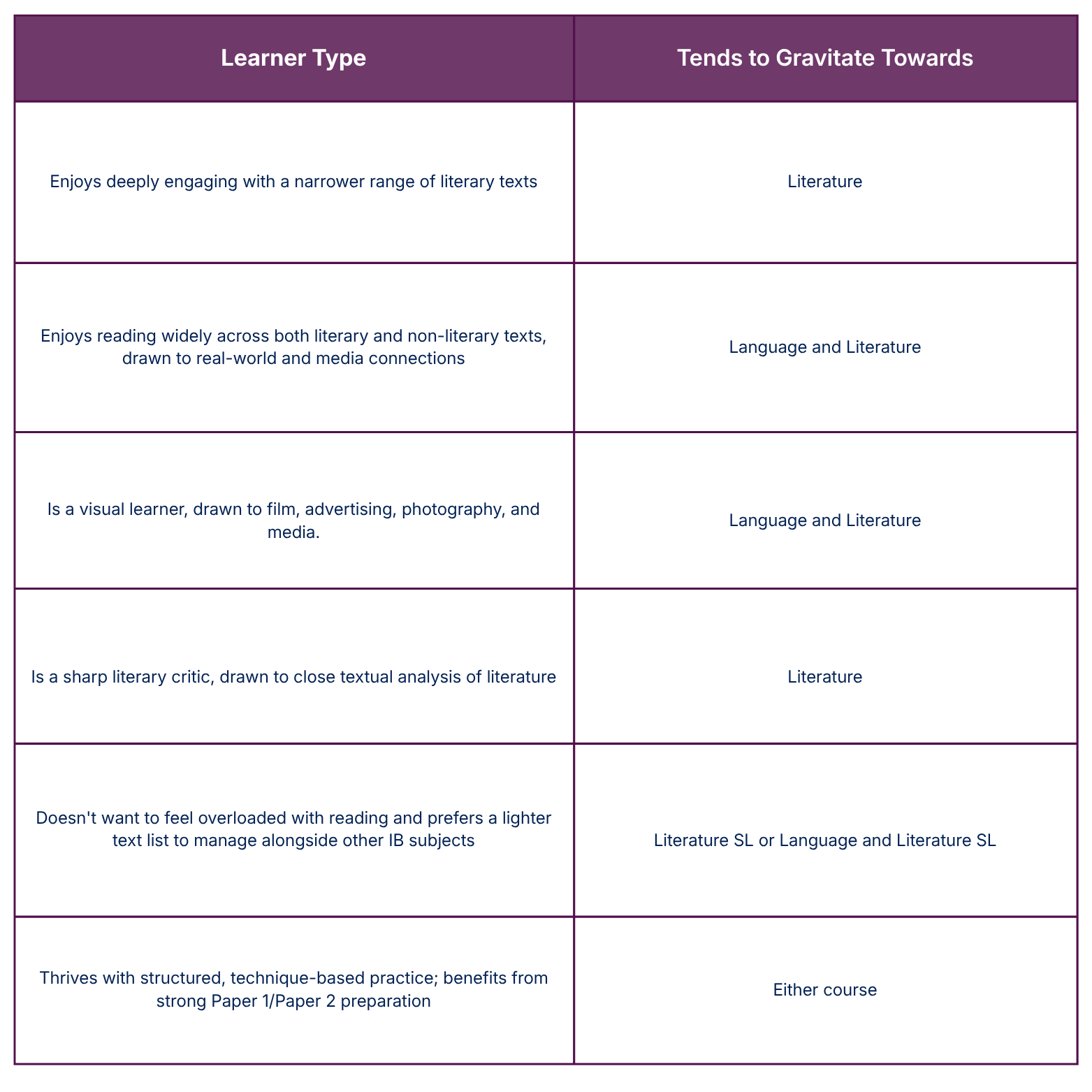
Based on patterns we see across thousands of IB students, a few broad learner profiles tend to map fairly consistently onto course choice:

Sumedha Achieved a 7 in English SL
Where These Subjects Ladder up to
While requirements vary by country, institution, and even individual degree program, this should be treated as general guidance to discuss with your high school maths teacher and school counselor rather than a guarantee. Here is a helpful starting point:
Literature HL
This is the course most commonly expected or strongly recommended for:
- Law (top-tier programs)
- English or Comparative Literature
- Humanities academia (Philosophy, Classics, History)
- Journalism and Creative Writing (competitive programs)
Literature SL
Generally sufficient for:
- Broader Humanities and Social Science degrees
- Law (less selective programs)
- Any pathway wanting strong English without heavy literary demands
Language and Literature HL
Increasingly well-regarded for:
- Media Studies, Communications, and Journalism
- Marketing, Advertising, and Digital Media
- Graphic Design and other Design programs
- Business with a communications or branding focus
Language and Literature SL
Suits students heading toward:
- Business and Management
- Design, Art, and Media-adjacent degrees
- Any pathway prioritizing a balanced IB profile
The most important piece of advice for parents to pass on to their child: Think about your interests, skills and passions and choose the course and level that will enable you to succeed and thrive.
The Bottom Line for Parents
The best subject choice is the one that lets your child do their most confident, engaged work and not necessarily the one that sounds most impressive on paper.
A student who is genuinely engaged with Language and Literature and earns a 6 has a stronger academic profile than one who is disengaged and anxious in Literature and earns a 4. At the same time, if a specific field, such as English Literature at university or a highly selective Law program, genuinely favors Literature, that conversation is worth having honestly and early, so your child can choose with full information rather than discover a preference too late.