Question
Psychology
How do you identify classical conditioning in an everyday example?
Answer
Psychology
Expert Answer
To identify it in an everyday example of classical conditioning, start with the stimulus that already produces a response, then identify the initially neutral cue that becomes associated with it.
Consider a hypothetical example: a person tries a sour sweet sold in an unfamiliar wrapper. The sour taste produces salivation. After several occasions when the wrapper’s distinctive rustle comes immediately before the taste, the rustle alone begins to make the person’s mouth water.
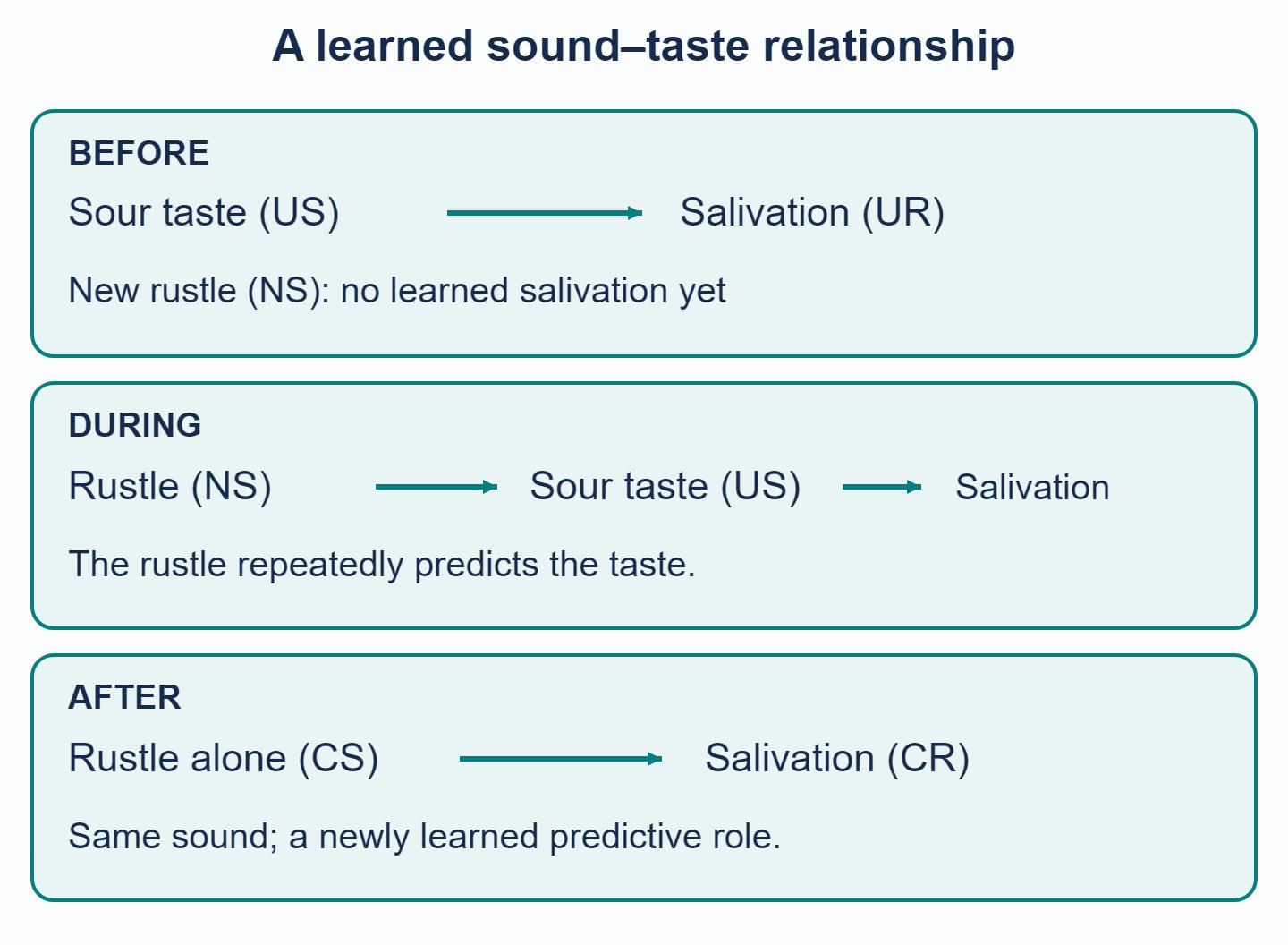
Classify the cue and response by their role at each stage of learning.
Label the five elements
| Element | In this example | Reason for the label |
|---|---|---|
| Unconditioned stimulus, US or UCS | Sour taste in the mouth | It naturally elicits salivation without learning the wrapper association. |
| Unconditioned response, UR or UCR | Salivation following that taste | Salivation occurs naturally in response to the sour taste, without learning the wrapper association. |
| Neutral stimulus, NS | The initially unfamiliar rustle | At first, it does not elicit salivation, although it could attract attention. |
| Conditioned stimulus, CS | The rustle after learning | After association with the sour taste, the rustle alone elicits salivation. |
| Conditioned response, CR | Salivation to the rustle alone | It is the learned response to the previously neutral sound. |
The neutral and conditioned stimulus are the same sound at different stages of learning. Salivation is labelled the unconditioned response when elicited by the sour taste and the conditioned response when elicited by the rustle alone. The two responses need not be identical in strength or timing.
Check the learning explanation
The useful test is the rustle without the sweet: does it now elicit salivation when it did not before? If salivation occurs only when the person tastes the sweet, this does not show that the rustle has become a conditioned stimulus.
The association matters: the rustle comes before the sour taste and predicts its arrival. Simply experiencing two unrelated events on the same day does not establish classical conditioning.
Repeatedly hearing the rustle without tasting the sweet may gradually weaken the conditioned response. This is called extinction, although the response may return after a period of time.
Distinguish classical conditioning from operant conditioning
Salivating to the wrapper is an elicited response to a predictive cue. Learning to press a dispenser button because pressing it produces a sweet concerns a behaviour and its consequence, making it an example of operant conditioning.
Both kinds of learning can occur in one situation, so identify the particular relationship the question asks about.
Follow Gerry’s notification-sound scenario in the Psychology application questions. Identify the unconditioned stimulus and response, then explain how the notification sound becomes a conditioned stimulus.
Answered by Revision Village IB Expert
Explore More IB Psychology Resources
Over 80% of IB students globally are experiencing the power of Revision Village