Question
Psychology
How does dual-process theory explain intuitive and deliberate decisions?
Answer
Psychology
Expert Answer
Dual-process theory explains intuitive decisions as relying on relatively automatic System 1 processing, while deliberate decisions involve more controlled and effortful System 2 processing. A decision can involve both: an initial impression may suggest an answer, then deliberate reasoning may check it, change it or find reasons to support it.
System 1 involves relatively fast, automatic and intuitive processing, often drawing on experience and mental shortcuts. System 2 involves more controlled, effortful and analytical processing, drawing heavily on attention and working memory.
System 1 and System 2 describe types of processing rather than separate physical structures in the brain.
Work through one decision
Imagine a student planning bus travel. A single journey costs 3 pounds and a day pass costs 18 pounds. Seeing “unlimited travel” produces an immediate impression that the pass is good value.
The student then checks the plan: four single journeys would cost pounds, so the day pass would cost 6 pounds more.
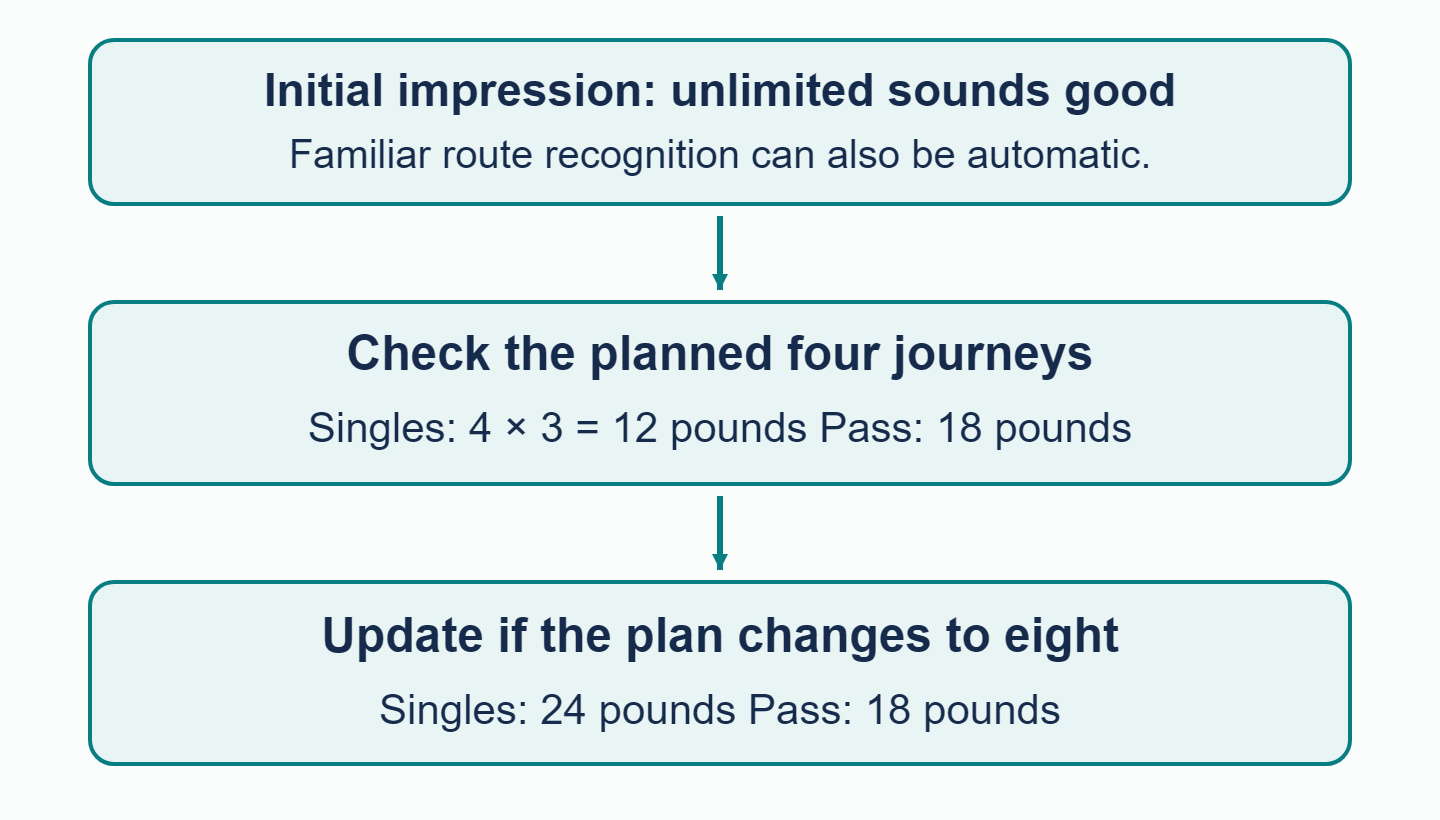
The immediate impression that “unlimited travel” offers good value illustrates System 1 processing because the student makes an intuitive judgement without carefully comparing the costs. Calculating that four single journeys cost 12 pounds, compared with 18 pounds for the pass, illustrates System 2 processing because it requires conscious attention and deliberate comparison.
How the two systems interact
System 1 can produce an initial judgement quickly and with little effort. System 2 may then check that judgement against the available information. In this example, the calculation leads the student to reconsider the initial impression and choose single tickets.
However, deliberate checking does not happen every time. If the student is distracted, rushed or sees no reason to question the initial impression, they may buy the pass without comparing the costs. Dual-process theory therefore helps explain how the same decision can be approached intuitively or through deliberate reasoning.
Does deliberate thinking always produce a better decision?
Intuitive decisions are not always wrong, and deliberate decisions are not always correct. An experienced traveller may immediately recognise which ticket offers better value. Someone calculating carefully could still make a mistake or use the wrong number of journeys.
The key distinction concerns how the decision is made, rather than whether the answer is correct. System 1 draws on automatic impressions and familiar patterns, while System 2 allows a person to consciously compare options and reconsider an initial response.
Consider different intuitive and deliberate decisions in the Psychology cognitive-approach questions.
Answered by Revision Village IB Expert
Explore More IB Psychology Resources
Over 80% of IB students globally are experiencing the power of Revision Village