Question
Psychology
How can schema theory explain different interpretations of the same event?
Answer
Psychology
Expert Answer
Schema theory explains different interpretations of the same event by suggesting that people use different schemas, or organised patterns of prior knowledge, to make sense of what they observe. Schemas develop through experience and shape expectations, so the same action can have different meanings to different people.
Consider a customer who enters a cafe, speaks briefly to a server, then sits at a table. Neither observer hears the conversation.
One observer usually visits counter-service cafes. Their counter-service script, an expectation that customers order before finding a seat, leads them to interpret the conversation as an order. Another observer is more familiar with table-service cafes. Their table-service script, an expectation that customers get a table before ordering, leads them to interpret the conversation as a request for a table.
A script is a type of schema that represents the expected sequence of events in a familiar situation. Both observers see the same action, but their different scripts suggest different meanings.
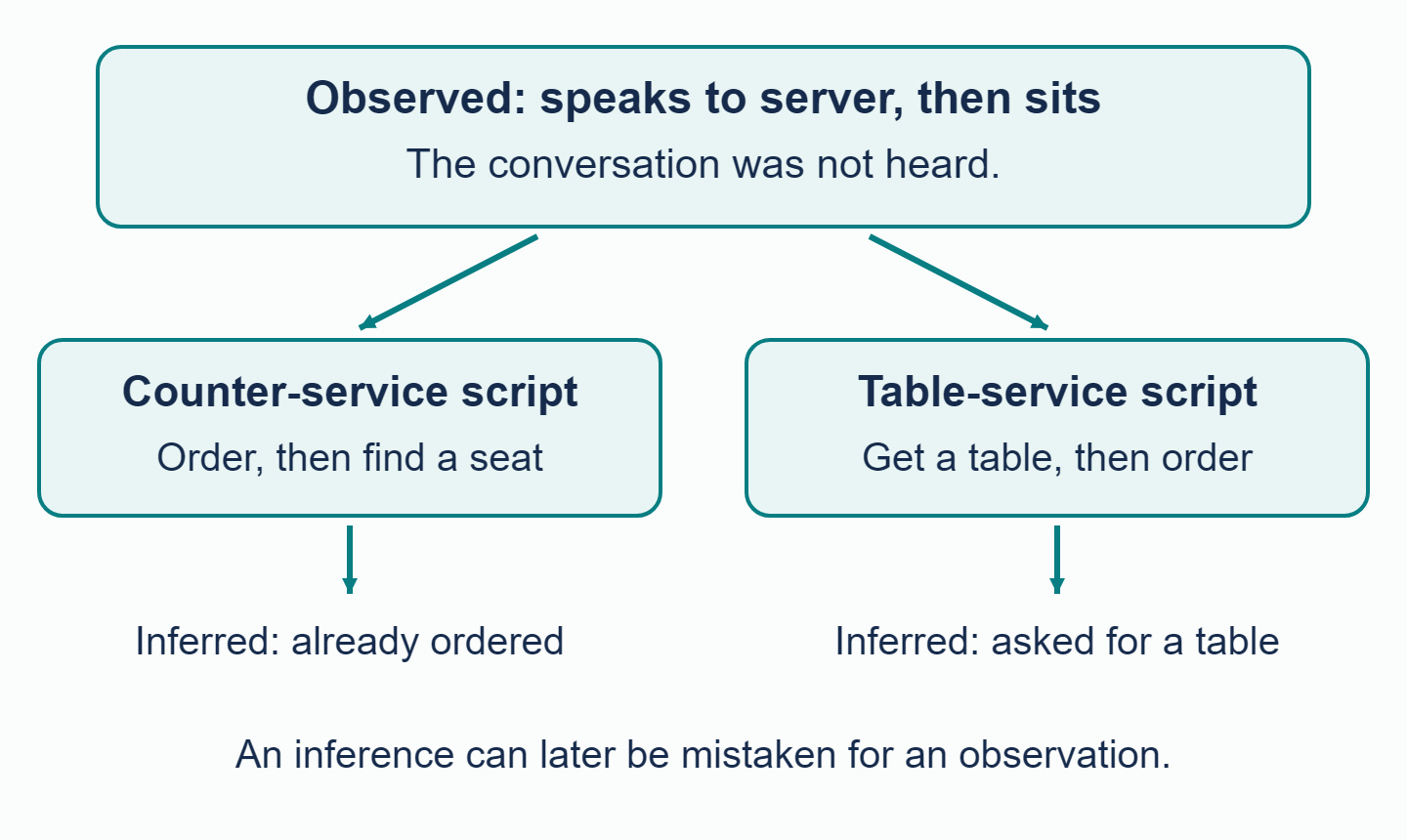
Different expectations about cafe service can lead to different interpretations of the same action.
How schemas shape understanding
Guiding attention: Schemas can influence which details people notice. The observer with a counter-service script may look for payment or a collection number, while the observer with a table-service script may look for a menu being brought to the table. Their expectations can direct attention towards different aspects of the same event.
Filling gaps: Because neither observer hears the conversation, the information is incomplete. Each uses their existing schema to infer what probably happened. The counter-service script suggests that an order was placed; the table-service script suggests that a table was requested. These interpretations draw on prior knowledge rather than the observed action alone.
Shaping later recall: Schemas can also influence how the event is remembered. An observer might later remember the customer placing an order, even though they only saw a conversation. In this case, an inference has been mistaken for an observation. Different accounts can therefore arise without either person deliberately being dishonest.
Different interpretations are not necessarily errors
Neither observer’s initial interpretation is necessarily wrong. Both offer plausible explanations of a conversation they did not hear. A memory error would occur if an observer later remembered hearing something that they had only inferred.
Schemas help people understand events quickly without analysing every detail from scratch. However, they can also lead people to rely on expectations that do not fit the particular situation. Schema theory therefore explains different interpretations by showing how the same information can be understood through different organised patterns of prior knowledge.
Take schema theory into a new setting with the work-experience scenario in the Psychology application questions. How might students already have expectations about a workplace before their placement begins?
Answered by Revision Village IB Expert
Explore More IB Psychology Resources
Over 80% of IB students globally are experiencing the power of Revision Village