How to Choose the Right IB Math Course
A parent and student’s guide to AA vs. AI and SL vs. HL
If you're facing IB Mathematics subject selection, it is very often the decision that causes the most anxiety in the household. In this guide below, we break down how each mathematics subject differs, the way learners approach each subject differently and the career pathways they ladder up to.
-Clem is on of the IB Math Subject Leads at RV. Clem has 18 years of experience spanning IB Mathematics teaching & IB examining with a BSc in Mathematics and an MEd.

Whether you’re a parent supporting your child through IB subject selection, or are a student who will be making the decision - possibly as the first in the family to pursue the IB, Mathematics is very often the decision that causes the most anxiety in the household. Unlike most other subject groups, Maths in the IB comprises of two distinct courses (Analysis and Approaches, and Applications and Interpretation) and two levels within each (Standard Level and Higher Level). Getting this decision right matters because it shapes not just the next two years of a student’s school life but potentially their university applications and long-term study options too.
Here's a breakdown to help you have a more informed conversations particularly with your school’s maths teacher too, about which path fits best.
AA vs. AI: What's Actually Different?
Mathematics: Analysis and Approaches (AA)
This subject is the more traditional, abstract, proof-driven course. It leans heavily on algebraic manipulation, calculus, and formal mathematical reasoning. Students are expected to derive results, work through multi-step algebraic problems, and engage with mathematics in a more theoretical way - closer to what many parents will remember from their own school days.

Mathematics: Applications and Interpretation (AI)
This course is built around using mathematics as a tool to model, interpret, and solve real-world problems. It leans more on statistics, technology, and applied contexts - using a calculator or software throughout to explore data, financial models, and real scenarios rather than deriving formulas from first principles.
The level of difficulty can depend on the type of mathematical thinking your child finds most natural. Generally speaking, if a student’s interests, strengths and future pathways lie in non-mathematical fields, this is the course for them.
Signs Math AA might be the right fit
- Enjoys solving abstract problems and is comfortable with heavier algebra
- Wants to keep the door open to engineering, physics, computer science, or economics at a quantitative university level
- Finds satisfaction in "why does this work" rather than just "how do I apply this"
- Is generally strong and confident in math already, and enjoys the challenge of proof-style reasoning
Signs Math AI might be the right fit
- Prefers seeing math applied to real, tangible contexts - business cases, data sets, financial or scientific modelling
- Is comfortable and confident using a calculator/technology as a genuine problem-solving tool, not a crutch
- Wants a course that supports university paths in business, social sciences, design, environmental studies, or applied sciences without needing the heaviest calculus load
- Finds pure abstraction less motivating than seeing an immediate, concrete application
Math SL vs. Math HL: A Separate Decision From AA/AI
It's worth being clear with your child that the AA-vs-AI decision and the SL-vs-HL decision are two separate questions, even though they get made at the same time.
Maths SL covers a narrower range of content in less depth, with less demanding assessment. It's a great option for students who need strong, solid maths but whose long-term academic direction doesn't require it as a specialist subject.
Maths HL covers everything in SL plus significant additional depth and content (in AA, this includes topics like more advanced calculus and complex numbers; in AI, deeper statistics and modelling). HL requires roughly 240 teaching hours versus 150 for SL, and it's genuinely a bigger academic commitment - not just "the same course but harder questions."
Guidance for parents: Math HL should be chosen because a university course or career genuinely requires it, or because your child finds real satisfaction and confidence in mathematics, rather than from a "just in case” standpoint. Equally important is to not avoid a subject such as Mathematics AA out of fear, when in fact it is a pre-requisite to a university course.
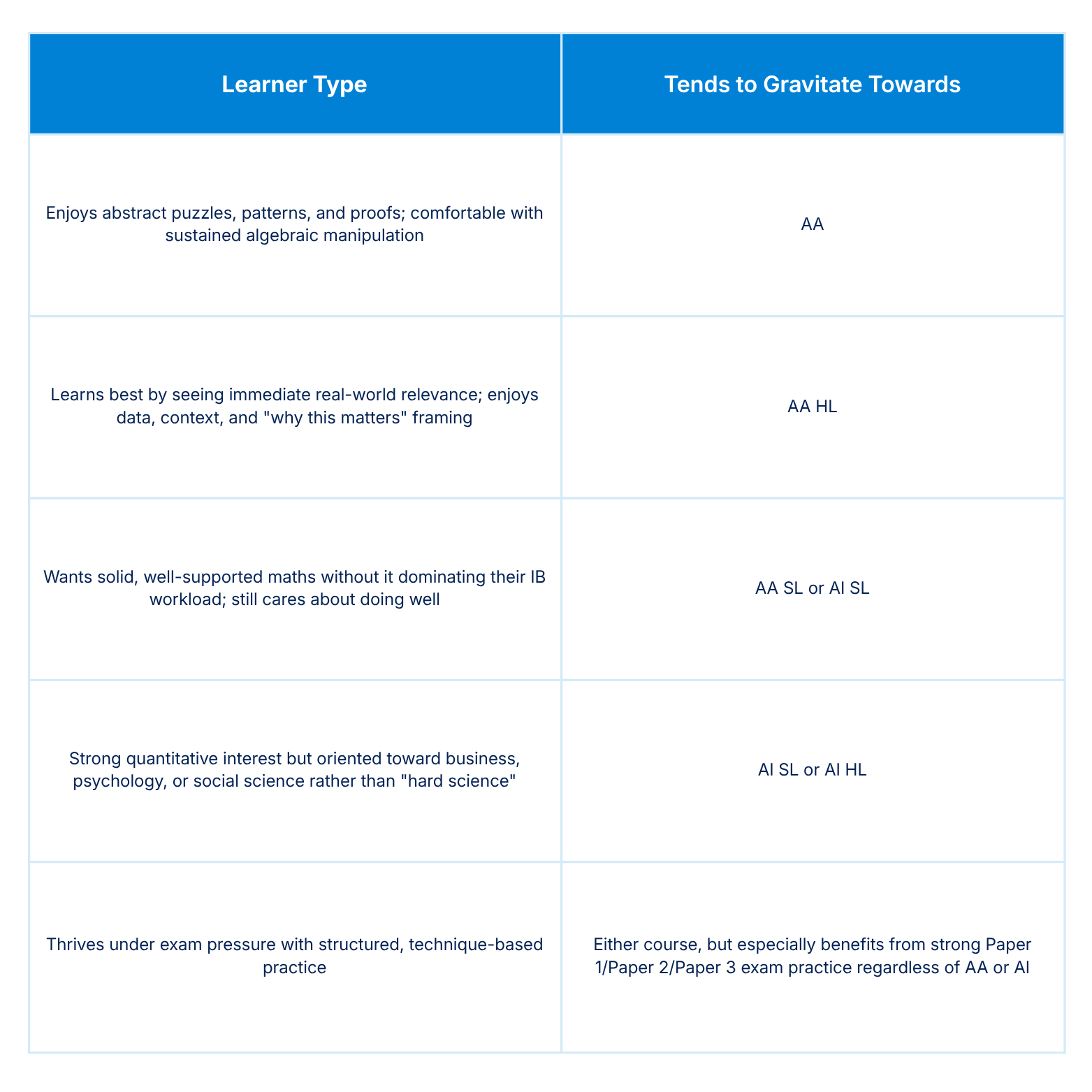
Learner Types: Matching the Course to the Student
Based on patterns we see across thousands of IB students, a few broad learner profiles tend to map fairly consistently onto course choice:

Sumedha Achieved a 7 in Math AA HL
Where These Subjects Ladder up to
While requirements vary by country, institution, and even individual degree program, this should be treated as general guidance to discuss with your high school maths teacher and school counselor rather than a guarantee. Here is a helpful starting point:
Analysis and Approaches HL
This is the course most commonly expected or strongly recommended for:
- Engineering (all disciplines)
- Physics, Mathematics, and most "hard science" degrees
- Computer Science at more selective/technical universities
- Highly quantitative Economics programs at top-tier universities
Analysis and Approaches SL
Generally sufficient for:
- Many Economics, Business, and Life Sciences degrees
- Architecture (requirements vary significantly by institution)
- Broad STEM-adjacent programs that want to see solid quantitative competence without demanding the deepest calculus content
Applications and Interpretation HL
Increasingly well-regarded for:
- Data Science, Statistics-heavy programs, and some Computer Science tracks (particularly at universities that value applied/computational skills)
- Business Analytics and quantitative Business/Finance degrees
- Social Sciences with a strong research-methods/statistics component (Psychology, Sociology)
- Environmental Science and other applied science fields
Applications and Interpretation SL
Suits students heading toward:
- Humanities, Arts, and Design degrees where maths is a supporting subject rather than a core subject
- Business and Management programs without heavy quantitative modelling requirements
- Any pathway where the priority is maintaining a strong overall IB profile without maths becoming disproportionately time-consuming
The most important piece of advice for parents to pass on to their child: if applying to a specific competitive program such as engineering, medicine or economics, it is worth checking the university's published entry requirements - ideally in the first year of the IB. Mathematics requirements can be specific about AA vs. AI and SL vs. HL, and they can also change from year to year.
The Bottom Line for Parents
The best subject choice is the one that lets your child do their most confident, engaged work - not necessarily the one that sounds most impressive on paper.
A student who is genuinely engaged with AI SL and earns a 6 has a stronger academic profile than one who is disengaged and anxious in AA HL and earns a 3. At the same time, if a specific university pathway genuinely requires AA HL, that's a conversation worth having, honestly and as early as grade 9 before the requirement is discovered too late.This is so your child can build the right foundation such as extended Maths in grade 10 with a support system in place.