Mathematics IA Resources
The Revision Village Mathematics IA Resources Are Here
The Revision Village Mathematics IA Resources are here to walk you through the full IA journey. Developed by our team of experienced IB Examiners, this structured framework supports you from brainstorming your initial idea all the way to running the statistical tests and building the model that will underpin your exploration.
Whether you are unsure how to choose a topic, confused about the assessment criteria, or ready to start crunching real data, this resource is built to help you move forward with clarity and confidence.


What is Currently Available?
Three modules are now live, taking you from your first idea through to a complete set of statistical tools for your exploration.
1. Getting Started
The Getting Started module helps you get started on your IA the right way. It includes instructional videos, flashcards, written guides, structured workshops, checklists, and practical examples, all organized into four key sections:
- A clear overview of the Mathematics IA and assessment expectations.
- Structured workshops and guided examples to help students generate and refine strong IA ideas.
- A detailed breakdown of the official assessment criteria.
- A comprehensive IA Support Hub providing up-to-date guidance on navigating academic honesty, responsible AI usage, and the effective use of mathematical software.
2. Exemplars and Samples
The Exemplars and Samples module lets you explore a range of sample explorations and apply the official assessment criteria yourself, to see exactly what separates strong work from weaker work across each criterion.
How This Helps You
Instead of guessing what examiners want, you will:
- Learn how to select an idea that is both interesting and realistic.
- Understand how marks are awarded, and see that understanding applied to real sample explorations.
- Learn how to avoid common IA mistakes.
- Understand precisely how higher criterion scores are awarded, and what you need to do to reach them.
- Review weaker IAs and work out how you would improve them.
- See a range of IAs specific to your course, giving you a feel for how to lay one out, how long it should be, and how sophisticated it needs to be, and more.
3. Statistical Methods
This module takes you from finding a dataset to testing hypotheses and building statistical models. The module is organized into five sections, each built around worked examples in Google Sheets using real datasets, from Titanic passenger data to differences between penguin species.
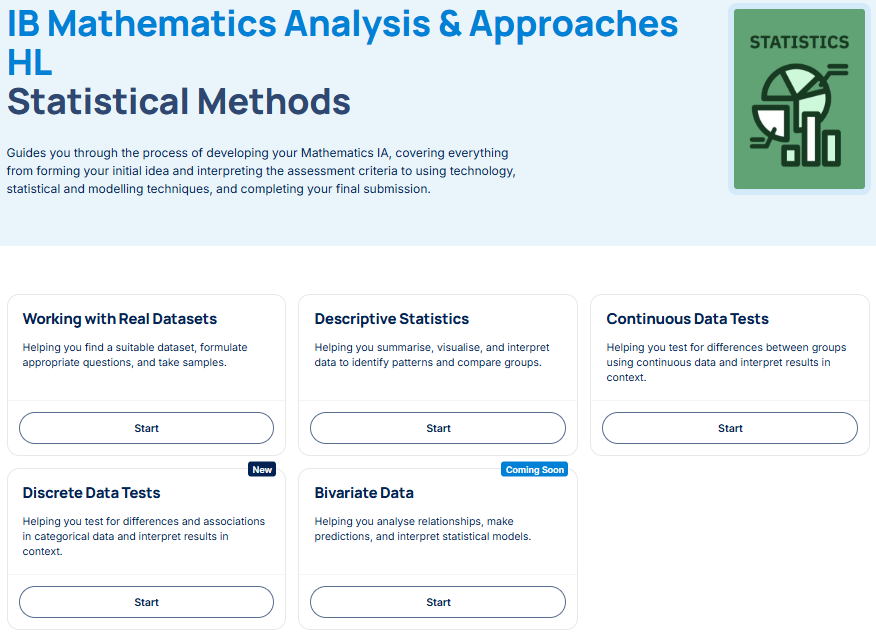
- Working with Real Datasets: Learn how to find and evaluate secondary datasets, develop suitable statistical questions with support from the Newton AI Chatbot, and select a representative sample using simple random, systematic, and stratified sampling.
- Descriptive Statistics: Learn how to summarize, visualize, and compare data using frequency tables, summary statistics, percentiles, box plots, stacked bar charts, and error bars. You will practice these skills using real datasets before applying them to your own IA data.
- Continuous Data Tests: Explore how to determine whether differences between groups are statistically significant. This section covers choosing an appropriate test; two-sample and matched-pairs t-tests; one-way ANOVA; checking assumptions; Type I and Type II errors; and transformations for skewed data.
- Discrete Data Tests: Learn how to test claims involving categorical and count data. You will cover chi-squared goodness-of-fit and independence tests, tests for proportions, choosing an appropriate test, and checking assumptions. The section ends with a workshop where you apply these methods to data collected at a restaurant.
- Bivariate Data (Coming Soon): Explore relationships between two variables using scatterplots and correlation, regression models, Spearman’s rank correlation, and significance testing. You will also look at how to check a regression model and use its predictions appropriately.
Each section pairs worked examples with a workshop, so you can build the skill and then apply it directly to your own exploration.
Coming Soon
The Mathematics IA Resources will continue to expand, with two further modules on the way:
- Modelling Methods: Step-by-step guidance on building, refining, and evaluating mathematical models using technology and creative approaches.
- The Express IA: How to complete an entire IA in under 4 hours.