Question
Mathematics
How do you sketch the absolute value of an even function?
Answer
Mathematics
Expert Answer
First complete the graph using the even-function symmetry . Then keep every section above the horizontal axis and reflect each negative section upwards. Taking changes the output, not the input.
Separate the two reflections
For an even function, a point has a partner . Absolute value instead sends to . For example, first has the even partner ; on the absolute-value graph these become and .
Do not reflect positive sections downwards or move points horizontally when taking the absolute value. Zeros stay in the same places.
Work through an example
Let on . It is even because . Its zeros are and , and the curve is negative between them. Therefore
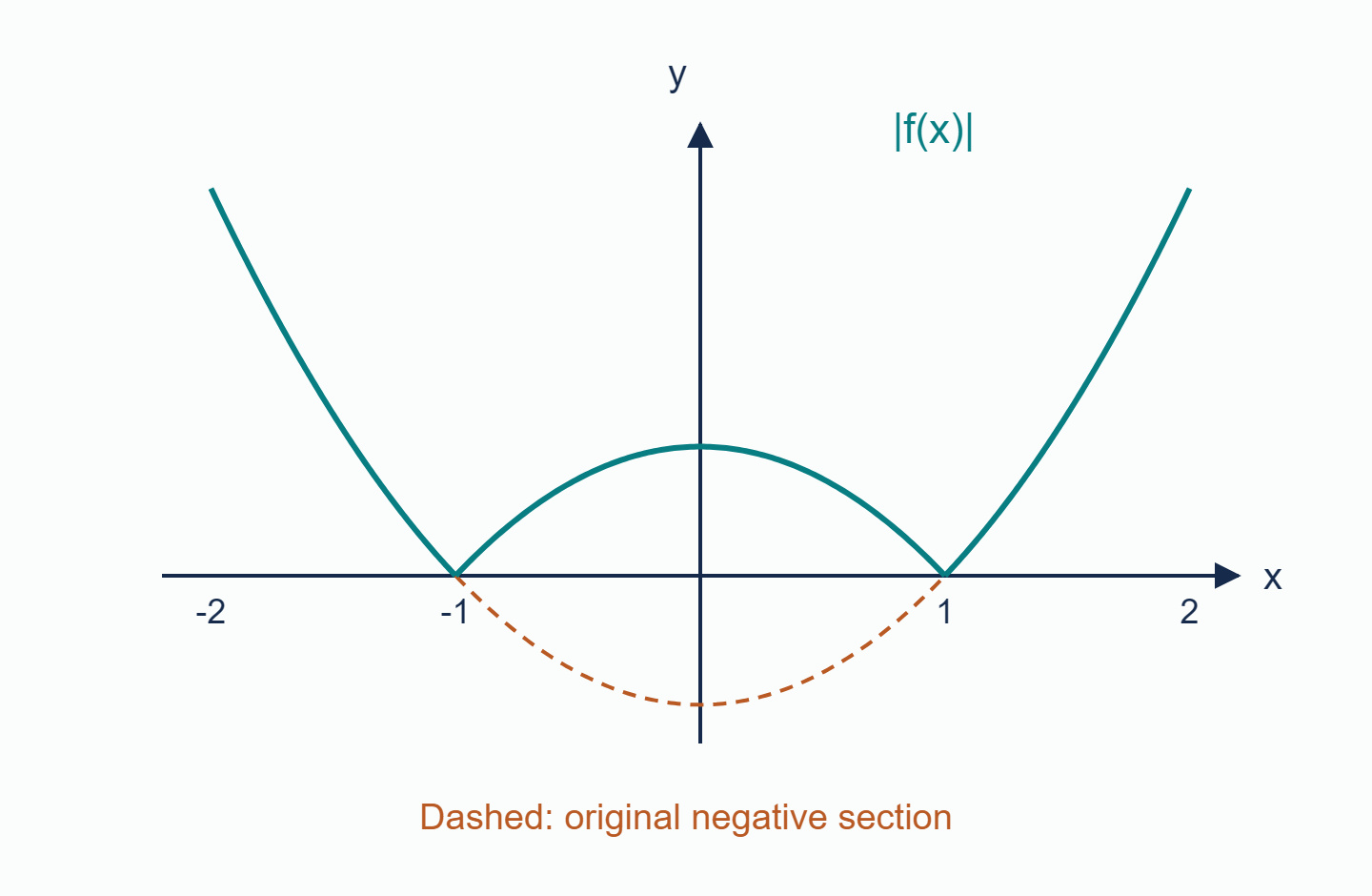
Only the section below the axis is reflected; the graph keeps its left-right symmetry.
The reflected centre is a downward-facing arc. The joins at are corners, not smooth turning points. A graphing calculator should reproduce those features.
Area is not the same as a signed integral
For the original function,
The central region is below the axis, so it subtracts from the signed integral. To find its total area with the axis, integrate the absolute value and split at the sign change.
Even symmetry lets us double the right-hand half, but it does not make a negative region positive automatically. The sign change must still be dealt with. Also, is not generally the same transformation as : the second changes inputs; for an already even function it leaves the graph unchanged.
Put the two reflections together in the even-function question in AA HL Mock Exam, Set 1, Paper 1. Use the sketch to explain why the signed integral and the total area are different, rather than treating both as the same calculation.
Answered by Revision Village IB Expert
Explore More IB Mathematics Resources
Over 80% of IB students globally are experiencing the power of Revision Village