Question
Mathematics
How do you find the area enclosed between sine and cosine graphs?
Answer
Mathematics
Expert Answer
Find where the curves meet, use a test point or graph on your G.D.C. to see which one is on top, then integrate top minus bottom between the intersections. If the curves swap order inside the interval, split the integral at the intersection point.
Find the intersections
Take and , with in radians. The curves meet when
Dividing by loses no solutions here. Wherever , , so the two can't be equal there.
Since the graphs repeat every , they enclose infinitely many regions of the same size. A question will pick one out with an interval or a diagram. Here, take the region between the consecutive intersections and .
Decide which curve is on top
Pick a test point between the intersections. At , and , so sine is higher. There are no other intersections between and , so sine stays above cosine across the whole region.
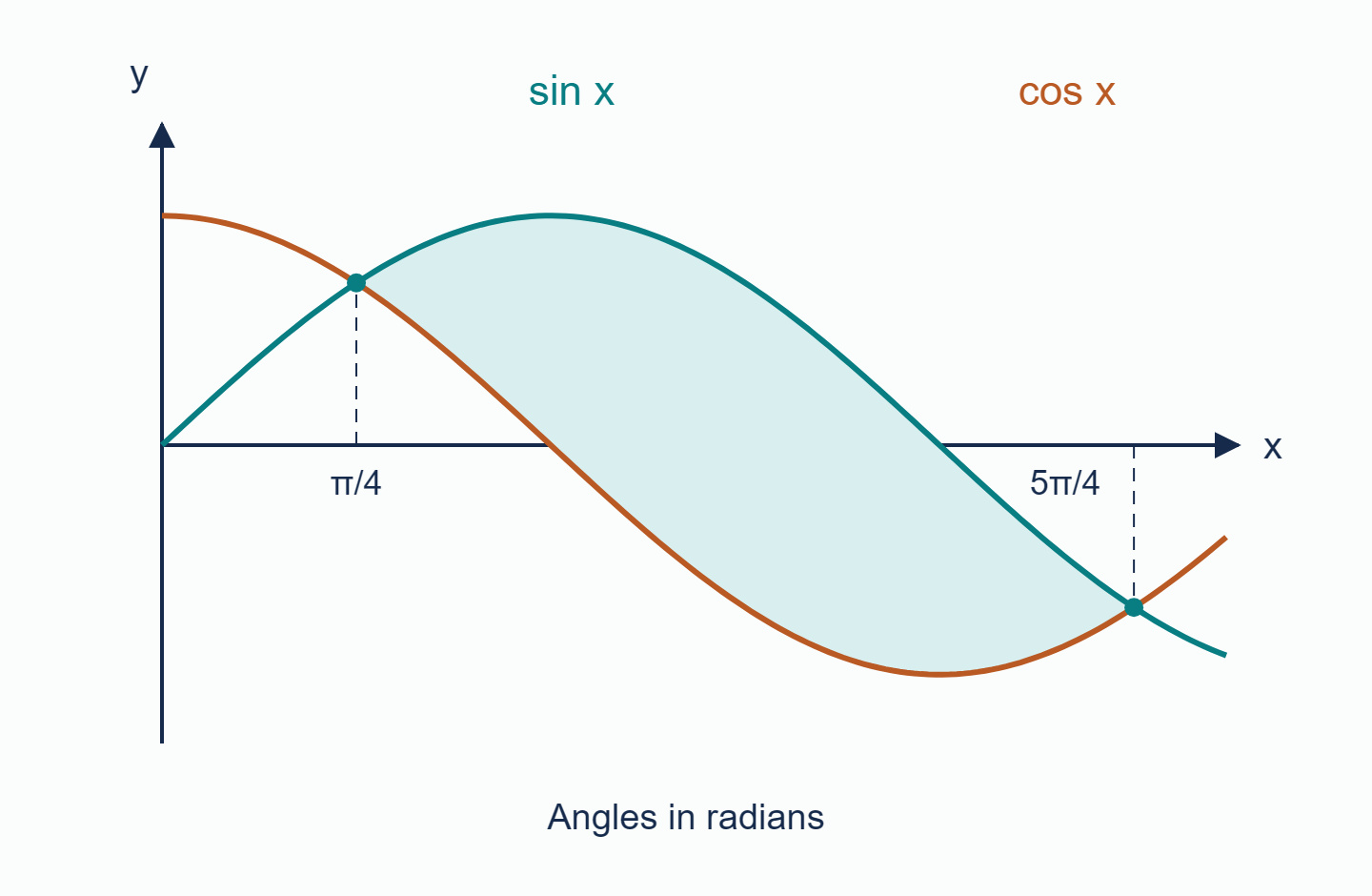
Sine lies above cosine across the shaded region, even where both values are negative.
So the area is
Each thin vertical strip has height and width , and the integral adds the strips together.
Evaluate and check
An antiderivative of is , so
That is units² (3 s.f.). Differentiating gives back , which confirms the signs. An area must be positive. A negative answer here would mean the curves were subtracted the wrong way round.
When the curves swap inside the interval
On , cosine is higher before and sine is higher after it, so the area needs two integrals:
A single integral of from to gives , because the two pieces cancel exactly. Taking the absolute value of that result still gives , which is not the area. On a calculator paper, entering into the GDC handles the split for you.
Harder pairs of curves
For and , rewrite to get a quadratic in :
This gives or . Keep every solution that lies in the given interval, then use test points and strip heights exactly as above.
Try the sine-and-cosine area question in AA HL Mock Exam, Set 1, Paper 1. Find every intersection first, then use a test point to decide which curve to subtract.
Answered by Revision Village IB Expert
Explore More IB Mathematics Resources
Over 80% of IB students globally are experiencing the power of Revision Village