Question
Mathematics
How do you calculate the total distance travelled by a bouncing ball?
Answer
Mathematics
Expert Answer
Count the initial drop once. After that, count every complete rebound twice: once on the way up and once on the way back down.
If a ball starts metres above the ground and each rebound reaches a fraction of the previous height, its total vertical distance in the infinite-bounce model is
For , this geometric series approaches the finite total
See where the factor of two comes from
Suppose the initial height is 5 m and each rebound reaches 60% of the previous height. The rebound heights are
The first 5 m is a downward journey only. The first rebound contributes m; the next contributes m.
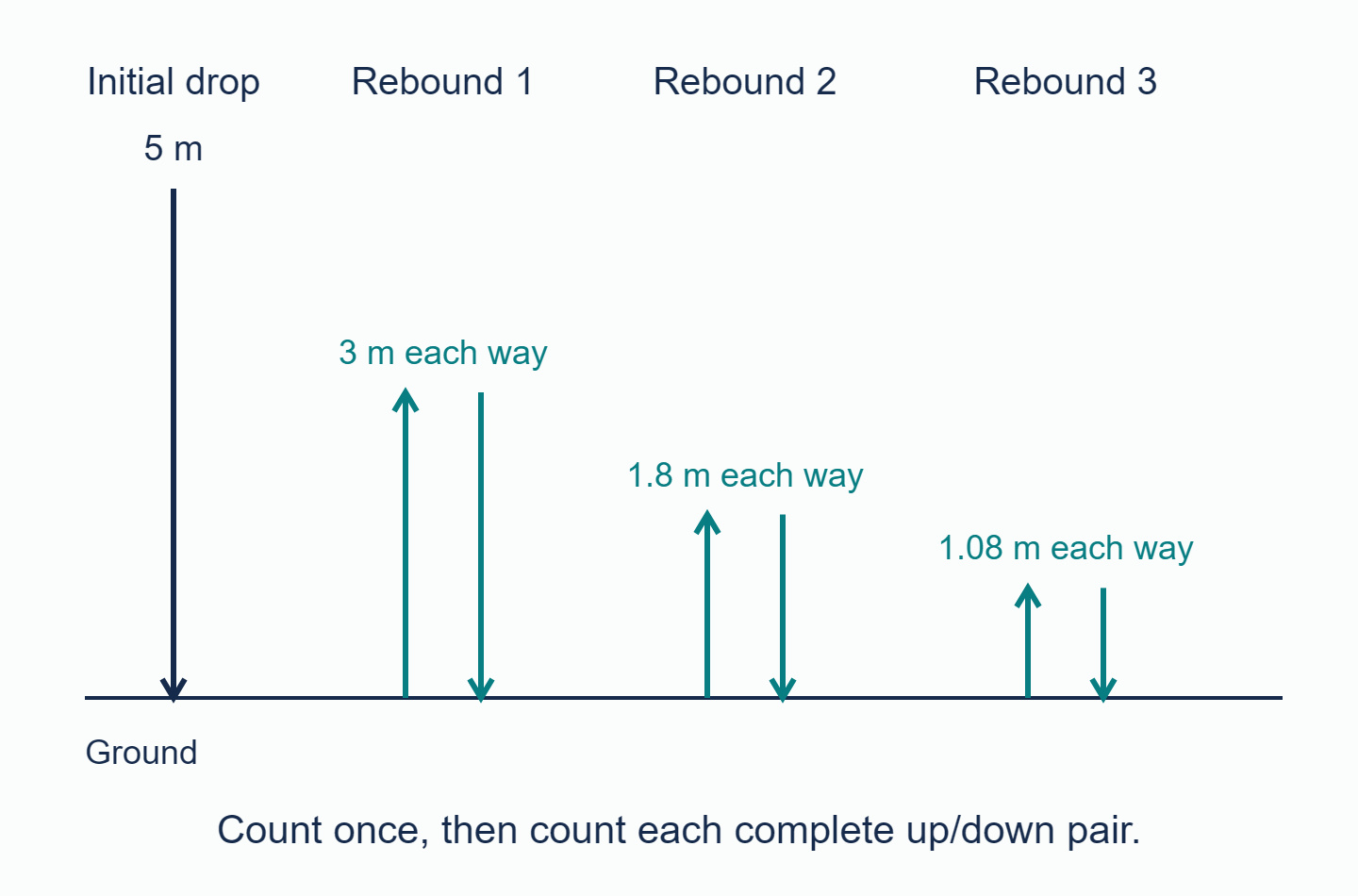
Count each rebound height twice only when both the upward and downward journeys are complete.
The diagram separates successive journeys horizontally to make them readable. We are adding vertical distances, not a sideways distance across the drawing.
Add the infinite series
For this example,
The series inside the brackets begins at 3 and has ratio 0.6, so
An infinite number of progressively shorter trips can have a finite total length. This is an ideal mathematical model: a real ball eventually stops rebounding, and its rebound ratio need not stay exactly constant.
What if the question stops after a few bounces?
First identify where the ball is when counting stops. After the initial drop and complete up-and-down rebounds,
For three complete rebounds in our example,
If counting instead stops at the top of the third rebound, its final 1.08 m downward trip has not happened. The distance is then
Be particularly careful with “the third time it hits the ground”: the initial drop is already the first ground contact, so that wording counts differently from three complete rebounds.
Distance is not displacement
Our 20 m result counts all the motion. The overall vertical displacement from the release point to the ground is only m if upward is positive.
Also check that is a fraction of height. A fraction of speed would need converting before using this model. When , the rebounds do not shrink and the infinite total does not converge.
See whether you can build the distance series yourself for the bouncing-ball question in the AI HL Mock Exam, Set 1, Paper 1. Sketching the first few journeys will help you decide which distance to count once and which distances to count twice.
Answered by Revision Village IB Expert
Explore More IB Mathematics Resources
Over 80% of IB students globally are experiencing the power of Revision Village