Question
Mathematics
Why do non-real roots of a real polynomial occur in conjugate pairs?
Answer
Mathematics
Expert Answer
Conjugation changes the sign of a complex number's imaginary part. For a polynomial with real coefficients, conjugating the input also conjugates the output. So if is a root, must be a root too.
The condition that the coefficients are real is essential. It does not mean every root must be real.
Why conjugation preserves a zero
Write
where every coefficient is real. You can conjugate a sum or product by conjugating each part first, and . Therefore
If , the right-hand side is , so as well.
On an Argand diagram, the two roots are reflections across the real axis: the real part stays the same and the imaginary part changes sign.
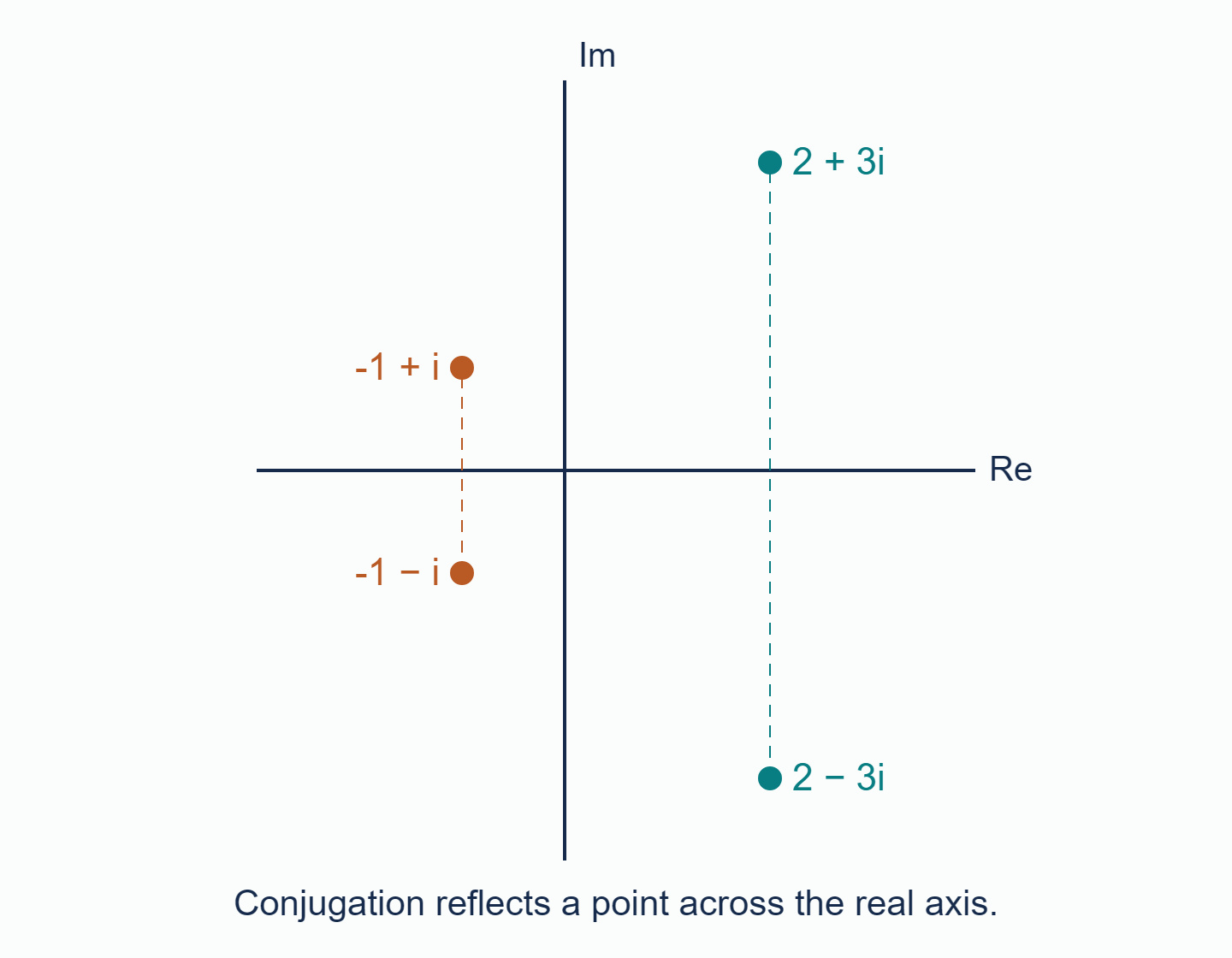
Each pair has the same real part and opposite imaginary parts.
Turn a conjugate pair into a real quadratic
For and ,
The imaginary terms cancel. This makes pairing conjugates a much cleaner way to expand a polynomial than multiplying all its complex linear factors at once.
For a non-real pair, . The quadratic's discriminant is , consistent with its two non-real roots.
Construct a quartic
Suppose a monic quartic, a fourth-degree polynomial, has real coefficients and includes roots and . The other two roots must be and .
The first pair produces
and the second produces
Hence the polynomial is
Its coefficients are all real, as required. As a quick independent check, the roots sum to 2, giving coefficient for , and their product is , giving the constant term.
The word “monic” fixes the leading coefficient at 1. Without it, any non-zero real multiple of this polynomial has the same roots.
When does the rule not apply?
The polynomial has root but not . Its constant coefficient is not real, so the conjugate-root rule cannot be used.
A real root equals its own conjugate. It does not need to be accompanied by a second, distinct root. For non-real repeated roots of a real polynomial, the conjugate root has the same multiplicity, meaning it is repeated the same number of times.
Look for the conjugate-roots and quartic questions in the AA HL Complex Numbers Questionbank to try constructing a polynomial yourself. Pair each non-real root with its conjugate before expanding, and check that the imaginary terms cancel from each quadratic factor.
Answered by Revision Village IB Expert
Explore More IB Mathematics Resources
Over 80% of IB students globally are experiencing the power of Revision Village