Question
Mathematics
How do you raise a complex number in exponential form to powers?
Answer
Mathematics
Expert Answer
If , raise the modulus, the distance from the origin, to the required power and multiply the angle by that power:
This is De Moivre's theorem in exponential form. For a positive integer , it follows from multiplying copies of . Negative integer powers also work when .
Example: square and cube a complex number
Let
For the square, the modulus becomes and the angle becomes :
To express this as , use :
For the cube,
The negative answer is consistent with an angle of : the point lies on the negative real axis.
Keep the modulus and angle separate
| Power | Modulus | Angle before reduction | Cartesian form |
|---|---|---|---|
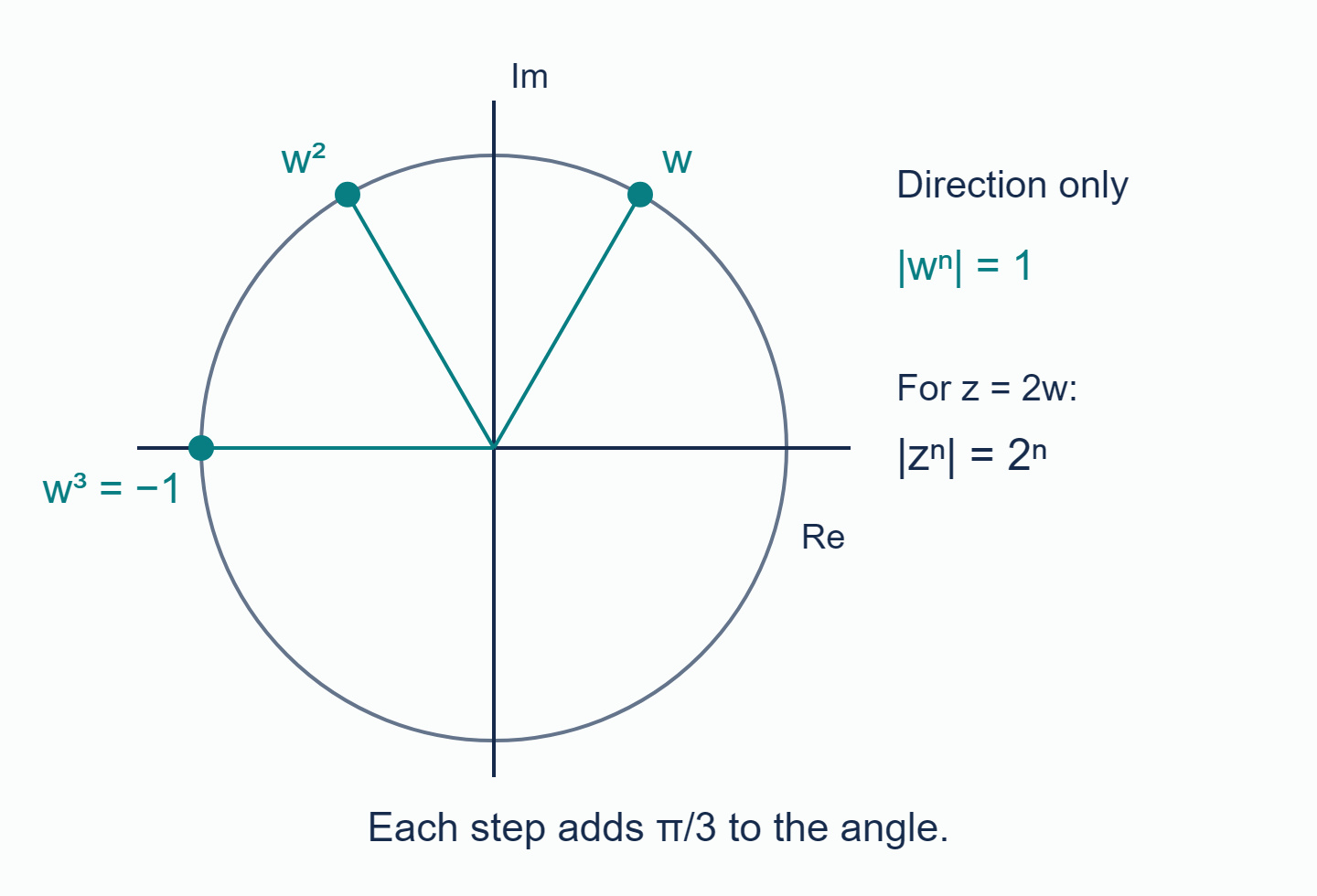
These points show w, w² and w³ on the unit circle: they show direction, not the growing distances of the powers of z.
The diagram uses to show just the changes in direction. Its powers have modulus 1. To obtain , multiply the corresponding unit-direction point by .
Reduce the angle only when needed
Angles differing by describe the same direction. For example, and are equivalent. If the question requests the principal argument, the angle in the specified interval , use .
Do not reduce the modulus when reducing the angle. Since ,
not 1.
What about a negative power?
Take the reciprocal of the modulus and reverse the angle:
Multiplying this by gives 1, which checks the result. Use radian mode when evaluating angles written with .
Try the complex-number powers question in the AA HL Number and Algebra Questionbank. As you convert the square and cube to Cartesian form, keep track of the modulus and angle separately so that you account for both the change in distance and the rotation.
Answered by Revision Village IB Expert
Explore More IB Mathematics Resources
Over 80% of IB students globally are experiencing the power of Revision Village