Question
Mathematics
How do you solve a related-rates problem for a conical water tank?
Answer
Mathematics
Expert Answer
Use similar triangles to write the water's radius in terms of its depth. Substitute that relation into the cone-volume formula, then differentiate with respect to time. This connects the given volume flow rate to the unknown rate at which the water level rises.
Set up the geometry
An inverted conical tank is 6 m tall and has a top radius of 3 m. Water enters at . Find the rate of increase of the water depth when it reaches 2 m.
Let be the changing depth and the changing radius of the water surface. The water and the full tank form similar cones:
Here 3 m is the radius of the tank's top, not the radius of the water at every depth.
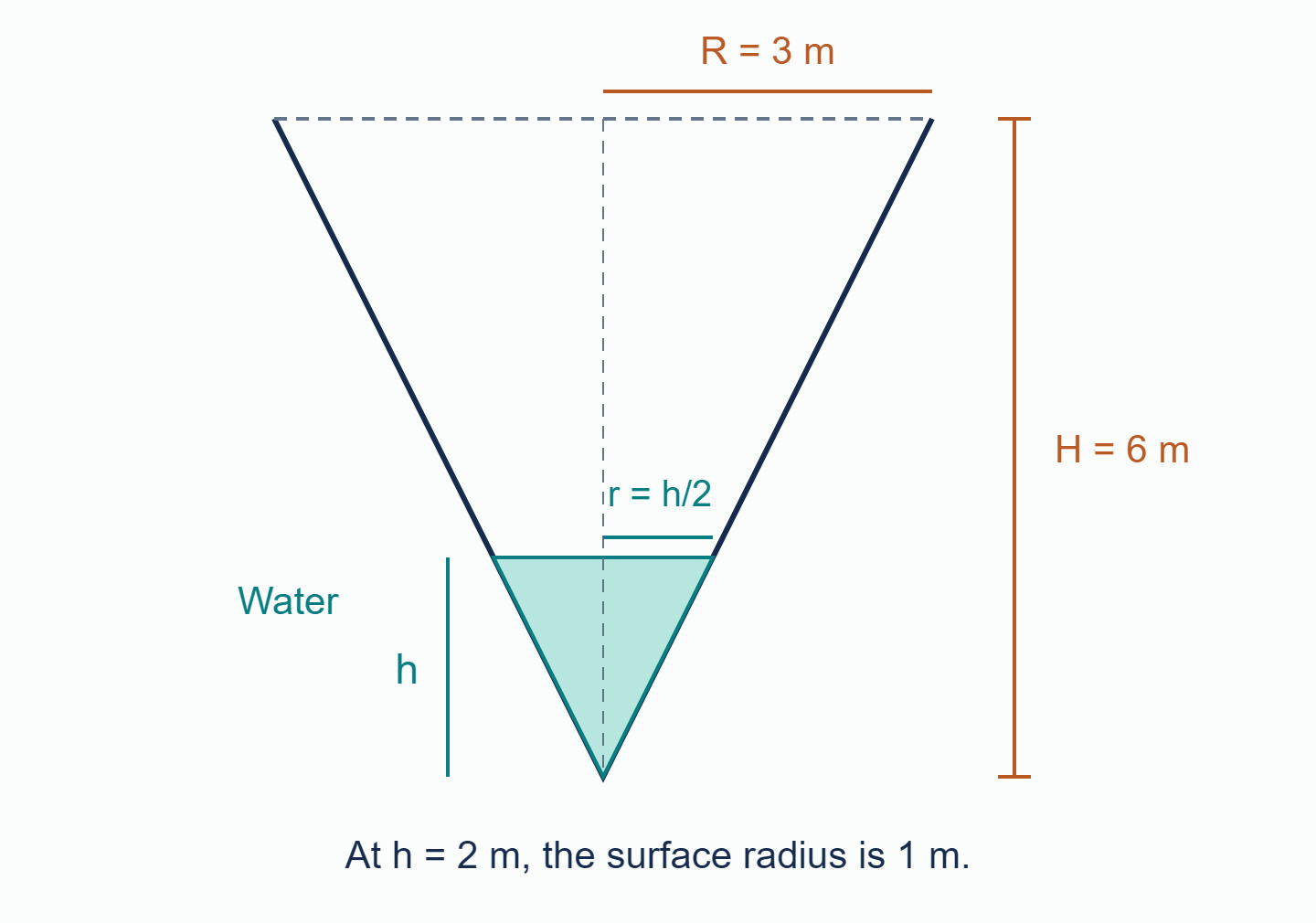
The water surface widens as the depth increases; r/h stays equal to 1/2.
Express the volume using depth alone
Start with and replace .
This substitution is what makes the problem manageable. Both and change, but the radius is always the same fraction of the depth.
Differentiate before inserting the depth
Because depends on time, the chain rule gives
At the required instant, use and :
Therefore
The answer is positive because the tank is filling. Its units are depth per time, not volume per time.
Why does the level rise more slowly later?
At depth , the horizontal surface area is
The equation says that volume flow equals this area multiplied by the vertical speed of the surface. As the cone widens, the same inflow is spread across a larger area.
At constant inflow, is proportional to . Doubling the depth from 2 m to 4 m reduces the rate to one quarter, about . The rate is not constant even though the tap's volume flow is constant.
Avoid these two substitutions
Do not replace by 2 before differentiating: that would turn the changing volume into a constant. Also, do not treat as fixed while the depth changes.
If a drain is open too, use the net flow:
A negative net flow produces a negative depth rate. The formula applies while ; at the ideal cone tip, , it cannot be used directly.
Explore what happens as a conical tank fills and drains in the AI HL Mock Exam, Set 1, Paper 2. Try connecting the changing radius and depth first, then use the sign of the net flow to check whether the water level should rise or fall.
Answered by Revision Village IB Expert
Explore More IB Mathematics Resources
Over 80% of IB students globally are experiencing the power of Revision Village