Question
Mathematics
How do you find the exposed surface area of a cylinder with a conical cavity?
Answer
Mathematics
Expert Answer
Add the areas of every surface exposed to the outside, including the inner wall of the cavity. Subtracting a volume does not mean subtracting the cone's curved surface area: carving the cavity creates an additional exposed surface.
Draw the cross-section first
Suppose a cylinder has radius 3 cm and height cm. A conical cavity is cut downwards from the whole circular top, with radius 3 cm and slant height 5 cm. Here the cone and the cylinder share the same radius, cm. The cavity's perpendicular depth is
Since , the tip of the cavity is 2 cm above the base, so the cylinder's bottom remains intact. The slant height and vertical depth are different lengths.
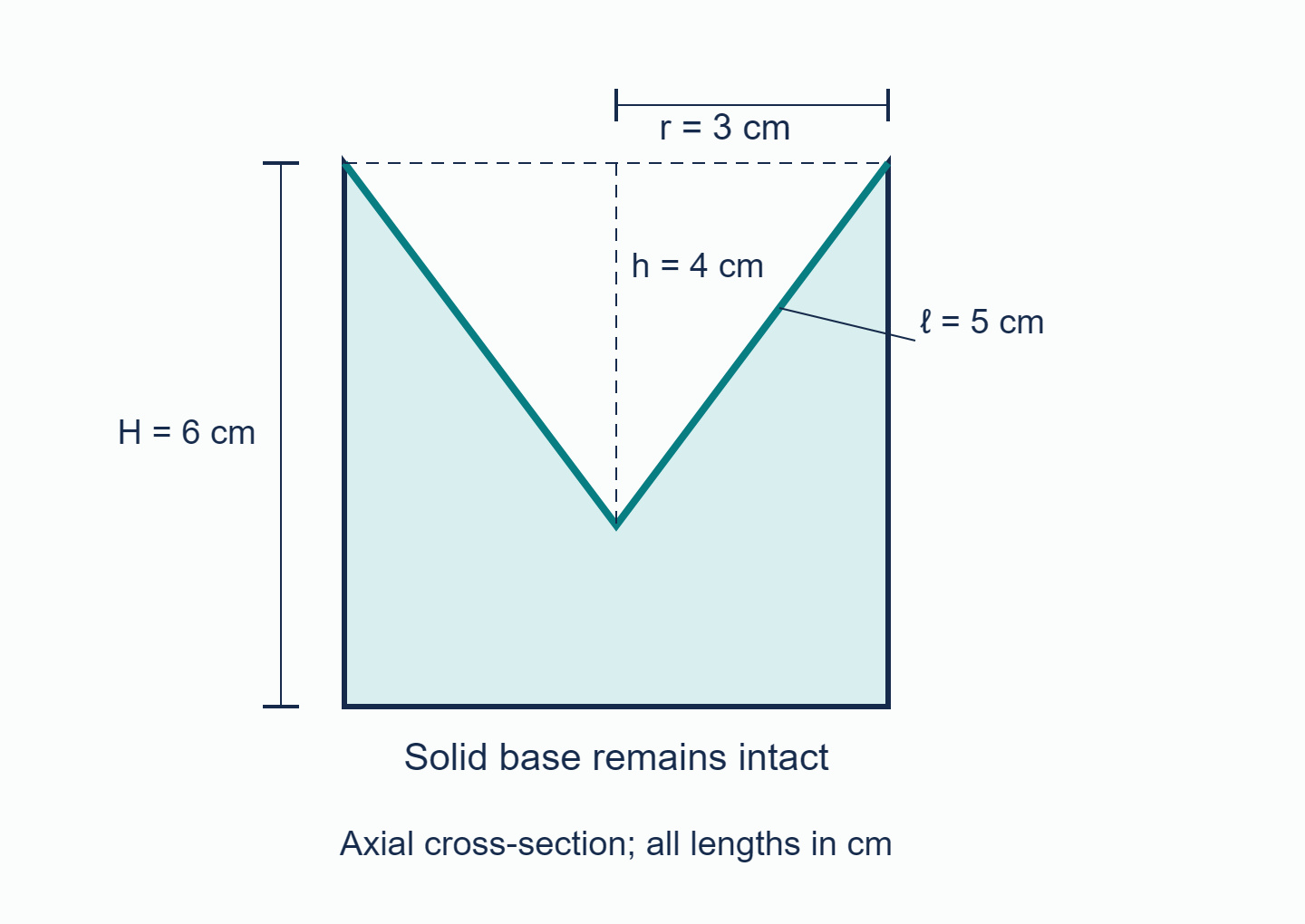
The cavity exposes a conical wall but removes the entire flat top disc.
List the exposed faces
| Surface | Calculation | Area |
|---|---|---|
| Outer cylindrical wall | ||
| Bottom circular base | ||
| Inner conical wall |
There is no flat top disc in this example: the cavity opening occupies the whole top. The opening is empty space, not a surface to include.
Therefore the total exposed surface area is
The formula for the curved surface area of a cone, , is in the formula booklet, and it uses the slant height . Using the perpendicular depth of 4 cm instead would underestimate the interior area.
Adapt the surface list to a different opening
If the cavity opening has radius smaller than the cylinder's radius , a flat ring remains around it. Include the annular, or ring-shaped, area as well as the outer wall, base and conical interior.
If a cavity passes through the bottom, redraw the cross-section rather than reusing the same list: the exposed bottom will no longer be a complete disc. Finally, check whether the question asks for all exposed surfaces or only a specified area to paint or coat. Listing the exposed faces works for any composite solid, so there is no need to memorise a separate formula for each one.
Put your surface-area checklist to the test with the cylinder-and-conical-cavity problem in Question 1 of AA SL Mock Exam, Set 1, Paper 2. Before calculating, list the surfaces that remain exposed and explain why the cavity adds an inner curved wall but does not add a flat disc across its opening.
Answered by Revision Village IB Expert
Explore More IB Mathematics Resources
Over 80% of IB students globally are experiencing the power of Revision Village