Question
Mathematics
How do you find the line of intersection of two planes?
Answer
Mathematics
Expert Answer
Find a point that satisfies both plane equations, then a direction that stays within both planes. Together they give the intersection in the form
Here, locates one point on the line and tells you how to move along it. Two distinct, non-parallel planes meet in a line. You therefore need one free parameter, a number you can vary to reach different points on the line, rather than a single solution for , and .
A worked example
Find the intersection of
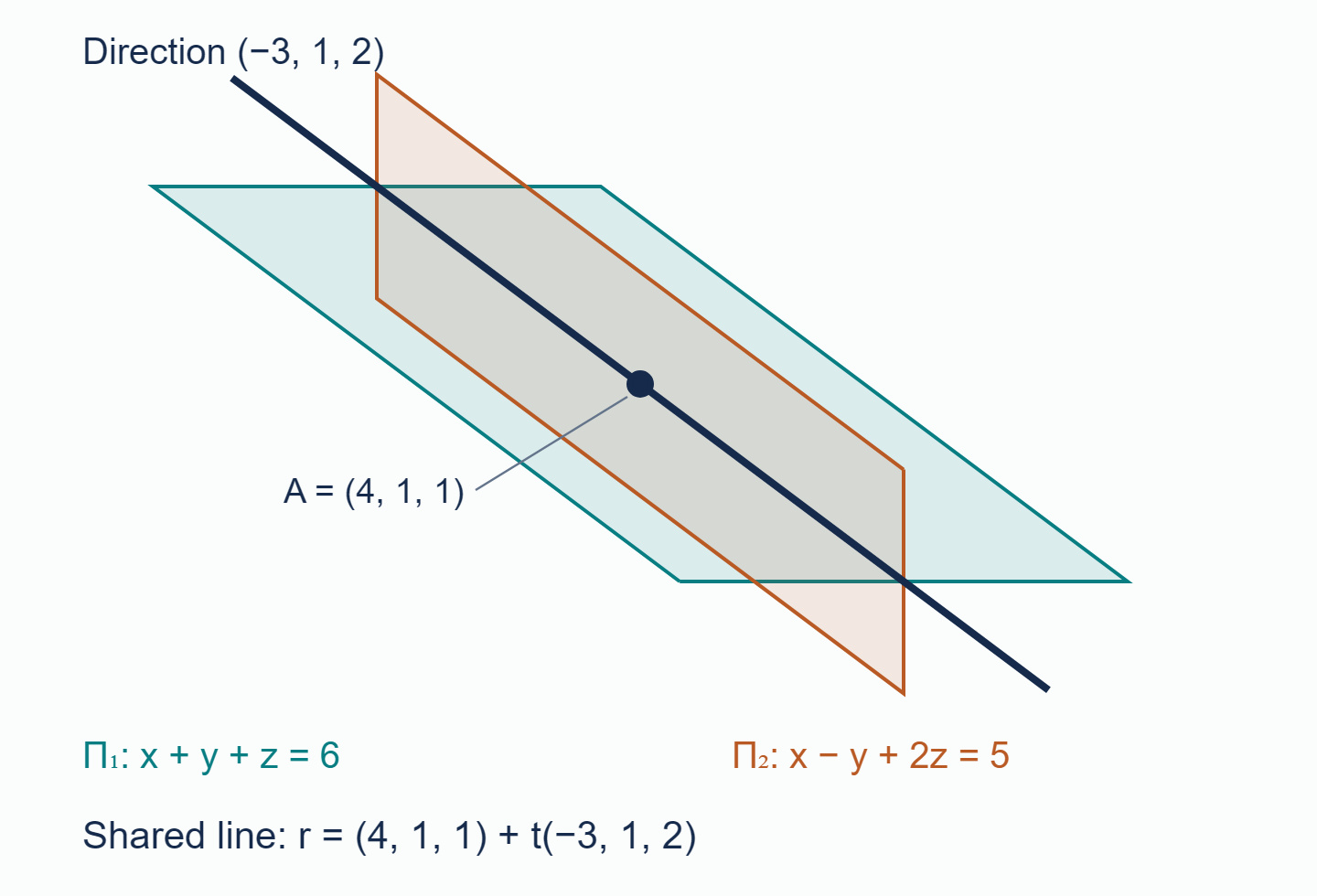
A point fixes the location; a direction lets you trace the shared line.
1. Eliminate one variable
Subtract the second equation from the first:
This relation must hold at every point on the intersection. Choosing gives , and substituting into the first plane gives . We have found a convenient point:
2. Allow the point to move
Let . The factor of 2 is a convenient choice that avoids fractions; it doesn't restrict the line because can be any real number.
From ,
Then gives
The three coordinates therefore describe the line
3. Check the whole line
Substitute the parametric coordinates into both original equations:
In each equation, the terms containing cancel. That confirms every point on our line belongs to both planes. Checking only would verify the starting point, but not the direction.
Can you use the plane normals?
Yes. The normals are and . A direction along the intersection must be perpendicular to both, so their cross product provides one:
This is the negative of our direction vector and describes the same line. Multiplying the vector by any non-zero number also works. You still need to find a point on both planes: a direction vector alone doesn't locate the line.
What if no intersection line appears?
If one normal is a multiple of the other, check the constants as well. The equations and describe the same plane. Replacing 12 with 13 makes them parallel and distinct, so they have no common points. A zero cross product tells you to check for these cases; it cannot give the direction of a line.
Put the method into practice
Try the two-plane question in the AA HL Mock Exam, Set 1, Paper 2 to work through an intersection independently. Once you have found the shared line, see how you can reuse its direction to describe a parallel line through a different point.
Answered by Revision Village IB Expert
Explore More IB Mathematics Resources
Over 80% of IB students globally are experiencing the power of Revision Village