Question
Mathematics
How do you link a geometric sequence to an arithmetic sequence through shared terms?
Answer
Mathematics
Expert Answer
Calculate the shared term from the geometric sequence first. Then use its value, at its stated position in the arithmetic sequence, to form an equation for that sequence's first term and common difference.
Use different letters for the two sequences:
If , the connecting equation is
The values are equal, but their positions need not be. A shared term also does not mean that the geometric ratio equals the arithmetic difference .
Example: the fourth geometric term is the sixth arithmetic term
Suppose and , with a positive common ratio. We are also told and . Find the arithmetic sequence.
1. Solve the geometric part
Moving from the first term to the third requires two multiplications by :
Because the ratio is stated to be positive, . Without that condition, would also need consideration.
Now calculate the term that links the sequences:
2. Translate the shared term correctly
We are told that this is the sixth arithmetic term. Therefore,
Do not use : the fourth-term position belongs to the geometric sequence, not the arithmetic one.
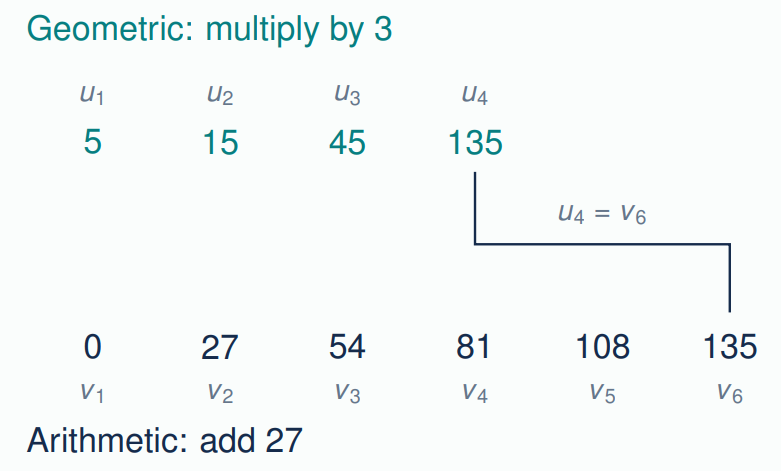
The same value occupies different positions in the two sequences.
3. Use the second arithmetic condition
Since ,
Subtract this from :
Then , so
The sequence is . Its second term is 27 and its sixth is 135, so it satisfies both conditions.
Why isn't one shared term enough?
Knowing only leaves the equation , which has two unknowns. For instance, and both satisfy it. You need another independent condition, one that gives new information, such as a second term or a sum, to identify the arithmetic sequence.
If the extra condition gives a sum, translate it using
Be careful to distinguish , which is one term, from , which adds all terms up to that position. Once both equations are written using the arithmetic variables and , solve them together and check the original shared-term statement.
Continue in the Questionbank
Look for the linked-sequences question in the AA HL Number & Algebra Questionbank and try using its sum condition to find the arithmetic sequence. If you want to refresh how the geometric terms are written first, What is the geometric sequence formula? will help you set up that part of the problem.
Answered by Revision Village IB Expert
Interested in diving deeper into this concept?
Explore More IB Mathematics Resources
Over 80% of IB students globally are experiencing the power of Revision Village