Question
Mathematics
How can diagonalisation make a high power of a matrix manageable?
Answer
Mathematics
Expert Answer
Diagonalisation replaces repeated multiplication of a matrix with powers of individual numbers. An invertible matrix has an inverse, and a diagonal matrix has zeros everywhere off the main diagonal. If they satisfy
then, for a non-negative integer ,
Only the diagonal entries need to be raised to the power . The two surrounding matrices remain the same.
Why does this work?
In the product for , the adjacent factors cancel.
Repeating this cancellation leaves . Matrix multiplication is associative, so we can regroup these factors. We have not changed their order.
There is also a useful interpretation. The columns of are eigenvectors: directions that stretches without moving them to a different line. Multiplication by expresses a vector in those directions, applies the repeated stretches, and converts back to the original coordinates.
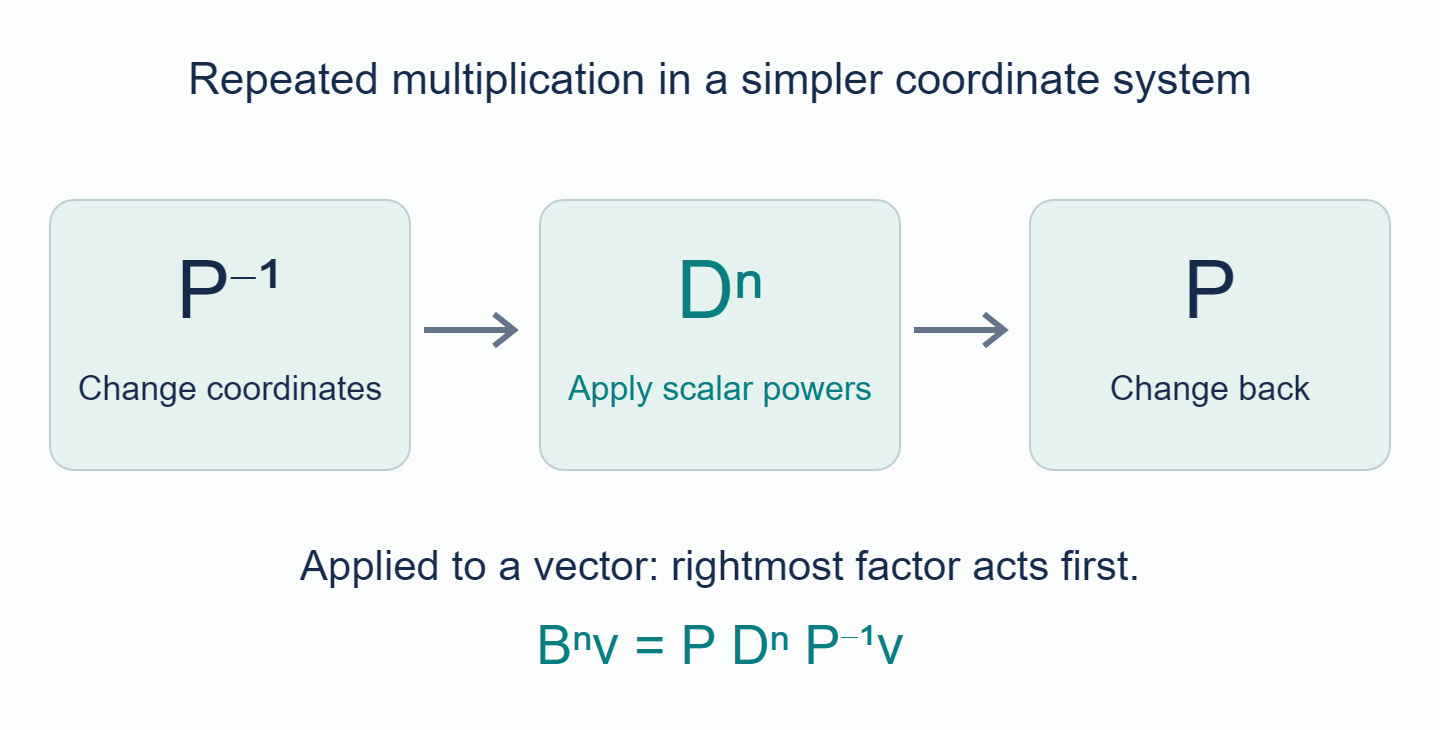
Follow the arrows from left to right; in the matrix product, the rightmost factor acts first.
Work through a matrix
Take
To find its eigenvalues, solve the characteristic equation
For eigenvalue 9, the equation allows the eigenvector . For eigenvalue 4, allows . Put these vectors into columns, keeping their eigenvalues in the same order:
Since , the inverse exists:
Now replace by
Multiplying the three factors gives
Even for , this requires two powers of numbers rather than 99 successive matrix multiplications.
Check the result before using a large power
Setting must give , and must reproduce . A further check is
which agrees with direct multiplication. These checks often expose a reversed eigenvector order or an incorrect inverse.
Can every matrix be diagonalised?
No. A two-by-two matrix needs two linearly independent eigenvectors, meaning they are not multiples of each other, to form an invertible . Distinct eigenvalues guarantee this, but a repeated eigenvalue needs further checking. For example, has only one independent eigenvector and cannot use this diagonal-power method.
For negative integer powers, must also be invertible, so its eigenvalues cannot include zero.
Practise the method
Try working through the diagonalisation question in the AI HL Number and Algebra Questionbank without looking back at the worked example. As you set up and , check that each eigenvector is paired with the correct eigenvalue before calculating the power.
Answered by Revision Village IB Expert
Explore More IB Mathematics Resources
Over 80% of IB students globally are experiencing the power of Revision Village